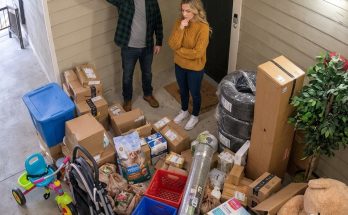
The list changed how we approached the boxes.
Until then, I had thought of them as purchases that needed sorting.
Now I wrote the names in a notebook, leaving space beside each one for what we learned.
Ben checked the tracking slips against Mom's numbered list.
The numbers weren't delivery dates.
She had assigned them according to people and occasions.
Some packages were still sealed from stores.
Others contained things she'd made herself and carefully repacked.
By lunchtime we had identified eleven recipients.
A parcel of drawing pencils belonged to a teenager upstairs named Leah.
A box of sturdy storage containers was intended for the community pantry.
A set of small gardening tools was marked for the retired bus driver who cared for the patch of ground behind the building.
Two parcels held things for family members.
One was addressed to Sophie.
The other carried Ben's name.
He pushed his aside.
“I can't do mine yet.”
“Neither can I,” I said.
The blue bowl stood on the counter.
I had washed it gently, not because it was dirty, but because I needed to do something familiar with my hands.
The shape reminded me of mornings when Mom used to let me crack eggs into batter.
I always left a piece of shell behind.
She would fish it out with the larger half and say the egg knew where home was.
I'd forgotten that joke until I saw the bowl.
For lunch, Ben found soup in the freezer.
Mom had labeled each container with a date.
I started crying when I saw her careful handwriting on one of them.
Ben didn't tell me to stop.
He heated the soup, set out two spoons, and sat with me at the small table.
“There were things I missed too,” he said.
“What things?”
“She told me three months ago that the bathroom light was flickering. I promised to come fix it.”
He stared at his bowl.
“Then I got called out on a school repair. Every weekend after that, I had something else.”
“Did you fix it?”
“No.”
I glanced toward the hallway.
The bathroom light still worked.
Its brightness was a little uneven, but it worked.
“Maybe Isaiah did it,” I said.
“That doesn't make me feel better.”
I reached across the table.
“We don't have to turn every missed errand into a verdict on our lives.”
He smiled faintly.
“You sound like Mom.”
At two o'clock, a young man knocked at the open door.
He was carrying a canvas tool bag.
“Mrs. Alvarez said you were here,” he said. “I'm Isaiah Bell.”
He worked at an auto-parts shop and lived in apartment 2C.
He had fixed the common-room shelves after they came loose.
Mom had refused to let him do more work without accepting a meal.
“She fed me vegetable stew that could have supported a roof,” he said.
Ben showed him the new toolkit.
Isaiah looked embarrassed.
“That's too much.”
“It's a small kit,” Ben said.
“She probably knew yours was missing pieces.”
Isaiah laughed.
“She noticed my screwdriver had a cracked handle. I told her it was fine.”
“Mom didn't believe in fine when something could be safer,” I said.
He went quiet.
Then he told us something we'd never heard.
Last winter, when he lost hours at work, Mom noticed he was skipping the Thursday coffee gathering.
She didn't question him.
She asked him to help move pantry supplies one evening.
When he finished, she handed him a grocery bag and told him it was the volunteers' share.
“Everybody who helped got one,” Isaiah said.
“Later I learned she'd made that rule because of me.”
His voice changed.
“I don't know if she meant for me to find that out.”
I looked at the toolkit between us.
“Take it,” I said.
“Please.”
He put his hand on the box.
“Then let me do something in return. I can help carry furniture when you need to clear the place.”
I began to refuse automatically.
But Mom's list was sitting nearby.
Start with the people, not the things.
“We'd appreciate that,” I said.
He stayed to check a loose cabinet hinge before leaving.
Ben watched him work.
“I know,” he said when I glanced at him.
“He fixed the light too, didn't he?”
Isaiah looked up.
“Yeah. Evelyn asked me last month. Took about ten minutes.”
Ben nodded, but after Isaiah left he went to the bathroom and stood under the repaired fixture for a long time.
I let him have the moment.
The next person came because Rosa had told her about the packages.
Nia was a young mother with a baby bundled against her chest.
She lived two streets away and had attended the community coffee mornings while pregnant.
Her son was only six weeks old.
When she saw the pale green blanket, she gasped.
“Evelyn said she was making it, but she wouldn't show me.”
She unfolded it carefully.
The stitches weren't perfectly even.
Mom's fingers had become stiff toward the end.
Nia touched the uneven edge as though it were the most beautiful part.
“My mother lives across the country,” she said. “Evelyn said every baby should have someone nearby who knows how to hold him while his mom drinks hot tea.”
She pressed the blanket against her son's cheek.
“Could I keep the note too?”
“Of course.”
Nia cried quietly.
Then she told us about the Tuesday Mom had watched the baby so she could make a phone call to her insurance company.
Mom hadn't offered advice.
She'd just sat rocking the carrier and humming an old tune.
I recognized the tune when Nia hummed a few notes.
It was the song Mom used to sing when Ben and I were sick.
For a moment, I couldn't speak.
The same song had soothed a child whose family I'd never met.
After Nia left, I wrote a little more in the notebook.
Isaiah: winter groceries, shelves, bathroom light.
Nia: blanket, tea, lullaby.
Rosa: Thursday mornings, flowers.
Ben looked over my shoulder.
“Are we writing a report?”
“I don't want to forget.”
He took the pen and added something beside Isaiah's name.
Helped Mom when we couldn't.
I read it twice.
Then I crossed out the last four words.
Ben frowned.
“Why?”
“Because we weren't absent from her life. We just weren't the only people in it.”
He considered that.
Then he nodded.
The following morning, I returned alone for an hour before Ben arrived.
I wanted to look at the packages without feeling we had to solve them immediately.
I made tea in Mom's chipped white mug.
Then I sat by the window with the notebook.
The handwriting on the page looked strange to me.
I had written names I hadn't known two days earlier, yet they were beginning to feel familiar.
I wondered how many times Mom had carried a bag downstairs while I was talking to her on the phone.
Perhaps she'd listened to me complain about work while labeling supplies for the pantry.
Perhaps she'd remembered my frustration and kept sorting groceries after we hung up.
I thought of what Rosa had said.
Our mother hadn't loved us less because she had friends.
If anything, those friendships had given her something to talk about when our lives were chaotic.
I opened the window a little.
A bus hissed at the stop outside.
The sound reminded me of childhood mornings waiting for school with Ben.
Mom used to stand with us until the bus turned the corner.
She never made a performance of staying.
It was simply what needed doing.
I closed the window when a gust shifted the papers.
As I gathered them, I found an old postcard behind the notebook.
It showed a field of wildflowers.
On the back was a message from Joan, the knitting friend, thanking Mom for helping her through a difficult winter.
I read it once, then placed it with the cards to preserve.
There was no grand statement in it.
Just gratitude for afternoons spent together.
I began to see that our mother had built a life in hours like those.
Not through a single defining act.
Through days of showing up, noticing, and occasionally making mistakes.
When Ben arrived, I asked him to sit with me for a few minutes before we opened anything.
He looked surprised but agreed.
We drank tea and watched a delivery truck cross the parking lot.
Then he told me about a school custodian who had helped him during a difficult repair last month.
He said he'd been meaning to thank him.
“Maybe you should,” I said.
Ben smiled.
“Maybe I will.”
We didn't make a promise to change our entire lives.
We just finished the tea and returned to the work Mom had left.
Before we stopped for the day, I checked every box we'd opened against Ben's list.
He read the numbers aloud while I marked them with a pencil.
We had made mistakes with two labels and corrected them.
Mom used to say that a good system wasn't one where nobody made mistakes.
It was one where people noticed them before they mattered.
I could hear her teasing Ben about his clipboard.
He tucked it under his arm and smiled.
The afternoon light moved slowly over the boxes.
By four, we were tired.
I thought we should stop, but Ben found a slim parcel tucked behind a larger carton.
A note on it said: For Leah, when she is ready to show someone her drawings.
He lifted the lid.
Inside were pencils, a sketchbook, and a plain white frame.
There was also a folded paper containing a drawing of Mom's apartment door.
I knew immediately it wasn't Mom's work.
Someone had drawn her standing in the doorway with a bowl in her hands.
Below it, in a teenager's careful handwriting, were five words.
She always opened the door.
I sat down again.
Outside the window, the afternoon traffic went on.
Inside, another person had left evidence of being loved by the woman I'd called Mom my whole life.
I didn't know yet whether the packages would make grief easier.
But I knew our job was no longer just cleaning out an apartment.
We had become the carriers of a hundred small things she'd meant to say.
Click here to continue reading: PART 4: An Old Toolbox and a Letter Reveal What Mom Wanted Her Children to Release
The Blue Bowl That Made Me Understand Why Mom Had Ordered Twenty-Eight Packages
Part 3 of 12