We went home before sunset.
Ben locked Mom's apartment and checked the door twice.
I carried the blue bowl against my chest while he took the notebook.
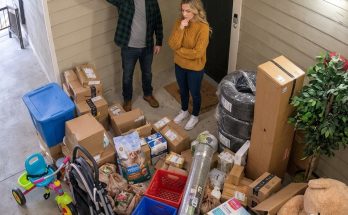
We left the remaining packages in neat rows, with the unopened flat box against the wall.
In the parking lot, Ben stopped beside his truck.
“I don't want to go back tomorrow,” he said.
“Neither do I.”
“Then why are we going?”
I looked at the building's fourth-floor windows.
“Because she asked.”
At home, I put the bowl on my kitchen counter.
My own cupboards were full of mismatched dishes.
There was no practical place for something so large.
I cleared a shelf anyway.
That evening Sophie came over with groceries.
She had inherited Mom's habit of arriving with food whenever words were insufficient.
She looked exhausted after driving from work, but she stood in my kitchen and peeled potatoes as if she'd been invited to cook.
I told her what Rosa and the others had said.
Sophie listened without interrupting.
When I mentioned the picture Leah had drawn, her eyes brightened.
“Grandma showed me that once.”
“She did?”
“She said Leah wanted to study design but didn't think her drawings counted as real work.”
Sophie paused.
“Grandma told her that anything she'd spent an hour noticing was worth showing somebody.”
I sat down.
“Your grandmother never said anything like that to me.”
Sophie turned around.
“She did. You told me she used to look at your school essays and make you read them aloud.”
I remembered.
I had interpreted that memory as a mother being proud of her child.
Sophie had recognized the same generosity extending to someone else.
She put a pan on the stove.
“Mom, it's okay that she had friends.”
“I know.”
“I mean, really okay.”
I folded my hands.
“I think I'm angry that strangers knew she was afraid.”
Sophie softened.
“Did they know she was afraid? Or did they know what she was doing?”
The distinction stayed with me overnight.
The next morning, Ben and I returned to the building.
Rosa was waiting near the elevator with a paper bag of biscuits.
She'd also brought a folder.
“Your mother asked me to give you this if she wasn't able to,” she said.
Inside was a contact sheet for the pantry volunteers, a copy of the building association's rules, and a note from Mom.
The first sentence read: Nobody owes me anything because I helped them.
The next said: Please don't turn these gifts into a public ceremony.
Ben smiled sadly.
“She knew someone would want to make a speech.”
Rosa nodded.
“She was terrified of speeches.”
The folder included a list of which packages could be handed out at the coffee gathering and which should be delivered privately.
There was no password or hidden bank account.
No complicated legal instruction.
Just practical advice for completing work she had begun.
I felt a little ashamed that my mind had already invented mysteries.
We made a plan to contact recipients, rather than arriving unannounced with gifts they might feel pressured to accept.
Ben checked each name.
I wrote down telephone numbers and asked Rosa which people preferred a text.
One package was intended for the building's custodian, Mr. Webb.
It held a replacement lunch bag, the kind that keeps food cool on hot days.
Mom had written that she was tired of seeing his sandwich crushed under his tools.
Another contained recipe cards and a baking tin for a woman who was starting a home baking business.
Neither item was expensive.
Both showed Mom had been paying attention.
At eleven, Leah came down with her aunt.
She was sixteen, tall and quiet, with charcoal smudged along one finger.
Her aunt explained that Leah had been nervous about visiting us.
“She doesn't want to seem like she's coming for a present.”
“She's not,” I said.
“We asked her here.”
Leah stood just inside the door.
When I handed her the sketchbook, she opened it and found the pencils.
Then she read Mom's note.
Her shoulders began to shake.
“Evelyn said she'd come to my school art night,” she whispered.
I looked at her aunt.
“Did the art night happen?”
“It's next month.”
Leah wiped her nose with her sleeve.
“I already knew she couldn't come. But I didn't want to take the drawing out of the show.”
“Don't take it out,” I said.
She looked up.
“If you'd like, I'll come.”
I surprised myself by saying it.
I had never attended a stranger's school event.
But there was something about the white frame that made the promise feel possible.
Leah's aunt smiled gently.
“No pressure. Just come if you can.”
Before they left, Leah asked whether she could draw us standing beside the blue bowl.
I laughed through tears.
“I don't think I can hold still.”
“You don't have to,” she said. “I remember people better when they're moving.”
After lunch, Ben opened the package addressed to him.
He insisted he was ready.
Inside was a battered red toolbox, cleaned and lined with new foam.
It was Dad's toolbox.
Ben had looked for it years earlier when he moved into his first house.
Mom had said she thought it had been donated.
Now it was in front of him.
Beside it lay a compact set of new drill bits and a card.
My dear Ben, I found this behind the storage cupboard after I told you it was gone. I was embarrassed, and then I kept forgetting to correct myself. Your father would laugh at the fuss I made. Use it, and please remember that being dependable doesn't mean you must always be available.
Ben read the card silently.
Then he laid the toolbox on the floor and opened every drawer.
The first held screws sorted into small jars.
The second held a pencil worn down to a stub.
Dad had used it to mark wood when he built our porch steps.
Ben picked it up and rolled it between his fingers.
“I thought it was gone,” he said.
“I know.”
He pressed the pencil to his forehead.
For years he had been the one to fix anything Mom called about.
I saw the weight he'd put on himself when he couldn't.
Mom had noticed it too.
He tucked the pencil into his shirt pocket.
“I'm going to keep this,” he said.
“Of course you are.”
That night I found myself looking through old family photographs.
In most of them, Mom stood a little to one side.
She was the person making sure everyone had a coat or that the birthday candles were lit.
I used to think that was simply what mothers did.
Now I wondered whether she had sometimes wanted someone else to take charge.
I chose a photograph from a summer picnic and sent it to Ben.
Mom was sitting in a lawn chair, holding a paper plate, while Dad worked the grill.
She looked completely relaxed.
He called me a minute later.
“Where did you find that?”
“In the old album.”
“I remember that day. Dad burned the hamburgers.”
“He did.”
“Mom ate hers anyway.”
“She always said you could scrape the black off.”
We laughed.
Then Ben said he'd been thinking about the letter.
He admitted he was afraid he'd stop feeling close to her once the apartment was empty.
I told him I felt the same.
The objects were so immediate.
The cardigan still held the shape of her shoulders.
The slippers stood where she'd left them.
But I knew we couldn't keep everything untouched forever.
We talked about making copies of her favorite recipes and dividing the family photographs fairly.
We could label pictures while our memories were fresh.
We could give each grandchild something meaningful without burdening them with a room full of possessions.
Ben said his oldest boy wanted the little wooden stool Dad had made.
I'd forgotten it was still in the closet.
“It's his if he wants it,” I said.
“I'll check with the rest of them first,” Ben answered.
That was new for us.
In the past, we'd assumed we knew what everyone needed.
Now we were trying to ask.
Before hanging up, Ben said something else.
“I'm glad you didn't go to Mom's apartment alone.”
“Me too.”
“I might have thrown half the things away because I couldn't stand looking.”
“And I might have kept every rubber band.”
He laughed.
We were a better team when neither of us tried to carry the whole day.
I put my phone down and looked at the photograph once more.
Mom was eating a badly cooked hamburger and smiling.
I decided to keep that picture near my desk.
I wanted evidence that she knew how to sit down and enjoy herself.
Before leaving, we checked the freezer again.
I didn't want to waste food Mom had carefully stored.
Ben chose two containers for dinner and set the others aside for us to divide.
There were no grand decisions in that moment.
Just small practical ones.
When I closed the freezer, I noticed she'd taped a tiny list of favorite meals to the inside of a cupboard.
She'd written which ones froze well and which ones turned watery.
I took a photograph.
It was a piece of knowledge I wanted to use, not merely keep.
That night, I reheated one of her soups and ate it at my kitchen table.
It tasted almost like her cooking.
Almost was enough for that evening.
That afternoon we called the apartment office about the lease.
The manager explained what documents she would need before changing access and arranging a final inspection.
We had several weeks to sort the unit.
That was a relief.
We could stop moving as though grief had an expiration date.
As we packed up, a message arrived from Sophie's phone.
She had sent a photograph of a small folded envelope.
Grandma gave me this last month, she wrote. It says to open after you and Uncle Ben read hers.
I called her immediately.
“What does that mean?”
“I don't know,” Sophie said. “I never asked.”
I looked toward Mom's unopened flat box.
She had not left us a grand secret.
But she had arranged something that required patience.
For the first time, I decided to give her that patience instead of trying to guess the ending.
Click here to continue reading: PART 5: Inside the Community Room, We See the Quiet Work Behind Her Many Purchases
The Blue Bowl That Made Me Understand Why Mom Had Ordered Twenty-Eight Packages
Part 4 of 12