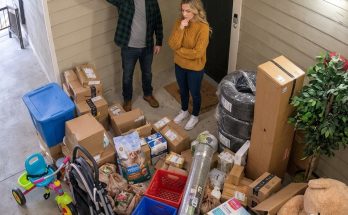
On Friday morning, Ben brought a clipboard.
He'd made columns for each package number, recipient, whether we'd contacted the person, and whether the gift had been delivered.
I told him he looked like an inspector.
He said someone had to make sure we didn't accidentally give the baby blanket to the security guard.
It was the kind of joke Mom would have made.
We had seventeen packages left to examine and a week of appointments ahead.
An attorney had already explained that Mom's modest estate would need ordinary administration.
Her will named Ben and me equally.
There was no special provision for the parcels, but most were clearly marked as gifts she had purchased for other people.
We agreed not to pretend that her handwritten requests were court orders.
We would check the larger items and the budget before giving anything away.
Mom had left a neat file of receipts in her desk.
The envelopes were arranged by month.
Ben added the purchases on a calculator.
“It's not a fortune,” he said.
“Thank goodness.”
Many gifts were under twenty dollars.
A few were secondhand finds she had collected over years.
The largest purchase was the replacement blue bowl.
It cost more than she would have admitted spending on herself.
We found no credit-card debt connected to the gifts.
That didn't mean we could ignore the rest of her finances.
It meant we could stop imagining an unseen catastrophe every time we opened a box.
At ten, we went to the community room.
Rosa had asked whether we would join the usual coffee gathering.
I thought perhaps six people would be there.
There were nineteen.
The room was plain, with folding chairs and a clock that ran two minutes slow.
A coffee urn stood beside a plate of biscuits.
Near the back was a row of pantry shelves, each labeled in Mom's block letters.
Canned vegetables.
Pasta.
Soap.
Baby supplies.
On one shelf somebody had placed a vase of yellow flowers.
Rosa whispered that the flowers were for Mom.
I had to step into the hallway before I could greet anyone.
Ben followed me.
“Too much?” he asked.
“A little.”
“We can leave.”
I looked through the glass panel in the door.
People were talking quietly, stacking napkins, carrying groceries, and checking on one another.
“This is where she was every Thursday,” I said.
“Yeah.”
“I want to see it.”
We went back inside.
No one asked us to make a speech.
A few shook our hands.
Several told us one small memory apiece.
A woman remembered Mom replacing the button on her daughter's coat.
A widower said she kept him from eating dinner alone on his first Christmas without his wife.
Mr. Webb, the custodian, recalled how Mom always thanked him for shoveling a safe path to the door.
When we gave him the lunch bag, he studied the label carefully.
“She told me my old one had seen enough battles,” he said.
He held it against his side.
“That sounds like her.”
Ben helped Isaiah tighten a shelf bracket.
I helped Rosa put labels on a box of donated cereal.
A woman named Denise showed me how the supply ledger worked.
Every item in the pantry had a simple tally so volunteers could spot shortages.
No recipients' names were recorded.
Mom had insisted on that.
“You can count food without counting people's troubles,” Denise said.
We carried a package of new measuring cups to the shared kitchen, where residents sometimes prepared meals for neighbors returning from the hospital.
Mom's note asked that they stay in the drawer marked BAKING.
I laughed when I read it.
Denise smiled.
“Evelyn could have organized a tornado.”
Over coffee, I spoke with a woman named Maribel who had recently started selling cakes from home.
Mom had ordered the tin and recipe cards for her.
Maribel showed me photos of cupcakes she'd made for a school fundraiser.
“Your mother tasted one and said it needed less frosting and more orange,” she said.
“Was she right?”
“Completely.”
There was so much affection in her answer that I had to look away.
I pictured Mom leaning forward to inspect a cupcake like a judge at the county fair.
I wanted the memory, even though it belonged to someone else.
Later, Rosa invited us to look at the bulletin board.
Pinned beside the volunteer roster was a short note Mom had written after she first became ill.
If I'm absent, keep the shelves open when you can. No one person should be the whole system.
I read it twice.
Mom had prepared other people to continue without her.
That frightened me less than it had at first.
It seemed less like a prediction and more like a practical response to uncertainty.
I asked Rosa whether she had known how much Mom was doing.
“Most weeks, we had to tell her to go home and rest,” she said.
“Did she listen?”
“Sometimes.”
“Not often, then.”
Rosa smiled.
“She listened better when we reminded her that the point was to help people, not exhaust ourselves.”
For the first time, I understood that Mom's friends had been caring for her too.
They had watched her stairs.
They had carried heavy grocery bags.
They had walked her back to her apartment when she was winded.
They had also let her be useful, which mattered to her.
Before leaving, Ben and I asked if the group would like us to bring the remaining pantry supplies next week.
“Only if you're ready,” Denise said.
“We're sorting things anyway,” Ben replied.
She nodded.
“Then we'll be glad to see you.”
Before leaving the community room, I noticed a small box beside the door.
It held clean reusable shopping bags, folded into squares.
A handwritten sign asked visitors to take one if they needed it and return it when convenient.
Mom had used the same system at home for years.
I touched a bag's frayed handle.
“Did Evelyn set this up?” I asked Denise.
“She helped,” Denise said. “But it was Helen's idea.”
I was pleased to hear that.
I had begun to fear that every useful thing in the building would be attributed to Mom simply because she was gone.
That wouldn't have been fair to the others.
Denise showed me the pantry's volunteer schedule.
The names rotated across the weeks.
Mom had worked most Thursdays, but she wasn't there every day.
When she was tired, other people filled in.
Denise pointed to three dates when Mom had canceled.
“She felt terrible,” Denise said. “We told her to get some rest.”
“Did she?”
“As far as I know. Rosa brought her soup.”
I traced the dates with my finger.
Two were days I'd driven her to medical appointments.
The third was a morning when Ben had taken her grocery shopping.
We hadn't been competing with her other life.
We had been part of the same circle of help.
I told Denise I was worried people might feel pressured to keep doing things just to honor Mom.
She shook her head.
“We'll change what needs changing. That was always the idea.”
They were discussing whether to reduce the opening hours during winter.
Some volunteers had less time.
Food donations fluctuated.
They needed a schedule they could maintain.
I admired the plainness of the conversation.
Nobody suggested working themselves into exhaustion to prove love.
Afterward, Ben and I walked through the garden behind the building.
A few marigolds from the previous season had gone to seed.
The soil was dry.
A gardener named Sam showed us a broken hose connection.
Ben offered to repair it.
I looked at him.
He stopped himself and laughed.
“First I should ask if Sam wants help.”
Sam said he had already ordered the replacement part.
He thanked Ben for asking.
We sat on a bench for a moment.
The garden was small enough that we could hear traffic from the road.
Mom used to complain that the tomatoes didn't get enough sun here.
Rosa had confirmed that she complained every summer.
I smiled at the memory.
Ben said he'd begun thinking of the way Mom taught us to look after plants.
She always insisted we check the soil before watering.
“Don't drown something just because you want to be helpful,” she used to say.
I looked at the dry patch of earth beside the bench.
She had been talking about gardening.
But it was still a good reminder.
I didn't need to rush into every gap her death had left.
Neither did Ben.
We could help where we were useful and leave room for other people to decide what they needed.
On the drive home I asked him to stop at a grocery store.
I wanted to buy ingredients for soup.
Not because Mom would have wanted me to.
Because I was hungry, and cooking something simple suddenly seemed comforting.
When the meeting ended, I helped carry the empty coffee cups into the kitchen.
The sink was old, and the faucet squeaked when I turned it.
Denise showed me where they kept the clean towels.
Mom had labeled that drawer too.
I dried a cup and handed it over.
Denise asked whether I planned to return the next week.
I told her I couldn't promise a regular shift.
She said that was fine.
It was a relief to say what I could do without apologizing for what I couldn't.
On our way upstairs, Ben admitted he liked knowing there were people who'd check on Rosa.
I did too.
The building had a community that didn't depend on either of us taking charge.
I finally understood why Mom had wanted to stay there as long as she could.
Back upstairs, Ben looked at the clipboard.
Eleven deliveries were completed or scheduled.
The rows were slowly filling.
He tapped the paper with his pen.
“I thought we'd spend today hauling furniture.”
“We will.”
“Eventually.”
I looked around Mom's living room.
Her favorite chair stood by the window, a folded blanket over the back.
I wasn't ready to decide where it belonged.
“Eventually,” I agreed.
Then Ben reached for another package and found a letter addressed to both of us.
Mom had written on the envelope: Please read this before you argue about what to keep.
We stared at each other.
“She knew us,” he said.
I tore the envelope open.
Click here to continue reading: PART 6: Mom’s Apology Changes How We Remember the Years We Tried to Help Her
The Blue Bowl That Made Me Understand Why Mom Had Ordered Twenty-Eight Packages
Part 5 of 12