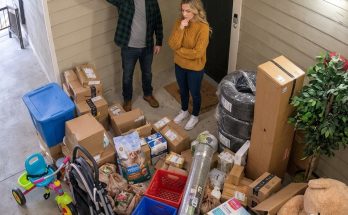
The letter began with an apology.
Not for dying.
Not for buying the packages.
For the way Mom sometimes made Ben and me feel responsible for her happiness.
I sat on the rug while Ben leaned against the sofa.
He read the first paragraph aloud.
My dear children, I know I have said things like “I don't know what I'd do without you.” I meant that I love you. Sometimes those words made you feel you couldn't say no. I am sorry for that.
Ben stopped.
He looked at the ceiling.
Mom went on to say that she was proud of the lives we had built, even when those lives kept us busy.
She admitted she sometimes asked for help without checking whether a repair or visit could wait.
She said she'd been practicing asking her neighbors, and accepting help without treating it as a failure.
Most importantly, she asked us not to measure our love by the hours we'd spent in her apartment.
I hadn't known how badly I needed to hear that.
Ben folded the page and unfolded it.
“She knew I felt guilty,” he said.
“She knew both of us did.”
For years I had lived with a constant private calculation.
If I visited one weekend, could I skip the next?
If I drove her to a doctor's appointment, could Ben pick up her prescriptions?
If I was tired after work, was a phone call enough?
Mom had never demanded a perfect schedule.
But she had sometimes sounded lonely.
I had sometimes sounded impatient.
Neither of us was proud of every conversation.
The letter did not erase that.
It simply gave us permission to remember the good conversations too.
Ben put the paper beside Dad's toolbox.
“I should have called more,” he said.
I shook my head.
“We should have called when we wanted to, not because we were keeping score.”
He gave me a long look.
“That sounds better.”
We kept opening parcels.
One held an inexpensive pair of sturdy shoes for a neighbor who had started walking to work.
Another contained a stack of large-print mystery novels for a man whose eyesight was changing.
A third had a small portable fan for the woman who ran the building's summer reading group.
Each note was particular.
Mom remembered shoe sizes and reading preferences.
She remembered who couldn't sleep in the heat.
She remembered which days people struggled to leave the house.
Yet she had not tried to solve every problem.
Many of the gifts were tools for people already doing the work themselves.
That mattered to me.
I had feared we'd discover a secret life of endless sacrifice.
Instead we were seeing a woman who had learned to be useful without taking charge of everything.
There were signs she hadn't always succeeded.
A folded note inside one box said: Ask before giving this. She might already have one.
Mom had crossed out a shopping item on the list, then written: Don't assume.
I laughed.
“Apparently she was still learning.”
Ben pointed to the words.
“So are we.”
At noon the landlord's office called about the apartment.
The lease permitted us to finish sorting after we supplied the estate paperwork and coordinated the final inspection.
The employee was kind but clear about deadlines and rent.
Ben wrote down the details.
We couldn't remain suspended in Mom's life forever.
We needed to decide which belongings to keep, donate, or sell.
But we could make those decisions without rushing in panic.
We began with the kitchen cupboards.
Mom owned three sets of measuring spoons, a drawer full of tea towels, and enough glass jars to open a small museum.
Ben found a bag labeled GOOD RUBBER BANDS.
He held it up.
“I rest my case.”
I laughed so hard I had to sit down.
Then I cried, because the last time Mom had complained about rubber bands, I'd rolled my eyes.
Ben sat beside me and waited.
Grief had become like that.
A laugh could turn suddenly, without warning, into tears.
We packed the good dishes in newspaper.
I chose two of Grandma's plates.
Ben wanted the chipped serving dish Mom used every Thanksgiving.
Neither of us wanted her collection of empty tins.
We agreed the pantry volunteers could choose some for storage, if they had a use for them.
A framed photograph of Mom and Dad went into a box marked FAMILY.
A basket of sewing notions went into another marked ASK SOPHIE.
We left the knitting projects untouched.
Each half-finished row felt like a sentence interrupted.
In the afternoon, Sophie arrived.
She had brought the envelope Mom had given her, still sealed.
“I'm not opening this yet,” she said.
“Good,” I answered. “We're not ready.”
Sophie looked at the packages and then at the clipboard.
“You've turned Grandma's surprise into a shipping department.”
Ben grinned.
“An efficient one.”
We made tea and sat together.
Sophie told us about the afternoon Mom had asked her to help place online orders.
Mom could use her tablet, but the checkout screens sometimes confused her.
Sophie had helped enter shipping information and save product pages.
“She was careful about every penny,” Sophie said.
“She made me compare two different bowls for fifteen minutes.”
“The blue one?” I asked.
“Yes. She wanted one with the same curve as the original.”
I looked toward the kitchen.
“Did she tell you why?”
“She said it wasn't really about the bowl.”
“Then what was it?”
Sophie smiled sadly.
“She said you would know.”
I did.
It was about a morning that had disappeared and a child she could still remember clearly.
It was about telling me that those mornings had mattered to her too.
In the week after we found the notebook, Sophie asked whether she could keep one of Mom's unfinished knitting projects.
She didn't know how to knit.
She wanted to learn.
I told her we could ask Joan, if Joan felt up to it.
Joan had taught Mom a complicated stitch years earlier.
It seemed fitting that the knowledge might pass to another pair of hands.
Sophie arranged a visit herself.
I didn't go with her.
For a moment I felt left out.
Then I reminded myself that loving Mom hadn't made me the owner of every relationship she left behind.
Two days later Sophie sent me a photograph.
She was sitting beside Joan with a length of uneven pale blue knitting across her knees.
The stitches rose and fell in a crooked line.
She looked delighted.
I called her that evening.
“How did it go?”
“I'm terrible at it,” she said.
“Sounds familiar.”
“Joan says I pull the yarn too tight.”
“Your grandma used to say that about me.”
Sophie laughed.
“She said I should try again next week.”
I thought about the months ahead.
At first, I'd pictured life after Mom as a series of absences.
No more Sunday calls.
No more birthday pancakes.
No more reminders to water the plants.
Those losses were real.
Nothing was going to replace them.
But relationships could continue to grow around what she had shared.
Joan could teach Sophie to knit.
I could learn Rosa's biscuit recipe.
Ben could show his sons how Dad used the red toolbox.
None of that meant pretending Mom was still here.
It meant letting the things she cared about remain part of ordinary life.
Later, Ben phoned to ask about the storage unit.
Mom had rented a small locker in the building's basement.
We hadn't opened it yet because the manager needed to confirm the paperwork.
When we finally entered, we found holiday decorations, winter coats, and a box of Dad's fishing gear.
There was no secret collection of valuables.
We both laughed at our own dramatic expectations.
Ben took the fishing gear to sort through with his boys.
I kept Mom's old Christmas tablecloth.
We donated the spare coats after checking their condition.
The locker was empty within an afternoon.
As we swept the floor, Ben said he wished he'd asked Mom more questions about Dad's tools.
I suggested he write down what he still remembered.
He said it felt silly.
“Then write down the silly things,” I answered.
He told me about a time Dad accidentally nailed a board to his own workbench.
We laughed so hard the building manager came to see whether something was wrong.
There were so many stories that didn't fit into a formal family history.
I went home that evening and started a notebook labeled MOM AND DAD.
On the first page I wrote about the blue bowl and the eggshell trick.
On the next I wrote about the ruined workbench.
I left most of the pages blank.
I wanted space for memories to come when they came.
I asked Sophie afterward whether the recipe book held any dishes she particularly wanted to learn.
She said she'd like to try Mom's vegetable soup, but she wanted to make it spicier.
I told her Mom would have laughed at that.
Sophie said she hoped so.
We looked through the cards together, reading the measurements and arguing gently about whether a pinch meant anything useful.
Then we agreed to cook one Sunday.
There was no rush.
The recipes would still be there.
Later, when Sophie helped move a stack of boxes, she discovered a thin notebook beneath Mom's crossword book.
On the cover were the words THURSDAY THINGS.
Inside were dates, reminders, and short observations.
Nothing in it was secret in the dramatic way I'd imagined.
But it was private in a quieter way.
Mom had written about being afraid of losing her independence.
She had written about how hard it was to ask for a ride when her legs felt weak.
She had also written that the coffee gathering kept her from feeling like a patient every day.
I closed the notebook.
We did not read farther that afternoon.
I wanted to understand her.
I didn't want to treat every page she'd left behind as something I was entitled to inspect.
Ben agreed.
We would look for practical information, then decide what should remain hers.
Sophie placed her sealed envelope beside the flat box.
There were still people to contact.
There were still things to carry.
But for the first time, we had begun to understand the difference between preserving a life and searching it for proof that we had been loved.
Click here to continue reading: PART 7: A Bus Driver’s Sketch Shows Us Another Side of the Woman We Miss
The Blue Bowl That Made Me Understand Why Mom Had Ordered Twenty-Eight Packages
Part 6 of 12