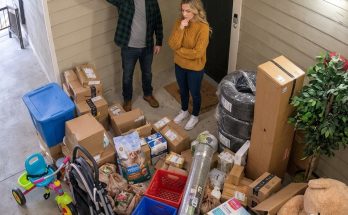
By the following Tuesday, the apartment no longer looked exactly like Mom's.
The hallway was clear.
The kitchen cupboards had been emptied and wiped.
A few framed pictures leaned against the wall while Ben decided which ones to wrap.
That change hurt more than I expected.
When I first entered after her death, every object seemed to insist she would be back.
Now the empty shelves told the truth.
But something else was happening too.
People kept coming through the door.
They weren't strangers arriving to claim gifts.
They were neighbors who brought memories, carried boxes, and asked how we were managing.
Mr. Webb lent us a dolly.
Isaiah tightened a table leg so the old kitchen table could go to a family who needed it.
Rosa brought lunch in containers she insisted we return.
Nia came with the baby and folded dish towels while he slept.
Everyone asked before taking on a task.
The apartment felt less like a place we were closing and more like a place we were saying goodbye to together.
One parcel remained especially puzzling.
It contained a set of watercolor paints, a small metal water cup, and a blank postcard.
The name on the envelope was Thomas.
We couldn't match it to the residents list.
Rosa didn't recognize the name.
The address book gave only a telephone number and the word BUS.
Ben suggested Mom might have known him from her old bus route.
We called the number.
A man answered after several rings.
When I said I was Evelyn Mercer's daughter, he became quiet.
“I was hoping I'd hear from you,” he said.
His name was Thomas Reid.
He drove the public bus Mom sometimes took to the clinic after she stopped driving regularly.
They had talked during her trips.
At first, he said, they discussed schedules and the weather.
Then he mentioned that he used to paint when he was younger.
Mom asked why he'd stopped.
“Life,” he told her.
She didn't argue.
The next time he saw her, she had brought a clipping about a free art exhibition at the library.
The time after that, she asked whether he had gone.
“I told her I hadn't,” Thomas said. “She said she hoped I wouldn't spend the rest of my life waiting for a day with no responsibilities.”
He laughed quietly.
“Then she told me she was talking to herself as much as to me.”
We arranged to meet him at the library on his day off.
Ben worried that giving a stranger a package sounded strange.
I agreed.
So I explained everything on the phone and told Thomas there was no obligation to accept it.
He said he wanted to meet us, with or without the parcel.
The next day he arrived carrying a worn sketchbook.
We sat at a table near the periodicals.
He showed us drawings he'd made during his breaks.
Bus windows.
Street corners.
A woman holding an umbrella in the rain.
Near the back was a quick sketch of Mom sitting by the window with a shopping bag at her feet.
I recognized her posture immediately.
She was looking out with the attentive expression she wore when someone else was talking.
“She asked me what I saw when I looked at people,” Thomas said.
“I thought she meant fares and stops. She meant faces.”
I handed him the paints.
He held the box carefully.
“I told her I couldn't justify spending on hobbies,” he said.
“She said hobbies weren't always a luxury.”
Then he added something that stayed with me.
“She never asked me to paint her. She was just interested in what I wanted to do.”
As we left, he asked whether he could send us a copy of the sketch.
I said yes.
I wanted Mom's face as someone else remembered it.
Back at the apartment, Ben and I discussed what we'd learned.
“She's in half the town,” he said.
“Not half,” I answered.
He smiled.
“Feels like it.”
A package for a woman named June turned out to be a stack of board games.
June was a grandmother who cared for her two grandchildren after school.
Mom had noticed they always borrowed the same game from the community room.
When June came to collect it, she tried to give us money.
We refused.
She insisted we accept a jar of homemade jam.
“Then you'll know I wasn't just taking,” she said.
I accepted the jam.
I understood why she needed the exchange to feel balanced.
Mom had understood it too.
One afternoon we found a receipt with a returned-item stamp.
The note beside it said, Asked June first. Already has one.
I laughed at the reminder.
Mom's kindness wasn't perfect instinct.
Sometimes it required asking questions and being willing to change her mind.
By Thursday, only six undelivered packages remained.
Two were for people who were away.
One belonged to an old friend from Mom's knitting group.
One contained supplies for the pantry's next winter collection.
One was for Sophie.
And one was the wide, flat box with the instruction we still had not followed.
The day before we met Thomas, Ben and I visited Mom's old neighborhood.
It was only a short drive, but I hadn't been there in years.
The bakery where she bought our birthday cakes had become a pharmacy.
The corner hardware store was now a coffee shop.
Our old street looked narrower than I remembered.
Ben parked near the house where we'd lived until I was twelve.
The new owners had painted the shutters green.
We stayed on the public sidewalk and didn't disturb them.
I pointed toward the front steps.
“Remember when you tried to teach me to jump from the third one?”
“You broke your wrist.”
“I landed badly.”
“You told Mom I pushed you.”
“You did push me.”
He looked offended.
“I gave you encouragement.”
I laughed.
The argument was familiar enough to be comforting.
We walked to the corner and stood near the bus stop.
Mom had taken us downtown from there when we were small.
She used to count the bus fare twice, then make us hold the coins in our fists until we boarded.
I could still remember the warmth of a penny against my palm.
Ben said Dad had once told him they couldn't always afford the trips.
Mom found free events at the library or park instead.
I had never thought of those outings as compromises.
To me they were adventures.
We found a bench and sat for a while.
A man walked past carrying groceries in two paper bags.
A teenager hurried toward the bus with headphones on.
None of them knew us.
The neighborhood had kept living while we grew older somewhere else.
That was what the apartment building would do too.
Its residents would move, argue over parking, help each other, and forget some things.
Mom's presence would fade from the daily routines, even if people remembered her name.
I disliked that thought.
Ben seemed to understand.
“Dad's been gone a long time,” he said. “But I still use the way he taught me to measure a board.”
I nodded.
“Sometimes I hear him when I do it.”
“Exactly.”
I told him about my memory of Mom fishing eggshell out of batter.
He said she had taught him the same trick when he was old enough to make breakfast.
We both smiled.
There was a strange comfort in discovering we shared a small memory without having discussed it.
Before driving away, we stopped at a grocery store and bought a loaf of bread.
Ben wanted to recreate Dad's favorite sandwich for lunch.
It wasn't particularly good.
He piled too much mustard on it.
I told him Dad would have complained.
“He would have eaten it anyway,” Ben said.
“Probably.”
We had come looking for the past and found that we were still capable of making new memories together.
That afternoon, I added one more line to the notebook.
Don't forget to go places with Ben that have nothing to do with paperwork.
It wasn't an instruction from Mom.
It was one I chose for myself.
Before I left the building that evening, Mr. Webb stopped me near the elevator.
He had heard we were sorting the last of the kitchen furniture.
He asked whether the community room could use one of Mom's folding tables.
I said I'd check with Ben and the building manager.
The table had belonged to Mom, and we were responsible for handling the estate properly.
I appreciated that he asked rather than assuming.
When I told Ben, he said the table wasn't valuable but might be useful.
We confirmed it could be donated, then arranged for Isaiah to help move it safely.
The next Thursday, the table stood near the pantry shelves.
A volunteer covered it with a clean cloth and placed boxes of supplies on top.
It wasn't a memorial.
It was a table doing what tables do.
I stood beside it for a moment and remembered Mom setting out sandwiches on the same surface when we were children.
Then I helped unpack soap and paper towels.
The ordinary work was comforting.
No one expected a speech or a lesson from me.
At the end, Rosa offered coffee.
I stayed for a cup.
We talked about a neighbor's new dog and a problem with the elevator.
I was surprised by how much I enjoyed the simple conversation.
It was possible to be among Mom's friends without making every visit about her death.
When I went home, I thought I might come back now and then, not out of duty but because I liked the people.
That evening I drove home with the new sketch of Mom resting on the passenger seat.
The traffic lights blurred in the rain.
I thought about Thomas saying she hadn't asked him to paint her.
She had made room for him to be someone besides a bus driver.
Perhaps that was what the Thursday gathering offered her too.
A place to be Evelyn, not only a mother, widow, or patient.
I had loved her in all those roles.
I was only just beginning to know the rest of her.
Click here to continue reading: PART 8: A Fight Over Her Favorite Chair Forces Us to Rethink What Keeping Means
The Blue Bowl That Made Me Understand Why Mom Had Ordered Twenty-Eight Packages
Part 7 of 12