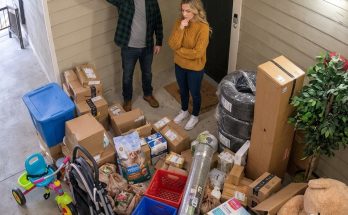
Mrs. Bellamy's name was written on the back of a photograph taken forty-three years earlier.
Mom was standing in front of a narrow house with a white porch.
She wore a yellow coat and held a baby carrier.
The baby was me.
I stared at the photograph.
“I've never seen this place.”
Ben leaned closer.
“Dad must have taken it.”
The address was in a neighborhood across town.
The street still existed, but the houses had changed.
Sophie looked at the back of the photograph again.
“Grandma said this was where she learned kindness. Maybe Mrs. Bellamy helped her when you were little.”
I remembered very little about my first years.
Dad had worked long shifts.
Mom had sometimes cleaned offices in the evenings.
They had never described themselves as struggling.
But I knew money had been tight.
We searched through her address book and found an old entry for Margaret Bellamy.
No current number was listed.
Ben suggested we contact the local historical society rather than visiting the address unannounced.
I agreed.
We had spent weeks learning to respect people's privacy.
We weren't going to abandon that because Mom had left us a clue.
The historical society confirmed that the house had been demolished several years earlier.
They couldn't tell us where the former owner lived.
But a volunteer remembered a woman named Margaret who had worked at the neighborhood library and later moved to a retirement community.
She suggested we ask the library whether any public oral-history material mentioned her.
A librarian helped us locate a recording from a community project.
Margaret Bellamy had spoken about running an informal meal table for young parents when the neighborhood factory closed.
The recording was brief.
She said people needed practical assistance without a lecture.
Then she laughed and said that some of her best helpers had begun as people receiving groceries themselves.
Sophie looked at me.
“That sounds like Grandma.”
The library could not share private contact information, but it offered to forward a letter if it had a valid address through the program.
I wrote a short note explaining who we were.
We asked only whether Margaret was still living and whether she would like to speak.
Three days later, a woman called.
She introduced herself as Margaret's daughter, Elaine.
Margaret had died eight years earlier.
I apologized for calling up a loss.
Elaine said she was glad to hear from us.
She remembered Evelyn.
“Your mother used to bring you to the house in a little blue stroller,” she said.
I held the telephone close.
“What did my mother do there?”
“She helped my mother pack food. Before that, my mother helped her.”
I closed my eyes.
Elaine explained that when Dad's work hours were cut, Mom had struggled to cover groceries and childcare.
Margaret invited her to the meal table.
Mom resisted at first.
She offered to wash dishes rather than accept anything.
Margaret told her that there would always be dishes to wash, but she didn't have to earn every meal.
Over time, Mom became one of the volunteers.
She carried groceries to people who couldn't get out.
She showed new parents how to stretch a small food budget.
She helped label shelves.
I laughed softly at that detail.
“Some habits never change,” I said.
Elaine laughed too.
Then she told me a story I wasn't ready for.
One afternoon, Mom had arrived in tears after a difficult week.
She said she felt ashamed because she could take care of everyone except her own family.
Margaret sat her down and gave her a bowl of soup.
“You're part of your family too,” she said.
“You get to be looked after.”
I repeated the words after Elaine.
They sounded like something Mom had been trying to teach us in her final letter.
Elaine said she had a box of photographs from the meal table.
She offered to scan a few and send them.
We thanked her and gave her our email address.
By evening, six photographs arrived.
There was Mom smiling beside a folding table.
There was Dad holding a stack of boxes.
There was a young Margaret with flour on her apron.
In one picture, Mom was holding me while another woman passed her a grocery bag.
I zoomed in on my mother's face.
She looked tired.
She also looked relieved.
I had never seen that expression in a photograph before.
It unsettled me at first.
I'd grown up believing Mom was the steady person who carried everything.
Here was proof that someone had carried something for her.
That wasn't a weakness.
It was part of the life she'd built afterward.
We printed the photographs and placed them beside the package list.
Ben read Mom's message on the original photograph again.
“This is where I learned that kindness is something people can teach one another.”
He touched the picture of Margaret.
“She wasn't inventing the pantry,” he said.
“She was continuing something.”
Sophie nodded.
“And she wanted us to know she hadn't always been the one giving.”
We called Rosa and told her what we'd learned.
She grew quiet.
“Your mother once said someone had fed her when she was frightened,” she said.
“She didn't tell us who.”
The next Thursday, we took the scanned photographs to the community room.
We asked whether the volunteers wanted to hear the story.
They did.
Rosa listened with tears in her eyes.
Denise said the story would help them remember why the pantry needed to remain a place where anyone could ask for help.
Nobody proposed renaming it after Mom.
I was grateful.
The project was older than her, and it would need to outlast us too.
The first night after Elaine sent the photographs, I couldn't sleep.
I kept returning to the picture of Mom holding me as someone passed her groceries.
I'd been too young to remember the exchange.
For decades, that day had existed only for the people who were there.
Now it had entered my memory through a photograph and someone else's words.
I wondered whether Mom ever meant to tell me.
Perhaps she had intended to, then never found a moment that felt right.
Perhaps she believed the circumstances no longer mattered.
Perhaps she didn't want me to worry about a difficulty that had ended before I could understand it.
I would never know for sure.
I resisted the urge to turn the missing explanation into a complaint.
She had told us plenty about our childhood.
This was one part she hadn't shared.
It didn't erase the rest.
The next morning, I asked Ben to meet me for breakfast.
We chose a diner near his workplace.
He arrived wearing a jacket with paint on the sleeve.
I brought the photographs in a folder.
He spread them on the table beside his coffee.
“Dad looks tired,” he said.
“He was working two jobs then.”
“He never told us about the groceries.”
“Maybe he was embarrassed.”
Ben studied a picture of Dad carrying boxes for the meal table.
“He was helping too.”
I nodded.
They had been receiving and giving, just as Margaret described.
We talked about how easily family stories become simplified.
Dad had been the hardworking one.
Mom had been the organized one.
Ben had been the reliable child.
I had been the responsible one.
Those descriptions weren't entirely wrong.
But they left out all the days we were frightened, impatient, foolish, generous, or in need of help.
I told Ben I didn't want our children to remember us only by our jobs in the family.
He said he'd been thinking the same.
Then he asked about the final box.
“What if it says something we don't like?”
I looked at the photographs.
“Then we'll read it anyway.”
“Do you think it's going to ask us to run the pantry?”
“I hope not. We both know we can't promise that.”
Ben nodded.
“We can help sometimes.”
“And we can say no sometimes.”
He smiled.
Mom had put those boundaries into her letter before we'd learned to say them aloud.
After breakfast, I phoned Elaine again to thank her for the pictures.
She told me Margaret had sometimes spoken of Mom with affection.
“She said Evelyn had the quickest hands in the kitchen,” Elaine recalled.
“Always peeling or sorting something.”
I pictured Mom moving efficiently around the meal table.
It made me smile.
Elaine asked whether we wanted the original photographs.
I said scans were enough.
They belonged with her family.
She seemed pleased.
We agreed to exchange a few more stories by email if either of us remembered something useful.
No obligation.
No promise of a lifelong friendship from one emotional conversation.
Just a respectful opening between two families who had shared a little history.
That evening, I wrote a short paragraph in my notebook about Margaret.
She helped Mom ask for help.
It was the simplest description I could find.
And perhaps the most important.
I called Ben again before we opened the box.
I wanted to check that neither of us felt rushed.
He said he had cleared the evening and could stay as long as we needed.
Sophie brought sandwiches and fruit.
We ate first, sitting at Mom's kitchen table, which was due to be collected the following week.
The apartment was almost bare.
I worried the emptiness would make the last letter feel too final.
But the room still held traces of everyday life.
There was a pencil mark beside the doorway where Dad had measured our heights.
There was a faint circle on the counter where Mom always put the kettle.
There were tiny scratches on the floor from years of moving the kitchen chairs.
The place had been lived in.
No set of packages could contain all that living.
I told Ben I'd been afraid that opening the final box would close something forever.
He looked around.
“We're returning the keys either way,” he said.
“I know.”
“We don't have to understand everything tonight.”
That was the most helpful thing he could have said.
We cleared the table, set out three chairs, and brought the flat box into the light.
That evening, after the last parcel had reached its recipient, Ben carried the flat box from the living-room wall to the kitchen table.
Sophie joined us.
We had done what Mom asked.
We had met the people.
We had learned about Margaret Bellamy.
We had returned to the beginning of a story our mother had never fully told.
I put my hand on the cardboard lid.
“Ready?” Ben asked.
I looked at my daughter and my brother.
“I think so.”
Click here to continue reading: PART 12: The Final Box Reveals Why Mom Wanted Us to Know the People Around Her
The Blue Bowl That Made Me Understand Why Mom Had Ordered Twenty-Eight Packages
Part 11 of 12