My eight-year-old son, Tyler, had always been incredibly close to my mother.
When I was raising him alone and working long shifts, Grandma packed his lunches, helped with homework, and never missed a school concert.
So when her heart condition suddenly worsened and she needed major surgery, I brought her home with us to recover.
Tyler became her little shadow.
He brought her water, reminded her about her medicine, and sat beside her bed reading comic books whenever she was too tired to talk.
At first, I thought it was sweet.
Then he started sleeping outside her bedroom.
Every night, Tyler dragged his pillow and blanket into the hallway and curled up at Grandma's door.
Every morning, I found him there.
I'd wake him gently.
"Sweetheart, Grandma is safe. I'm right across the hall."
He always answered the same way.
"I know. I just need to be close."
I assumed seeing Grandma so weak had frightened him.
It seemed reasonable.
My brother, Jason, had also been visiting almost every day.
He brought groceries, fixed little things around the house, took out the trash, and offered to stay with Mom whenever I had to run errands.
"You've got enough on your plate," he'd tell me. "Let me help."
Jason had always been more charming than dependable.
But after Mom's surgery, he seemed different.
More attentive.
More useful.
I wanted to believe the fear of losing her had finally made him more responsible.
Then I started noticing something strange.
Whenever Jason went upstairs, Tyler followed.
If Jason offered to sit with Grandma alone, Tyler suddenly found a reason to stay in her room.
Once, Jason laughed and ruffled his hair.
"What's with you, little bodyguard?"
Tyler didn't smile.
I actually scolded him afterward.
"Uncle Jason is trying to help Grandma. You don't have to follow him everywhere."
Tyler stared at the floor.
"Okay, Mom."
But that night, he slept outside her door again.
After that, I started paying closer attention to Tyler.
He wasn't only protective.
He was tense.
When Jason rang the doorbell, Tyler's shoulders tightened.
When my brother spoke quietly to Grandma, Tyler stopped whatever he was doing.
When Jason offered to help her shower or change clothes, Tyler appeared in the hallway almost immediately.
I thought he was overreacting.
But Tyler was eight.
Children sometimes cling to fears they can't explain.
Then, just after four in the morning last Thursday, a faint whisper woke me.
I stepped into the hallway.
Tyler was lying under his blanket outside Grandma's door.
But he wasn't asleep.
He was staring at the handle, one small hand gripping his pillow.
"I won't fall asleep tonight," he whispered to himself.
Then, after a pause:
"I won't let Uncle Jason do it to Grandma again."
My blood went cold.
"Tyler?"
He jumped and sat up.
I hurried over.
"What won't you let Uncle Jason do again?"
His eyes immediately filled with tears.
He looked toward Grandma's closed bedroom door.
Then at me.
"Mom, promise you won't tell anyone."
I could barely breathe.
"What did he do?"
Tyler covered his face with both hands.
Then he leaned toward my ear.
"He takes her medicine away and gives her different pills so she'll sleep."
For a few seconds, I couldn't process the words.
"What pills?"
"The white ones in his pocket."
"When did you see that?"
"The first time when you went to get Grandma's prescriptions."
Tyler told me exactly what he'd seen.
Jason entered Grandma's room carrying her pill organizer.
He removed two tablets.
Then he took different pills from a small metal tin.
Grandma asked what they were.
Jason said:
"The doctor changed the dose."
She took them.
Less than an hour later, she was sleeping so deeply Tyler couldn't wake her.
"And then?"
"He went through her drawer."
My stomach tightened.
"Which drawer?"
"The one where she keeps the papers."
I knew exactly which one.
My mother kept her wallet there, along with bank documents and a pouch holding her cards.
Tyler had seen Jason take something.
He didn't know what.
The second time, he heard Jason asking Grandma for her banking code.
She was half asleep.
Jason kept saying he needed it to "pay bills."
Tyler tried to enter.
Jason told him to go watch cartoons.
After that, Tyler started sleeping outside the bedroom.
I felt sick.
Not only because of Jason.
Because of me.
I'd scolded my son.
I'd told him to stop following Jason.
When all along, he was trying to protect my mother.
I knelt beside him.
"Tyler, listen to me. You did the right thing telling me."
He was crying.
"Are you going to tell Uncle Jason?"
"Not right now."
"He's going to be mad."
"That is not your problem."
I took both of his hands.
"From now on, this is my job."
I brought him into my bedroom.
Then I called the after-hours nursing service connected to Mom's recovery team.
I explained that I suspected someone had altered her medication without permission.
The nurse told me not to give Mom any pills from an unknown source and said she needed urgent assessment if she showed unusual drowsiness, confusion, or breathing problems.
I checked Grandma.
She was asleep.
Her breathing was steady.
The pill organizer looked normal.
But when I opened the drawer, her banking pouch was partly unzipped.
A checkbook was missing.
At six, when Mom woke up, I opened her banking app with her.
She was still groggy.
"Why are we looking at this now?"
"Because I need to check something."
There were three transfers I didn't recognize.
$1,200.
$1,500.
$900.
All to an account with Jason's first name in the memo.
Mom frowned.
"Did I do that?"
"Do you remember?"
She stared at the numbers.
Then shook her head.
"No."
I asked whether Jason sometimes helped with bills.
"Sometimes."
"Did you give him your passcode?"
She closed her eyes.
"Maybe. I don't know. I was so tired."
Looking back, what upset me most was how many small signs I had missed.
A week earlier, Tyler asked whether Jason was "allowed to change Grandma's pills."
I'd answered without thinking:
"No, of course not."
Then I went back to folding laundry.
Another time, he asked:
"If somebody helps Grandma with money, can they take some for themselves?"
I laughed.
"No, sweetheart."
Then my phone rang.
Conversation over.
I felt guilty remembering those moments.
But guilt was useless if it only made me hate myself.
It had to make me listen better.
Children don't always come with a perfect accusation.
Sometimes they give you a fragment.
A strange question.
A changed behavior.
A pillow in a hallway.
And wait for an adult to understand the rest.
I asked Tyler why he had never woken me.
His answer was painfully simple.
"Because you were tired."
I told him:
"Even if I'm tired, even if I'm working, even if I'm asleep, you can always wake me if something scares you."
He asked:
"Even if I'm wrong?"
"Even if you're wrong."
"You won't be mad?"
"No."
He studied me before nodding.
At eight, I called Mom's cardiologist and primary doctor.
They asked me to bring every medication in the house.
I bagged each bottle.
Then I found the metal tin.
Not in Grandma's room.
In the hallway closet under folded towels.
It contained pills prescribed to Jason months earlier after a back injury.
A strong sedative.
Not prescribed to my mother.
I photographed it.
Then I called the police.
Not because I wanted my brother arrested in front of Tyler.
Because we now had a real medical and financial problem.
Before Jason arrived that morning, I also called my mother's pharmacy.
I did not accuse anyone.
I asked whether any recent prescription had changed.
Nothing had.
No new sedative.
No new sleep medication.
No change from the cardiologist.
That small confirmation mattered.
It meant Tyler had not misunderstood some legitimate adjustment.
The pharmacy also told me exactly what each pill in Mom's current plan should look like.
I wrote it down.
Round white tablet.
Small blue capsule.
Half of one larger tablet in the evening.
For the first time, I realized how much trust we had placed in a handful of people simply because they were family.
Nobody had been checking.
Nobody thought we needed to.
That is what trust normally looks like.
But once trust is abused, ordinary routines suddenly need structure.
I also asked Mom whether she remembered feeling unusually sleepy after Jason visited.
At first, she said no.
Then she frowned.
"There were two afternoons I lost almost the whole day."
She had assumed it was recovery fatigue.
So had I.
One time, I came home and found her asleep at three in the afternoon.
Jason was downstairs making coffee.
He told me:
"She finally relaxed."
I had thanked him.
That memory made my stomach turn.
The same scene looked completely different now.
I wrote down every date I could remember.
Not because I wanted to exaggerate.
Because I did not want memory to become softer later.
Families are very good at softening ugly things once the immediate fear is gone.
I did not want that.
Not for Tyler.
Not for Mom.
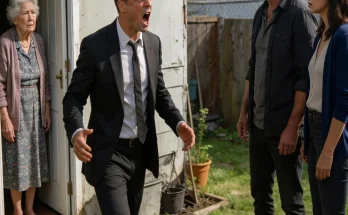
Jason arrived around ten, like usual, carrying grocery bags.
"How's Mom?"
I stayed in the doorway.
"She's seeing her doctor today."
His expression changed.
"Why?"
"Because someone gave her medication that wasn't prescribed to her."
He froze.
Then laughed.
"What?"
"And because there are bank transfers she doesn't remember authorizing."
His face closed off.
"You're accusing me?"
"I'm checking facts."
He tried to step inside.
I blocked the doorway.
"You're not going upstairs."
"She's my mother too."
"Exactly."
His eyes shifted past me.
Tyler stood at the end of the hall.
Jason understood.
"What did he tell you?"
Tyler stepped back.
I moved in front of him.
"You do not talk to him."
"He's a kid. Kids make things up."
"He described a box of pills I found exactly where he said."
Silence.
Jason's jaw tightened.
Then he said:
"You don't understand."
"Then explain."
He lowered his voice.
"Mom wasn't sleeping. She was agitated. I was trying to help."
"By giving her your medication?"
"Half a dose."
"Without her doctor?"
"She was stressed."
"And the transfers?"
He looked away.
There it was.
Two different problems.
Same logic.
Jason had decided he knew better.
What medication Mom should take.
What money she could spare.
What access he was entitled to use.
I didn't let him inside.
The police arrived twenty minutes later.
No sirens.
No dramatic scene.
They took statements, photographed the medication, and documented the transfers.
Mom's doctor asked that she be evaluated that day.
Tyler spoke to one officer with me beside him.
The officer told him something I will never forget.
"You were not responsible for protecting Grandma by yourself. But you did the right thing asking for help."
Tyler started crying.
So did I.
Because for several nights, my eight-year-old son had believed his grandmother's safety depended on whether he could stay awake.
And I had been sleeping across the hall.
Click here to continue reading: PART 2: Jason Said He Was Helping Grandma, but the Investigation Showed He Had Turned Her Weakness Into Access to Her Medication and Her Money
Tyler Wasn’t Sleeping Outside Grandma’s Door Because He Was Afraid She Would Fall — He Was Trying to Protect Her From My Brother
Part 1 of 2