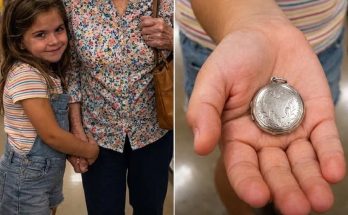
The foundation held its first small public gathering in June.
I almost didn't attend.
The event took place in the community center gymnasium.
There were folding tables, paper cups, and a banner made by local students.
I worried someone would ask me to tell a dramatic story about finding a ring.
I had no desire to become a lesson about how poor people are rewarded for honesty.
But Ms. Chen assured me the evening would focus on the families the program could support and the volunteers who made the work possible.
Harper wanted to come.
I agreed after arranging for Denise to join us.
If the speeches grew long, they could go outside.
Isabel greeted us near the door.
She wore the diamond ring on her right hand.
Harper spotted it immediately.
“That's the treasure!”
Isabel knelt to her height.
“It is. And I'm keeping it very carefully.”
“Was it expensive?” Harper asked.
“Probably,” Isabel said.
“But the reason I love it isn't the price.”
“Because it was your mommy's?”
“Exactly.”
Harper nodded with complete understanding.
She knew what it meant to have something a mother had touched.
She kept Claire's blue scarf folded beside her pillow.
Isabel asked whether Harper would like to see a photograph of Miriam wearing the ring years ago.
Harper looked to me first.
I nodded.
The photograph showed Miriam laughing in a garden.
The diamond flashed on her hand.
Harper examined the image.
“She looks happy.”
“She was,” Isabel said.
“Sometimes.”
The pause was gentle.
Harper didn't need the rest of that story yet.
Inside, Ms. Chen described the foundation's first grants without naming recipients.
One had helped a family pay for transportation during an extended medical treatment.
Another had supported temporary child care after a caregiver was hospitalized.
A third helped replace a broken refrigerator used to store prescribed medication.
Each case had been verified and approved through the proper process.
There were no miracles.
There were practical problems made smaller.
When Ms. Chen thanked the advisory committee, I stood with the other volunteers.
I did not speak.
Nobody seemed disappointed.
Afterward, a man approached me and asked whether I was the Evelyn Mercer mentioned in Miriam's old letters.
I stiffened.
He introduced himself as a former neighbor from Cedar Falls.
He remembered Arthur repairing bicycles behind our garage.
He remembered Samuel running across the yard with a wooden airplane.
“I thought you'd all moved away,” he said.
“We did.”
“I was sorry about the boy.”
“Thank you.”
He hesitated.
“Some people said foolish things afterward. I was young. I should have spoken up.”
I studied his face.
I vaguely remembered him as a teenager who helped unload groceries at the corner store.
“You can stop carrying that,” I said.
He nodded.
“I'll try.”
I had never expected to say those words to anyone from Cedar Falls.
Perhaps I said them to myself too.
Later, Harper found a table with small paper airplanes children could decorate.
She made one red and another blue.
She sent the blue one sailing toward Denise.
It landed in an empty cup.
Everyone laughed.
I looked across the room at Isabel.
She was talking to Ms. Chen with her mother's ring resting quietly against her hand.
For months, I had thought of that ring as the beginning of our story.
Of course it wasn't.
It was a way for two old stories to find one another again.
Harper came back with an extra airplane.
“This one is for you.”
I held it carefully.
“Thank you.”
She looked at the ring across the room.
“Grandma?”
“Yes?”
“I'm still glad we gave it back.”
“So am I.”
“Even without the roof?”
“Even without the roof.”
She smiled and ran toward the craft table.
I stayed where I was for another moment.
The paper airplane had a crooked wing.
It flew perfectly well.
After the community gathering, a local reporter called the foundation office.
She wanted to write about the new fund and had heard that a lost ring played a part in bringing people together.
Ms. Chen asked whether I would consent to an interview.
I declined.
I did not want strangers looking at Harper's picture and deciding that grief had made her an inspiring symbol.
The reporter was welcome to describe the foundation's public work using information approved for release.
Our private family history belonged to us.
Isabel agreed.
The foundation published a short note about its mission and the types of assistance available.
No names of children.
No photograph of the ring.
No claim that generosity had made anyone wealthy overnight.
I was relieved.
A few days later, someone at church mentioned the fund and asked whether I'd heard of it.
“I serve on an advisory committee,” I said.
She looked surprised.
Then she asked how to apply.
I gave her the foundation's public telephone number.
I didn't ask why she needed it.
She thanked me and put it in her purse.
I thought that was how the work ought to happen.
People should be able to ask for help without telling their troubles to the whole neighborhood.
At home, Harper wanted to organize her bedroom.
She had outgrown several shirts and pairs of shoes.
We sorted them together.
She chose items that were clean and in good condition to donate.
I explained that donated things needed to be useful, not merely something we wanted out of the house.
She held up a shirt with a missing button.
“Can we fix this?”
“Yes.”
We found a matching button and I showed her how to sew it on with a blunt practice needle under supervision.
Her stitches were enormous.
The button held.
She grinned.
“Like Grandpa Arthur.”
“Very much.”
We folded the repaired shirt into the donation bag.
Then she chose one toy she no longer played with.
I asked whether she was sure.
She said yes.
I let her decide.
When we dropped the bag at the collection center, the volunteer thanked us.
Harper asked who would receive the clothes.
The volunteer explained that the center sorted items and offered them to families who needed them.
We left without asking for anyone's story.
In the car, Harper looked out the window.
“I like helping when nobody has to be embarrassed,” she said.
I reached across and squeezed her hand.
“I do too.”
For a moment I thought of the diamond ring again.
Harper had returned it because she imagined someone crying.
She had never needed an audience.
I hoped she would keep that instinct as she grew older.
The week after the fundraiser, I found an old photograph of Claire in the attic.
She was seven, the same age Harper had been when she found the ring.
She stood beside Arthur in the garden holding a tomato almost as large as her hand.
I brought the photograph downstairs and placed it beside Harper's school picture.
For several minutes I studied their faces.
They had the same serious expression when they concentrated.
They both tilted their heads before asking a difficult question.
I had spent years telling Harper she looked like her mother.
Now I realized I hadn't shown her enough of the ordinary life Claire had lived.
We began making a family photo album that afternoon.
Harper chose the order.
We included Arthur cooking breakfast, Claire graduating from school, and Daniel holding Harper as a baby.
We left blank pages at the end.
“What are those for?” she asked.
“For pictures we haven't taken yet.”
She considered this.
Then she picked up a pencil and wrote OUR NEXT ADVENTURES on the first empty page.
I couldn't think of a better title.
Click here to continue reading: PART 14: The First Summer Without a Leak Made Space for Ordinary Happiness Again
The Stranger at Our Door Brought a Photograph I Had Hidden for Forty Years
Part 13 of 16