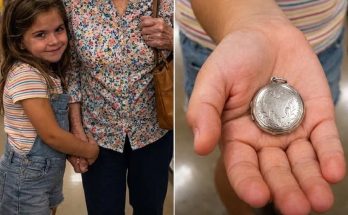
I hadn't spoken Miriam Calder's name in years.
Harper knew Arthur as the grandfather who had built her small bookshelf.
She knew he made pancakes shaped like animals.
She did not know he once worked nights at a furniture factory in Cedar Falls.
She did not know that we had taken in a family during a winter when the factory nearly closed.
James spread three letters across my table.
The envelopes were yellowed.
I recognized Arthur's handwriting before I could read a word.
“Where did these come from?” I asked.
“Miriam kept them in a lockbox. Her daughter Isabel found the box after the funeral.”
“Isabel?”
“The woman whose ring Harper returned.”
I looked toward the living room.
Harper was making a paper crown for her stuffed rabbit while Mrs. Alvarez watched.
She had no idea her small act at the store had brought back a story I'd spent forty years trying to put down.
Miriam had lived two streets away when Arthur and I were young.
Her husband, Robert, lost his job before Samuel became ill.
We brought groceries.
Arthur repaired their heater.
When Robert left, Miriam worked at the factory cleaning offices.
She sometimes asked me to watch Samuel after school.
He had a weak heart.
We knew he needed careful medical attention.
What we didn't know was how rapidly his condition could worsen.
One February afternoon, I picked him up because Miriam's shift ran late.
He asked to stay with us instead of going home.
I made tomato soup.
Arthur helped him finish the wooden airplane.
An hour later, Samuel collapsed.
I called emergency services at once.
I rode beside him in the ambulance.
He died at the hospital that night.
The doctors explained that his underlying heart condition had caused the crisis.
But Miriam was shattered.
She asked why I'd let him play.
Why I hadn't known sooner.
Why her son had died in my kitchen when he should have been home.
I had no answer that could ease her grief.
By spring, she stopped speaking to us.
A year later, Arthur found work in another town.
We moved.
We sent cards.
They came back unopened.
I never blamed Miriam for being unable to forgive.
I had lost a child under my care.
The fact that it wasn't my child did not make those hours disappear from my memory.
James pointed to the first letter.
Arthur had written it six months after we left.
Miriam, we know no amount of talking can return Samuel. But Evelyn still wakes up calling his name. Please let her know she did everything anyone could have done.
I folded the paper with both hands.
“I remember that one,” I said.
Arthur had asked me whether he should send it.
I told him he had to try.
James showed me another.
It was dated thirteen years later.
Arthur wrote that we had moved again.
Our daughter Claire had just started secondary school.
He asked only whether Miriam was well.
The letter had never been mailed.
“She kept it?” I whispered.
“She apparently found it among old belongings Arthur left with a mutual friend. There were others.”
James handed me a smaller sheet covered in Miriam's handwriting.
I looked at the date.
Six weeks before she died.
Evelyn, I spent forty years blaming the wrong person. It was easier than admitting how frightened I was, and how much I regretted not being there when Samuel needed me. I knew the doctors did not blame you. I knew even then. I let you carry what belonged to grief itself.
I stopped reading.
A tear fell on the word grief.
James waited.
I didn't ask him to leave.
I took a tissue and continued.
I tried to find you after Arthur died. I sent letters to the wrong address. I hired someone twice. I thought you did not want to hear from me. Isabel kept trying after I became ill.
A noise came from the living room.
Harper was laughing at something Mrs. Alvarez had said.
That sound brought me back to the room.
“How did Isabel know who I was in the store?”
“She didn't at first. She recognized the little wooden airplane charm on your key ring when you helped her stand. Her mother kept its twin.”
I pulled my keys from my pocket.
The small wooden airplane had hung there for decades.
Arthur had made three.
One for Samuel.
One for me.
One for Miriam, which she refused when we left.
Later Arthur turned the spare into a pendant and stored it.
I had never thought anyone would recognize the shape.
“Isabel asked the store manager whether you had left contact information,” James said. “The manager wouldn't disclose it. But Isabel had also heard Harper call you Grandma Evelyn. She looked through Miriam's old notes and recognized your photograph.”
“That doesn't explain how you found the house.”
“Miriam's notes had your full married name. I checked public property records and independently verified the address. I should have called before appearing. I'm sorry.”
I looked again at the card.
“You should have.”
He nodded.
“Isabel was overwhelmed yesterday because she was on her way to a meeting about settling her mother's belongings. Losing the ring had felt like losing the last thing they shared.”
“Was it Miriam's?”
“Yes. She gave it to Isabel before she died.”
I remembered the woman's face at the counter.
Now I understood a little of what had made her cry.
James returned the letters to their envelopes.
“There are financial matters too,” he said.
I stiffened.
“I'm not here asking for money,” he added.
“What financial matters?”
“Miriam left a small charitable fund and asked that you be consulted about how it is used.”
“Why me?”
“Because she believed you knew better than anyone what families need when things go wrong.”
I glanced at the stained ceiling.
I knew how families got through things.
Mostly by doing without.
James slid another document across the table.
The amount at the top made me reach for my glasses.
Then I looked up.
“This cannot be right.”
That evening I opened the drawer where Arthur had kept his notebooks.
He wrote down repairs, grocery totals, and the names of people who borrowed tools.
Most of the pages were ordinary.
Mrs. Green, two fence boards.
New belt for washing machine.
Milk and bread after work.
Then I found a page labeled February.
The date was from the year Samuel died.
Arthur had drawn a box around a telephone number.
Beneath it he wrote, Dr. Ellis confirmed underlying condition. No warning symptoms we could have recognized. Tell Evelyn again.
I sat on the bedroom floor.
I couldn't count how many times Arthur had told me the doctors did not blame us.
I always nodded.
Then I spent another night wondering whether I might have noticed something earlier.
The notebook wasn't new evidence.
It didn't change the medical facts.
It showed me the patience with which Arthur had tried to help me live beside them.
I turned another page.
He had listed the cost of flowers we sent Miriam after the funeral.
There was a note beside it.
Evelyn wanted blue. Shop had white. Go back tomorrow.
He had gone back.
I remembered the blue flowers arriving late and feeling foolish that color mattered when a child was gone.
Yet Arthur had understood why I asked.
Samuel loved blue.
The following day, I visited the local history desk at the library.
I asked whether old town directories from Cedar Falls were available.
The librarian showed me how to search an archive.
I found the street where Miriam had lived.
Several businesses had closed.
The factory had been converted into apartments.
I printed one photograph of the old building.
I wanted to see what the years had done to a place I still carried in my head as it used to be.
On the bus home, I sat beside a woman holding a tired toddler.
The child dropped his mitten.
I picked it up and handed it back.
His mother thanked me.
She looked exhausted.
I remembered Miriam after Robert left.
I remembered leaving groceries on her porch because she sometimes would not open the door.
I wondered whether I had thought of myself as helpful without ever asking what she found difficult about accepting that help.
People could love one another and still misunderstand the shape of a need.
At home, I added the printout to the Calder folder.
The folder was already growing thick.
I had not expected an old photograph to bring homework back into my life.
But I felt ready to do it.
Click here to continue reading: PART 3: An Unexpected Offer at My Kitchen Table Was Not the Kind of Rescue I Wanted
The Stranger at Our Door Brought a Photograph I Had Hidden for Forty Years
Part 2 of 16