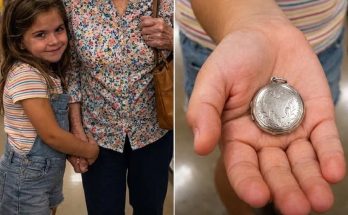
A year after Harper found the ring, we went back to the same Target.
We needed milk, bread, and a birthday card for Denise.
Harper stopped beside the candy display.
“That was where it was,” she said.
I looked at the shelf.
The boxes had different wrappers now.
Someone had moved the price labels.
The world hadn't preserved the place where an extraordinary thing happened to us.
Why should it?
People found and lost objects every day.
Most of those stories never reached anyone beyond the people involved.
Harper peered behind a box of candy.
I smiled.
“Looking for another treasure?”
“No.”
She straightened up.
“I just wanted to see.”
We finished shopping.
At the checkout, the cashier asked whether we needed a bag.
I said no.
Harper carried the bread.
On our way home, she asked if I remembered how frightened I had been when the man knocked on our door.
“I remember.”
“Were you afraid he'd take me away?”
I considered her question.
“I was afraid because I didn't know why he was there. It was sensible to check who he was before letting him in.”
She nodded.
“Like when you tell me not to open the door for strangers.”
“Exactly.”
Then she asked the question I had hoped would come someday.
“Are you still scared all the time?”
I thought about our life.
The repaired roof.
The emergency savings.
The medical appointments I no longer postponed.
The names in Harper's school folder.
The people who would answer if I called.
I thought about the old fears that still visited on difficult nights.
“Sometimes,” I told her.
“But not as often.”
“Me too.”
She slipped her hand into mine.
We walked the rest of the way home without saying anything.
Isabel visited that afternoon.
She brought a small framed photograph of Miriam and Samuel in their garden.
I had given her permission to make a copy.
We placed it beside the picture of Arthur holding tomatoes.
They were different families.
Their histories had crossed in grief and separated in anger.
Now those photographs could share a shelf without asking anyone to deny what had happened.
The foundation was operating steadily.
Its board had approved a modest annual grant budget that preserved money for future years.
I still served as an adviser.
I spoke when I had something useful to say.
I stayed home when Harper was sick.
Nobody made me feel guilty about either choice.
Harper had finished another round of counseling and was doing well enough to space appointments farther apart.
We kept the option of returning more often if she needed it.
She still missed her parents.
I still missed my daughter.
That did not mean we'd failed to heal.
It meant we loved people who weren't coming back.
After lunch, Harper showed Isabel the small yellow airplane we'd made for Samuel.
“Grandpa Arthur was good at making things,” she explained.
“Grandma taught me.”
Isabel held the airplane carefully.
“It looks wonderful.”
“Sometimes it falls over.”
“Most airplanes do when they're on a shelf,” Isabel said.
Harper laughed.
Later, while Harper played outside, Isabel and I sat on the porch.
She asked whether I ever regretted accepting Miriam's bequest.
“No,” I said.
“I needed the money. I won't pretend otherwise.”
“And the letter?”
“I needed that too.”
We looked at the garden.
The basil had grown taller than expected.
A few tomatoes were beginning to turn red.
I remembered standing at the grocery counter one year earlier, calculating whether a found ring could buy us a safer house.
The thought embarrassed me then.
It didn't now.
Desperation can make an idea appear for a moment without making it a decision.
What mattered was what Harper and I did afterward.
We gave the ring back.
Not because we expected anyone to notice.
Because another person was missing something precious.
In return, we had found far more than a check.
We had found letters that corrected an old misunderstanding.
A family connection that could begin again slowly.
A fund that might help other children keep their routines through difficult months.
We had also learned to accept practical support without giving away our independence.
None of it made us rich in the way fairy tales promise.
Our car still needed repairs from time to time.
Our house still required work.
I was still seventy-one now, and my knees still reminded me every morning that I had been walking on them for a long time.
But the bills no longer made me sick with worry.
Harper had shoes that fit.
She had friends, teachers, and relatives she trusted.
She had stories about the people she'd lost and plans for the years ahead.
As evening came, she ran up the porch steps carrying a drawing.
It showed a crooked yellow house under a bright blue sky.
There were three people in the garden.
One was small.
One had gray hair.
The third had a ring glittering on one hand.
“That's Isabel,” Harper explained.
“She came to visit.”
“It's lovely.”
Harper pointed to the roof.
“Look. I didn't draw any rain coming in.”
I smiled.
“That's my favorite part.”
She climbed into my lap even though she was getting too big for it.
“Grandma, do you think we were lucky?”
“Yes,” I said.
“Very lucky.”
“Because I found the ring?”
“Because we found people who cared, and we learned how to let them care.”
She considered that.
Then she rested her head against my shoulder.
“I'm glad the lady got her mommy's ring back.”
I kissed the top of her hair.
“So am I, sweetheart.”
Beyond the porch, the last light of the day lay across the garden.
Inside, dinner was waiting.
There would be laundry tomorrow and a school form to sign.
There would be hard days too.
But for that evening, I had everything I needed within reach.
I held Harper close until she asked to go inside.
The evening after our anniversary shopping trip, Harper asked to write a thank-you note to Isabel.
I gave her a sheet of stationery.
She sat at the kitchen table with her tongue tucked into the corner of her mouth.
She wrote slowly.
Dear Isabel, I'm glad you found your ring. Thank you for being our friend. Our roof doesn't leak. I am eight now. Love, Harper.
She decorated the border with little blue airplanes.
I looked over her shoulder.
“That's lovely.”
“Do you think she'll keep it?”
“I'm sure she will.”
Harper folded the paper and put it in an envelope.
The next morning, we walked to the mailbox together.
She lifted the red flag.
Then she stood on the path for a moment.
“Grandma?”
“Yes?”
“Do you still have the paper from the man in the black car?”
I knew which paper she meant.
“The letter from Miriam?”
“Yes.”
“I do.”
“Can I read it when I'm bigger?”
“If you want to.”
“Will it make me sad?”
“Parts of it may.”
She thought about that.
“Then maybe I'll read it with you.”
“I'd like that.”
In the afternoon, I reviewed the household budget.
The emergency savings were still there.
The roof warranty lay in the proper folder.
My next medical appointment was on the calendar.
Harper's school had the correct contact information.
These were unremarkable achievements.
I had once imagined that any dramatic change in our fortunes would be accompanied by music and applause.
Instead, our greatest relief came in quiet forms.
A prescription picked up on time.
A dry ceiling.
A child walking confidently into school.
A friend calling because she wanted to share a recipe rather than deliver bad news.
I closed the notebook and made dinner.
We ate chicken, rice, and the last beans from Harper's garden.
Afterward, she showed me a spelling test with every answer correct.
I put it on the refrigerator beside her picture of the yellow house.
She asked whether we could have pancakes on Saturday.
I said yes.
She asked whether we could make them shaped like airplanes.
“I can try.”
“Grandpa Arthur could.”
“He had more practice.”
“Then we'll practice.”
We cleared the dishes together.
Outside, rain began to fall.
Harper paused and listened.
Then she looked up at the ceiling.
No dripping.
She grinned.
“It works.”
I listened too.
“Yes,” I said.
“It does.”
Before bedtime, Harper asked to look through our family album.
She turned the pages carefully.
She stopped at Claire's photograph in the garden.
“Mommy liked tomatoes?”
“She loved them. She ate the little ones before Arthur could bring them into the kitchen.”
Harper giggled.
“I do that too.”
“I've noticed.”
She pointed to a blank page near the back.
“Can we put a picture of Isabel here?”
“Of course.”
“And Mrs. Alvarez?”
“Yes.”
“And Denise and my swimming teacher?”
“We might need another album.”
Harper looked delighted.
“Good.”
I tucked the blanket around her and switched on the small hallway light.
She didn't ask me to leave it brighter.
She didn't ask whether I'd still be there in the morning.
She simply said goodnight and closed her eyes.
I stood outside her door for a moment, listening to the quiet house.
The old fear hadn't disappeared completely.
Neither had the grief.
But there was laughter in our photographs and tomorrow's shopping list on the refrigerator.
There were friends who knew where we lived and people who would answer the phone.
And there was a little girl sleeping safely in a room with a dry ceiling.
That was enough for tonight.
THE END
The End
Read more original stories on Feel Every Story.
The Stranger at Our Door Brought a Photograph I Had Hidden for Forty Years
Part 16 of 16