I asked Ellen to follow me home.
It wasn't an invitation I had planned.
I simply couldn't watch her drive away without knowing where she would go.
My house sat on a narrow street in Deer Park.
The paint above the front porch had started to peel.
Mama used to complain about it every April.
Then she would remind me that a person could live perfectly well under imperfect paint.
Her walker was still beside the coat closet.
I hadn't found the strength to move it.
Ellen stopped when she saw it.
“I didn't know she lived here.”
“For eight years.”
“Did she need much help?”
“Near the end.”
I put the kettle on although neither of us had asked for tea.
Mama's blue sugar bowl stood beside the stove.
Ellen looked around without touching anything.
I wondered whether she could recognize some part of herself in the place that had belonged to us.
She wore a gold wedding band with a small nick near the stone.
Her hands were longer than mine.
But when she folded them together at the table, she did it just the way I did.
“Tell me about the photograph,” I said.
Ellen set a small envelope on the oilcloth table covering.
“My mother saved it with the christening gown. There were two pictures. One was taken at the hospital. One was taken when I came home.”
“Can I see the second?”
She slid it across.
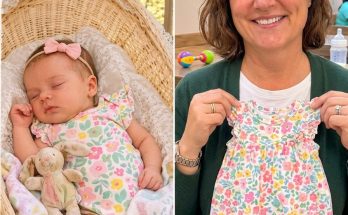
Miriam Rountree sat in a rocking chair with a newborn against her shoulder.
I recognized Miriam at once.
She looked younger than I'd remembered, with her hair pinned up and tears on her smiling face.
At the edge of the picture stood Walter.
He had one finger resting on the baby's blanket.
The baby was mine.
Or might be.
I refused to let certainty come from resemblance alone.
“Have you had a test?”
Ellen nodded.
“A DNA test from one of those ancestry companies. A relative on your mother's side matched with me. That's how I started looking.”
“Who?”
“A woman named Carla Bell. She said her grandfather and yours were brothers.”
I knew Carla.
We had exchanged Christmas cards for years.
I hadn't seen her since Daddy's funeral.
Ellen showed me an email thread.
There were dates, messages, and careful questions.
Carla had told Ellen about Ona, called Doll, who once had gone to Louisiana for a spring visit.
“Carla never knew about my baby,” I said.
“She didn't. She only knew there was a family story nobody would explain.”
Ellen turned her phone around.
A message from Mama appeared on the screen.
It was written fourteen months earlier.
I read it twice.
I know who you are. I have prayed about answering you. Please do not contact Ona yet. She has suffered enough.
My mother's name was signed at the bottom.
I looked at Ellen.
“You waited because she asked?”
“At first. I didn't want to hurt anybody. Then I asked her whether you actually knew I'd been adopted. She stopped answering.”
“Did you ever meet her?”
“Yes.”
The kettle whistled.
I turned it off without making the tea.
“When?”
“Last September. At a little diner near the highway.”
I pictured Mama telling me she needed to go to the bank.
It had been September.
I had offered to drive her.
She insisted on taking a taxi.
Ellen continued slowly.
“She recognized me as soon as I walked in. She didn't touch me. She asked if I'd had a happy life.”
“What did you say?”
“That I had. Mostly.”
I gripped the counter.
“What did Mama say about me?”
“She told me you were good to her.”
That answer hurt in a way I couldn't explain.
I was good to her.
I had helped her shower, cut her sandwiches, sorted her pills.
She had sat across from my living daughter and said I was good to her without telling me my daughter existed.
“Did she tell you I thought you died?”
Ellen lowered her eyes.
“Not that day.”
I opened the cabinet and took down two mugs.
One had a chipped handle.
I gave it to myself.
“Who told you?”
“An attorney wrote to me after she died. He said there were papers your mother had left. He included a letter addressed to me, and he said there was one for you.”
“What attorney?”
She gave me his name.
I had heard it before.
Mr. Sutter had helped Mama update her will when she moved into my house.
His office was in Pasadena, not far from the gas station.
“He called me yesterday,” I said. “I thought it was about the house contents.”
“Did he tell you anything?”
“No. He asked if we could meet after the funeral.”
Ellen folded her hands.
“I came because I couldn't let her be buried without you at least seeing me.”
“I'm glad you did.”
I took a breath.
“I'm also angry.”
“I know.”
“You don't know what it's like to bury someone who didn't die.”
“No,” she said. “And I don't want to pretend I do.”
That was the first thing anyone had said all day that made me feel less alone.
I finally made tea.
We drank it with no sugar.
Ellen asked about my work.
I told her about the chicken plant, the register, the early mornings, and my manager's text.
She didn't tell me to quit.
She asked whether the station had given me funeral leave.
“Two hours.”
“That's not much.”
“It was what they could spare.”
I pushed my mug away.
“Maybe I won't have a job tomorrow.”
“I hope they understand.”
I appreciated that she didn't promise everything would work out.
I had lived long enough to know it often didn't.
Then she asked the question I had been expecting.
“Did you ever have other children?”
“No.”
My voice caught on that single word.
“I married a man named Roy when I was twenty-five. We tried. No luck. He never blamed me.”
“I'm sorry.”
“He was a good husband. Gone eleven years now.”
Ellen took a little notebook from her bag.
“I wrote down things I wanted to ask. I don't have to ask any of them today.”
“Ask one.”
“Did you give me a name?”
I stared at Mama's sugar bowl.
“Yes.”
I had never said the name aloud to another person since the hospital.
“Rose.”
Ellen put a hand over her mouth.
“My middle name is Rose.”
For a moment I could hear nothing but the refrigerator humming.
“Ellen Rose Mercer,” she said. “My parents always told me they thought Rose sounded right.”
I pressed both palms flat on the table.
I wanted to believe it was a sign.
But I wanted facts more than signs.
“Tomorrow,” I said, “we go to the attorney.”
Ellen nodded.
“And then we figure out what really happened.”
Before she left, she wrote her telephone number on a piece of grocery-list paper.
I put it beside the kitchen phone.
At the door she turned around.
“May I call you Ona?”
I thought of Mama saying it every time she needed something.
I thought of Roy calling me Doll when he came home from work.
“Call me Doll,” I said. “That's who I know how to be.”
Ellen smiled, and the dimple appeared again.
After her car disappeared, I looked at the walker in the closet.
I no longer knew whether I could bear to keep it.
Then I saw Mama's purse hanging from the hook behind it.
Inside was the September bank envelope she'd brought home last year.
It had never been opened.
“Then put it in the freezer,” she said. “You've got to eat eventually.”
I almost told her about the September envelope.
Instead I asked her to describe the woman she'd seen at the cemetery.
“Why?” she asked.
“Because I need to know I'm not imagining her.”
June was quiet.
Then she said, “She's about your height when you're sitting down, but taller standing. She has your smile. She was kind to the pastor's wife. She held the door for a lady with a cane.”
I put the telephone closer to my ear.
“You noticed all that?”
“She looked scared, Doll. I was watching to see if she needed help.”
After the call, I carried Mama's laundry basket into the living room.
Her favorite sweater lay at the top.
I remembered the afternoon she had bought it at a church rummage sale.
She said the color made her look younger.
I told her it made her look like a mint-flavored cough drop.
She had laughed so hard she nearly spilled her coffee.
That memory didn't vanish because of the letter.
I still knew what her laugh sounded like.
I still knew where she kept the spare flashlight batteries.
I still knew how she folded a towel into three narrow sections.
I picked up the sweater and smelled the sleeve.
Then I put it in a box marked KEEP FOR NOW.
I didn't have a box marked FORGIVE.
I didn't have one marked FORGET.
I wasn't going to pretend decisions of that kind could be made with a marker and packing tape.
The next morning I went to the grocery store.
I bought bread, eggs, tomatoes, and the cheapest coffee on the shelf.
At the checkout I saw a young mother struggling with a stroller and two bags.
Her little boy was crying.
I helped lift one bag without touching the stroller.
She thanked me.
I thought about the person who might have helped Miriam with Ellen when she was tiny.
I thought about the woman I'd never been allowed to become at seventeen.
Outside, I sat in my car until the traffic thinned.
I called Ellen's number just to hear it ring.
She answered on the third try.
“Hello, Doll.”
I hadn't told her to call me that more than once.
It sounded natural now.
“I don't need anything,” I said. “I only wanted to know if you made it home.”
“I did. Paul was waiting up for me.”
“Did you eat?”
“Yes. Soup and toast.”
“Good.”
She paused.
“I kept thinking about your house.”
“Why?”
“Because you showed me where you've lived all this time. I don't know why, but that meant something.”
I looked through my windshield at the supermarket sign.
“People can be dear to each other without knowing much yet,” I said.
“I think so too.”
We talked about the weather for a minute.
Then we said goodbye.
I remained in the parking lot long enough to write down exactly what she'd said.
I didn't trust my tired mind to hold every new memory.
I wanted to keep the small ones too.
Click here to continue reading: PART 3: THE ENVELOPE FROM SEPTEMBER HELD A RECEIPT AND A NAME MY MOTHER HAD NEVER SPOKEN ALOUD
THE WOMAN IN THE BACK PEW WALKED TOWARD ME WHILE MY MOTHER WAITED TO BE BURIED
Part 2 of 12