The envelope was heavy enough to bend in my hand.
Mama had written SEPTEMBER in block letters across the front.
Below it was a date from the previous year.
I sat at the kitchen table and eased the flap open with a butter knife.
Inside lay a diner receipt, a photograph, and a carbon copy of a cashier's check.
The check had been made out to Miriam Rountree's estate.
I stared at the amount.
Five hundred dollars.
Mama lived on a fixed income.
She would argue over the price of canned peaches.
Why had she paid five hundred dollars toward a dead woman's estate?
The photograph showed Mama sitting across from Ellen at a diner booth.
They looked uncomfortable.
A waitress had taken the picture, judging by the blurred hand at the edge.
Mama's back was very straight.
Ellen had a napkin folded beside her coffee cup.
I studied their faces.
Both of them had been trying to smile.
I turned the photograph over.
For her birthday. She would not take the money.
Those words were in Mama's handwriting.
On the back of the check copy was a note from the bank.
Payment stopped at purchaser's request.
Maybe the check had never been cashed.
I put everything back in the envelope.
I could have called Ellen at once.
Instead I went to the bedroom and opened Mama's dresser.
Her nightgowns smelled faintly of lavender soap.
I sat on the edge of her bed.
“What did you do?” I asked the empty room.
There was no answer.
At six the next morning my manager called.
“Doll, I talked to the district office.”
I waited.
“You can use a day of unpaid leave. But I need to know whether you're coming back Thursday.”
“I am.”
He sighed.
“I know you had a hard day.”
“I did.”
I almost told him about Ellen.
But I couldn't explain it in a phone call between gas pumps and the morning bread delivery.
“Thank you,” I said.
Ellen arrived at ten.
She was wearing jeans and a pale green shirt.
Without her funeral suit, she looked less like a stranger and more like somebody who might come over to borrow flour.
I showed her the envelope.
She recognized the diner photograph.
“I didn't know she kept one.”
“What's the check for?”
Ellen touched the copy with one finger.
“Your mother tried to give me money. She said she'd been putting it aside for years.”
“Why?”
“She said it was what she owed me.”
“For what?”
Ellen shook her head.
“I asked. She wouldn't tell me.”
I took the check copy back.
“Maybe Mr. Sutter will.”
His office was in a tan building behind a medical center.
The waiting room held two plastic plants and a rack of magazines from last year.
Mr. Sutter was a small man with neat silver hair.
He greeted me as Mrs. Bell.
Then he looked at Ellen.
“Ms. Mercer. Thank you for coming.”
I didn't appreciate that he knew her before he knew what I knew.
He led us into his office and closed the door.
“I'd like to make clear that I represented your mother,” he said. “I cannot tell you what I don't have permission to disclose, but she left instructions for two letters to be delivered after her death.”
“Did you know my child was alive?” I asked.
“I learned of that possibility last year.”
“Possibility?”
“I am not a witness to what occurred in 1971.”
He pushed two sealed envelopes across the desk.
One bore my name.
The other Ellen's.
We opened them separately.
Mine began with the words I had heard Mama say a thousand times.
My dear Doll.
The handwriting shook more than it had on her shopping lists.
I owe you something I should have given you long ago, it said.
The truth was not easy, and that is no excuse for keeping it.
Your baby did not die.
I stopped reading.
Ellen reached for the tissue box.
I couldn't take one.
If I moved my hands, I thought the letter might fall and shatter.
I forced myself to continue.
Mama wrote that I'd been weak after the birth.
She said she had been told there was a family willing to care for the child.
She said she believed I would have no future if I returned to Texas with a baby.
She described speaking with Aunt Lydia and a man connected to the hospital.
They had arranged for the Rountrees to take the newborn.
Mama wrote that she had told me the baby died because she believed I'd never agree otherwise.
I read that sentence three times.
I hadn't been asked.
I hadn't refused.
I hadn't chosen.
She had made a decision about my child and then built my life around a grave without a body.
“Does this mean she signed for me?” I asked Mr. Sutter.
“I don't know exactly what documents were signed,” he said. “She gave me only copies of correspondence and this statement.”
“Would that have been legal?”
“Not necessarily. Laws and procedures differed at the time. We'd need the actual court and hospital records before drawing conclusions.”
I nodded because I needed somebody in the room to speak carefully.
The letter continued.
The Rountrees moved soon after.
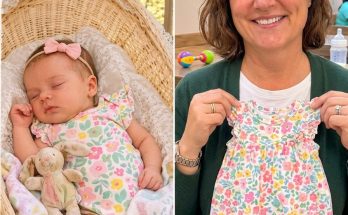
Mama received one photograph of the baby in the gown.
She kept it for years in a locked box.
When I asked to see my daughter, Mama had thought the lie would make me stop asking.
I folded the paper in half.
It had.
It had made me stop asking for fifty-five years.
Ellen was reading her own letter with tears running down her face.
I didn't ask what it said.
Some things belonged to her alone.
Mr. Sutter explained that Mama's will left her personal belongings and modest savings to me, as she'd previously told me.
“There is no inheritance provision for Ms. Mercer,” he said. “Your mother wanted that distinction understood.”
I looked at Ellen.
She seemed relieved.
“I'm not here for money,” she said.
“I didn't think you were.”
The attorney offered us copies of a folder containing several old letters.
The originals, he said, were being preserved with his estate papers until they could be inventoried.
One letter was from Miriam Rountree.
Dated the month after my daughter's birth.
She wrote that the baby was eating well and that she had named her Ellen Rose.
Another letter asked Mama not to contact the family again.
I swallowed.
“What happened between them?”
Mr. Sutter shook his head.
“Your mother never explained it to me.”
We drove back to my house with the copies in a brown folder.
Ellen followed behind me again.
At a stoplight, I watched her car in my mirror.
I thought about all the times I'd seen a mother and grown daughter shopping together.
I had envied them without saying so.
I hadn't known one of them might be mine.
At my front door, Ellen said, “You don't have to invite me inside.”
“Come in,” I said. “We have more work to do.”
On the kitchen table, I spread Mama's letter beside the diner photograph.
I read one line aloud.
I believed you would be better off without the shame.
Then I looked at Ellen.
“I wasn't ashamed of you.”
She began crying again.
“I'm glad you told me.”
I moved Mama's sugar bowl so there would be room for the documents.
For the first time, I let myself imagine a different story of my life.
One where I came home from Louisiana carrying a baby.
One where I wasn't alone in the front pew.
But the people in that story hadn't been given a chance to exist.
I had only the woman across from me now.
And I didn't intend to lose her while chasing the years that were gone.
She had believed the people who said they knew best.
I couldn't blame her for trusting her own mother.
When I returned to the desk, I found a ledger Mama kept for household expenses.
In the years after my trip to Louisiana, there were entries for bus tickets, shoes, and church offerings.
Nothing suggested that she paid a hospital bill for a funeral.
But old household notebooks were not complete records.
I refused to take an absence in one notebook as proof of anything.
I had made too many guesses in my life already.
There was a sheet of yellow paper between the pages.
Mama had written three questions in pencil.
Has Ona forgiven me?
Would Ellen want to know her?
What if they both hate me?
I sat at the desk for a long time.
I couldn't know when those words were written.
I couldn't know whether they had been questions she asked once or every day.
I only knew she had feared the consequences of her choices.
I wanted to shake her.
I wanted to ask why fear had mattered more than letting me hold my own child.
I also wanted to sit beside the frightened old woman who had written those words.
It made me angry that I could feel both things.
The next morning I took a folder to the attorney's office.
The receptionist recognized me from the previous day.
Mr. Sutter came out to speak in the waiting room.
I asked whether I could have a dated inventory of the originals he held.
He agreed to prepare one.
I asked whether Mama had ever instructed him to contact me before her death.
He said she'd considered it, but had not authorized him to disclose her private correspondence while she was alive.
“Did you encourage her to tell me?” I asked.
“I told her that was a conversation no document could replace.”
“Did she say why she wouldn't?”
“She was afraid of losing your care and your love.”
I thought of the root beer floats.
The pills sorted into a weekly box.
The nights I sat up because she couldn't sleep.
“She already had those things,” I said.
Mr. Sutter didn't answer.
I was glad he didn't try to defend her.
Before leaving I requested a copy of her signed instructions so I could understand what papers she'd asked him to deliver.
He said he'd review what he was authorized to provide.
Nothing happened quickly.
I had to learn to let processes take the time they took.
On my way home I bought a fresh legal pad.
I wrote QUESTIONS at the top.
Then I made two columns.
What we know.
What we still need to ask.
It wasn't much.
But the columns kept me from drowning in everything at once.
Click here to continue reading: PART 4: WE SEARCHED FOR THE HOSPITAL RECORDS AND FOUND THAT THE PAPER TRAIL DID NOT MATCH THE STORY
THE WOMAN IN THE BACK PEW WALKED TOWARD ME WHILE MY MOTHER WAITED TO BE BURIED
Part 3 of 12