The drive to Louisiana took longer than it used to.
I had not traveled that road since Aunt Lydia's funeral.
Ellen offered to drive, and I accepted after she promised to stop whenever I needed to stretch my legs.
We packed sandwiches in a cooler.
Paul gave us a paper map even though Ellen's car had a navigation screen.
“Paper doesn't lose a signal,” he said.
Ellen rolled her eyes and put it in the glove compartment anyway.
I brought Mama's letter, copies of the old correspondence, and the address book we'd found in Lydia's box.
The courthouse was our first stop.
Denise met us in the parking lot.
She wore flat shoes and carried a canvas briefcase.
She had already explained that the records we might see were limited.
Some were public administrative materials.
Others were sealed adoption records and would require formal requests.
She did not let us confuse those categories.
Inside the courthouse, a clerk showed us an index of historical civil filings.
We found an entry for the Rountrees' adoption case.
A number.
A date.
A judge's name.
It felt cruel that an event which had taken my daughter away could be reduced to one short line.
But the index mattered.
It told Denise where to direct the next request.
We could not open the sealed case file that afternoon.
I looked at Ellen.
She was disappointed but trying not to show it.
“It's all right,” I told her.
“I know. I just wanted one answer.”
“So did I.”
The librarian at the parish historical collection met us after lunch.
Her name was Mrs. Landry.
She brought out a thin ledger from a donation of papers belonging to a local social-services committee.
The material was not an official medical record.
It listed visits, transfers, and names of people who'd helped arrange temporary care for young mothers.
Mrs. Landry reminded us that old handwriting could be wrong.
I thanked her for the warning.
Near the middle of the ledger was an entry bearing Aunt Lydia's surname.
A few lines below was the name Rountree.
The dates matched the week of my daughter's birth.
Beside one entry were the words infant girl, placement pending.
My knees became weak.
Ellen guided me to a chair.
“Breathe slowly,” she said.
“I am breathing.”
“Not much.”
I gave her a look, and she smiled faintly.
The record showed that a baby had left the hospital with an approved caregiver on a date shortly after I gave birth.
It didn't say I had consented.
It didn't say I hadn't.
But it contradicted the claim that my child had died at the hospital that night.
Denise asked permission to photograph the page and record the collection reference.
Mrs. Landry agreed.
I copied the entry number into my notebook.
I wanted something solid to carry home.
On the drive to the old hospital site, I kept looking at the number.
The building was gone.
A small clinic and a parking lot stood in its place.
I sat in Ellen's car and stared through the windshield.
I had remembered a long hallway and the smell of bleach.
I had remembered a nurse telling me to count backward before the anesthesia.
I didn't remember signing anything.
My memory wasn't proof, and I knew it.
But neither was Mama's claim that everything had been properly arranged.
Ellen asked if I wanted to get out.
“No,” I said. “I don't think the building owes me anything.”
We drove to the diner where Aunt Lydia used to buy lemon pie.
It had a different name now, but the windows faced the same street.
Ellen ordered soup.
I asked for coffee and toast.
Denise had another appointment, so it was just the two of us.
“Tell me about being a teenager,” Ellen said.
I stared at her.
“Why?”
“Because you know things about my childhood now. I want to know yours.”
I told her about being four foot eleven, about the nickname Doll, and about the boy who'd shipped out with the Army.
His name was Danny.
He had promised to write.
He did for a while.
Then his letters grew shorter.
He never knew I had given birth.
I had been too afraid to tell him after Mama said the baby died.
Ellen stirred her soup.
“Do you want to find him?”
I thought carefully.
“I don't know if he's alive. I don't know whether he has a family. We shouldn't turn up on somebody's doorstep without thinking.”
“I'm not asking you to.”
“Good.”
I looked down at my toast.
“I only want you to know he wasn't a cruel boy. He was seventeen too.”
Ellen nodded.
After lunch we stopped at the cemetery where Aunt Lydia was buried.
I hadn't brought flowers.
There was a little weed growing through the gravel near her marker.
I pulled it up.
“I loved you,” I told her. “But you should have told me.”
Ellen stood a short distance away.
She didn't try to make me forgive a woman who had kept silent.
On our way home the road crossed a long stretch of pine woods.
Ellen asked whether she could play music.
I said yes.
She chose old country songs, and we discovered we knew the words to half of them.
At a gas station she bought two peach sodas.
I told her Mama used to make root beer floats every Sunday.
“Did you like them?”
“I made them for her.”
“That's not what I asked.”
I looked at the bottle in my hand.
“Sometimes. Other Sundays I wanted a quiet afternoon instead.”
Ellen nodded.
“You can tell me things like that.”
It felt as though I had been given permission to be imperfect.
For the first time in years, I didn't have to be the good girl who did the next thing.
When we reached Deer Park, Ellen dropped me at the house and waited until I unlocked the door.
Before leaving, she handed me a copy of the ledger photograph.
I placed it beside Mama's confession.
One paper showed what Mama admitted.
The other showed a child being placed with a family.
Between them was an empty place where my own decision should have been.
We had to find out whether that space could ever be filled.
A few weeks later we made another short trip to Louisiana. The motel where we stayed had a small swimming pool covered with leaves.
Ellen and I sat outside our rooms with paper cups of tea.
Paul had called twice to make sure we arrived safely.
She teased him for worrying.
I didn't.
I had once been a young woman in Louisiana with nobody who knew how frightened I was.
It was comforting to hear someone ask whether we'd arrived.
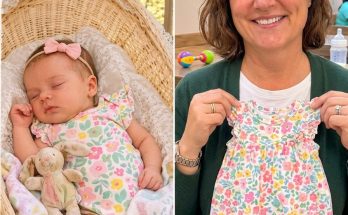
“I've been thinking about the gown,” I told her.
“Would you like to see it when we get home?”
“I think I would.”
She told me how Miriam stored it.
Every year she unfolded the tissue paper, checked for damage, then wrapped it again.
As a child, Ellen thought it was a precious wedding dress for a very small bride.
I laughed at that.
“She told me it was what I wore when I became part of the family,” Ellen said.
“Did you wear it again?”
“No. She said the fabric was too delicate.”
I remembered holding the satin on my belly and wondering whether my baby would be warm enough.
It was spring in Louisiana.
But hospital rooms were cold.
“Your grandmother sewed that,” I said before I could stop myself.
Ellen looked at me.
“Mama,” I corrected. “My mother. I don't know what you'll want to call her.”
“I don't think I knew her well enough to call her Grandmother,” Ellen said gently.
“Fair.”
We watched the leaves move across the water.
Then Ellen asked what Roy had been like when he was young.
I described his old pickup, his work gloves, and the way he'd rescue bugs from the kitchen rather than kill them.
“He sounds patient.”
“He was, mostly. But he could get mad at a leaky faucet like it had insulted his family.”
She laughed.
I told her about the night we learned we might not have children together.
Roy had brought home takeout and suggested we spend our savings on a trip instead of another treatment we couldn't afford.
“We'll make a life,” he'd said. “Whatever shape it has.”
I had loved him for that.
He never knew how much of our grief had been built on an untrue story.
“I wish I could tell him,” I said.
Ellen held her paper cup with both hands.
“Maybe you can still talk to him at the cemetery.”
“I do sometimes.”
“Then tell him.”
I leaned back in the plastic chair.
“I will.”
The motel clerk came out to empty a trash bin.
He wished us a good night.
We went inside and agreed to meet for breakfast at seven.
At six forty-five, Ellen knocked on my door carrying two cups of coffee.
“I didn't know how you like it,” she said.
“Plain is fine.”
She had brought cream on the side.
I thought about all the years I had spent wondering what kind of coffee my grown daughter might drink, then stopping myself because I believed she was dead.
Now she was standing at a motel doorway holding a cup for me.
I took it.
“Thank you,” I said.
The coffee was terrible.
We drank it anyway.
And we drove to the courthouse together, without expecting more than one small answer at a time.
Before leaving the motel, Ellen found a postcard in the lobby showing the old courthouse square.
She bought it for me.
I told her it was a foolish thing to spend money on when we were already visiting the place.
“It's fifty cents,” she said. “Humor me.”
I put it beside the ledger copy.
At breakfast we made a rule about the trip.
If one of us felt overwhelmed, we'd say so.
We would stop asking questions until that person was ready.
Ellen tested the rule by admitting she didn't want to visit the former hospital site again.
I told her that was fine.
I hadn't enjoyed it either.
The waitress brought us toast with a little cup of grape jelly.
I handed Ellen the last packet without thinking.
She asked how I'd known she liked grape.
“I didn't,” I said.
She grinned.
“Then you guessed right.”
We laughed over something so small, and it took the sharpness out of the morning.
I knew we couldn't control what the records said.
But we could control how we treated each other while looking for them.
Click here to continue reading: PART 7: MY DAUGHTER INVITED ME TO DINNER, AND I MET THE FAMILY I HAD NEVER KNOWN I HAD
THE WOMAN IN THE BACK PEW WALKED TOWARD ME WHILE MY MOTHER WAITED TO BE BURIED
Part 6 of 12