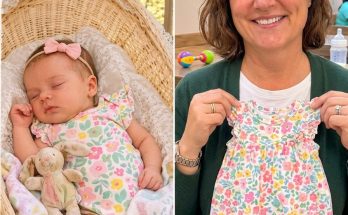
The testing center called on a rainy Thursday.
The report was ready.
Ellen said she wanted us to open it together.
I agreed.
She came over after lunch, her hair damp from the weather.
We sat at Mama's kitchen table.
I had cleaned it twice even though it was already clean.
The laboratory report used words I couldn't have explained without help.
But its conclusion was plain.
The results supported a biological mother-daughter relationship between us with extremely high probability.
Ellen covered her mouth.
I touched her wrist.
Neither of us spoke for a long time.
A picture, a gown, a date, and a family resemblance had led us here.
Now a test had confirmed what we'd hoped and feared.
“My daughter,” I said.
Ellen began to cry.
I stood and went around the table.
She put her arms around my waist.
I held her while the rain tapped on the kitchen window.
I wasn't holding an infant in a satin gown.
I was holding a grown woman with a husband, children, and a history of her own.
That mattered more than the picture I'd carried in my head.
When we sat down again, Ellen asked me whether I was going to tell people.
“Yes,” I said. “But carefully.”
I wanted to tell June first.
Then the pastor.
I didn't want the whole town treating Ellen like a spectacle.
Ellen agreed.
She also wanted time to explain the result to her children.
We called June that afternoon.
She cried so hard she had to hand the phone to her husband.
When she came back she said, “Doll, I wish we'd asked your mother the questions we were afraid of.”
“So do I.”
I told her she didn't have to apologize for what she didn't know.
But I asked her to help me find any remaining documents from Aunt Lydia.
She promised.
The pastor came to my house the next evening.
He sat across from me with his hands folded.
I told him I wanted the little stone removed from the memorial garden.
He asked whether I was certain.
“I buried a child there in my mind. But my child is alive.”
“We can discuss it with the church trustees,” he said. “The stone belongs to the memorial garden record. We should handle it respectfully.”
I appreciated that he didn't offer to pull it up that afternoon.
He asked whether I wanted a small service before it was removed.
“Maybe,” I said. “Not a funeral. Something else.”
We made no decision that night.
On Saturday I took Ellen to the chicken plant where I'd worked for thirty years.
The building had changed owners, but the fence was still the same.
I showed her the bus stop where Roy used to wait for me in his truck during bad weather.
I told her about the women I worked beside.
Some were still alive.
Others had died or moved away.
There had been years when I took overtime because the house needed repairs.
Years when Roy's back hurt and I brought home the larger paycheck.
Years when I used my lunch break to call Mama and make sure she had eaten.
Ellen listened.
“Were you happy here?”
“Not every day. But I was proud of supporting myself.”
She nodded.
“I understand that.”
I asked about her work.
She'd spent most of her career in a public library.
She loved helping children find books.
She had retired the year before.
I smiled.
“A library.”
“What?”
“I used to read to you before you were born.”
Her eyes widened.
“What did you read?”
“Whatever Aunt Lydia had in her house. Recipes. Newspaper stories. A manual for her washing machine.”
Ellen laughed.
“No wonder I enjoy instructions.”
We went to lunch at a small cafe near the plant.
I ordered chicken salad.
Ellen ordered soup and half a sandwich.
We traded bites, arguing lightly over which was better.
Then she asked about the boy who was her biological father.
I told her what I remembered of Danny.
His full name.
The town where his family had lived.
The way he whistled when he was nervous.
“I don't need you to find him for me,” she said.
“You have a right to know whatever can be found.”
“I want to think about it first.”
“Take your time.”
I knew how it felt to have other people decide what you should want.
I wasn't going to do that to her.
The next week Denise told us the court file review had produced an old copy of an adoption consent form.
She could not immediately share sealed materials beyond what the court permitted, and additional steps were needed before we could examine them together.
She warned us again that paperwork from decades ago required context.
Then she told me something I had dreaded hearing.
The document appeared to contain a signature under my name.
“Could it be mine?” I asked.
“We don't know,” Denise said. “I wouldn't ask you to make that judgment over a telephone.”
I looked at the floor.
I had been sedated.
I remembered waking to Mama beside the bed.
I remembered nothing about a consent form.
If there had been one, I needed to know when it was signed and who had witnessed it.
Ellen sat with me that evening while we made a list of questions for Denise.
We did not try to settle them by guessing.
I showed Ellen a photograph of Roy in his work boots.
She asked whether he had liked children.
“He always wanted them,” I said. “He would have adored Lucy.”
She touched the edge of the photograph.
“I think I would have liked him.”
I smiled through tears.
“You probably would.”
Before leaving, Ellen picked up Mama's blue sugar bowl.
“Do you want this put away?”
I thought about all the Sundays Mama had sat here.
I thought about the letters she had never mailed.
“No,” I said. “Leave it.”
I wasn't ready to erase her.
I also wasn't going to pretend she hadn't hurt us.
The bowl could stay until I knew what to do with it.
The next morning I went to work.
A customer complained that the coffee tasted burned.
I made a fresh pot.
Another asked where the batteries were kept.
I showed him the shelf.
My life had changed.
The world still expected me to make change and stock napkins.
I found that strangely comforting.
The laboratory had mailed us a longer explanation of the result.
I kept it with the certificate in a new folder.
Ellen showed me how to scan the papers using my phone.
I asked her to do it twice so I could learn.
“Press this,” she said.
I pressed the wrong thing.
The camera took a picture of my shoe.
She laughed.
“Your shoe isn't part of the test.”
“Maybe it's trying to tell me something.”
We started again.
By the third attempt I had a readable copy.
I sent it to myself by email.
Then I printed it at the library because I trusted paper I could hold.
While we were there, Ellen walked among the shelves with a look I recognized.
Roy used to get that same look in hardware stores.
He could spend an hour studying screws he didn't need.
Ellen stopped at a display of children's books.
She told me she had worked in a branch with a small reading room and a mural of a tree.
Every Thursday she read stories to preschoolers.
Some children loved the books.
Others wanted to crawl beneath the chairs.
“I loved them all,” she said.
I watched her turn the pages of a picture book.
“I used to imagine my daughter might become a teacher,” I said.
“I tried student teaching once. It wasn't for me.”
“What happened?”
“I couldn't manage twenty-nine third graders at the same time.”
I laughed.
“Could anybody?”
“My friend Sharon could. She was wonderful.”
We took two books home on my library card.
Ellen suggested we read the same one and talk about it over lunch.
I thought that sounded like something sisters might do.
Then I remembered we were mother and daughter.
We could make our own habits.
The following week I read the first few chapters during my breaks at work.
Luis asked why I was smiling at a book beside the cash drawer.
I told him I had a reading partner.
He nodded as though that were an ordinary thing.
It was.
The ordinary things kept surprising me.
One afternoon Ellen called to say she'd had a disagreement with Hannah.
It was about a family holiday schedule, nothing to do with me.
She sounded tired.
I nearly offered advice.
Then I stopped.
“Do you want advice or just someone to listen?” I asked.
“Just listen.”
So I did.
She explained how she and Hannah had misread each other's messages.
I didn't tell her whose side to take.
When she finished, she sighed.
“Thanks, Doll.”
“I didn't do anything.”
“You listened.”
I thought about the years when I had needed someone to do exactly that.
I was learning how much a family could change when people asked before they answered.
The next time I needed to complain about work, I called her.
She listened too.
We didn't solve everything.
We no longer had to.
The week after our library visit, I tried reading to Lucy over a video call.
The picture froze twice.
My reading glasses kept slipping down my nose.
Lucy corrected my pronunciation of the dragon's name.
I told her the dragon could choose an easier name next time.
She laughed and made me start the page over.
Hannah stayed nearby, folding laundry.
When Lucy wandered off for a snack, Hannah thanked me.
“For what?”
“She looks forward to seeing you.”
“I look forward to seeing her.”
Hannah smiled.
I didn't want to turn the moment into a speech about lost years.
I asked instead how her work was going.
She told me about a difficult costume she was sewing for a community play.
I offered to show her a trick Mama had taught me for turning narrow fabric straps.
Then I stopped, surprised by myself.
Some of Mama's lessons were useful.
I could pass them along without passing along her silence.
Hannah said she'd bring the fabric when we met next Sunday.
I wrote it on the calendar so I wouldn't forget.
Click here to continue reading: PART 9: THE SIGNATURE ON THE ADOPTION FORM FORCED US TO FACE WHAT A HOSPITAL RECORD COULD NOT PROVE
THE WOMAN IN THE BACK PEW WALKED TOWARD ME WHILE MY MOTHER WAITED TO BE BURIED
Part 8 of 12