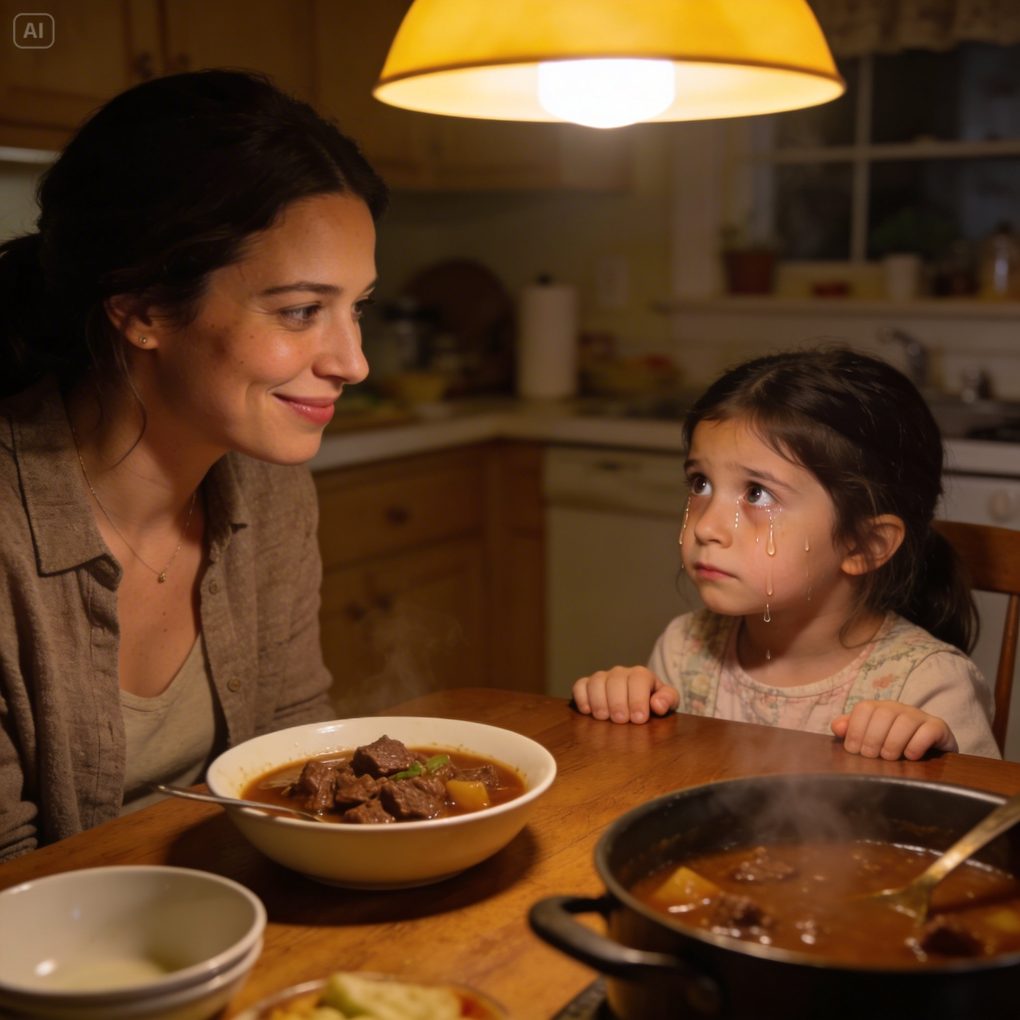
I sat with her while she took tiny bites, pausing between each one like she was waiting for someone to shout “Stop.” I kept my voice calm and steady, talking about silly things—how carrots make you see in the dark, how the stew was “superhero soup,” anything to make eating feel normal instead of dangerous.
After dinner, when she was calmer, I brought out crayons and paper and asked casually, “Do you have rules at home about food?”
Maisie nodded slowly. “Mom has ‘good days’ and ‘bad days,’” she whispered.
“What makes a day bad?” I asked gently.
Her eyes dropped. “If I cry,” she said. “If I ask too many questions. If I wake up at night.” She swallowed hard. “If I talk when Mom’s boyfriend is tired.”
Mom’s boyfriend.
I kept my face still, but my stomach twisted. “What’s his name?”
Maisie hesitated. “Kyle,” she whispered. “He says I’m ‘spoiled.’”
I thought of Jenna’s texts about being “stressed lately,” about Kyle “helping with discipline,” about how Maisie was “too sensitive.” I’d brushed it off as adult venting.
Now it sounded like a warning I’d ignored.
I waited until Maisie was in the bath—safe, playing with foam letters—then I stepped into the hallway and called my sister. She didn’t pick up. I tried again. Straight to voicemail.
I texted: Maisie asked if she was allowed to eat. What is going on?
No reply.
My hands shook as I called the pediatric after-hours nurse line first, because I wanted guidance and documentation. The nurse’s tone changed immediately when I described “withholding food as punishment.” She told me to bring Maisie in for an exam the next day and to consider contacting child protective services if I believed there was ongoing neglect.
I didn’t want to believe it. My sister was my sister. She loved her child.
But love doesn’t cancel harm.
That night, Maisie refused to sleep alone. She curled up on my couch clutching a stuffed rabbit, eyes darting every time the house made a sound.
“Auntie,” she whispered, “when Mom comes back… will I have to be hungry again?”
My throat burned. “I’m going to make sure you don’t,” I said, and I meant it.
Because at this point, staying quiet wasn’t “keeping peace.”
It was helping a child stay trapped.
Part 3 (≈445 words)
The next morning, I took Maisie to a pediatric urgent care clinic. I kept it simple for her: “We’re going to see a nice doctor who makes sure kids are healthy.” She nodded too quickly, like she’d learned agreement keeps adults calm.
The doctor, Dr. Priya Shah, examined Maisie gently—height, weight, bruising check, general wellness. Maisie’s weight was slightly low for her age, and Dr. Shah asked careful questions: “Do you ever feel hungry at home?” “Do you always have breakfast?” “What happens if you spill something?”
Maisie answered in small, honest pieces. “Sometimes there’s no dinner.” “Sometimes Mom says I have to ‘learn.’” “Kyle says food is for good kids.”
Dr. Shah’s expression stayed calm, but her voice turned firm when she stepped out to speak with me privately. “Withholding food as punishment is neglect,” she said. “I’m a mandated reporter. I have to file a report, and I’m glad you brought her.”
My heart pounded. Part of me wanted to cry with relief—someone else was saying it out loud. Part of me wanted to throw up.
A social worker met us before we left. She explained next steps: a safety assessment, interviews, possibly an emergency plan for Maisie to remain with family temporarily while they investigated. She emphasized something that hit me hard: “Kids often think hunger is their fault. They learn to apologize for basic needs.”
That afternoon, Jenna finally called me back—voice sharp, defensive. “Why is Maisie at a doctor? What are you doing?”
I kept my tone steady. “She asked me if she was allowed to eat,” I said. “She cried when I said yes. Jenna… that is not normal.”
There was a pause—too long.
Then Jenna snapped, “She’s dramatic.”
I felt my hands go cold. “No,” I said quietly. “She’s hungry and scared.”
Jenna’s voice rose. “Kyle is trying to help! You always judge me—”
“Stop,” I said, more firmly. “This isn’t about you being judged. This is about your daughter learning that food is conditional.”
Silence. Then Jenna’s voice dropped, smaller. “I’m tired,” she whispered. “I didn’t think it was that bad.”
I didn’t soften. “It is that bad,” I replied. “And it stops now.”
That night, Maisie ate a full dinner and asked for seconds with a shy smile, like she was testing whether love would disappear when she wanted more. When I said, “Of course,” she didn’t cry this time.
She sighed.
Like her body was finally unclenching.
If you’re reading this, I’ll ask you gently: if a child ever asks, “Am I allowed to eat?” or seems afraid of basic needs, would you trust that as a serious sign and seek help—even if it means upsetting family? Share what you think. Sometimes the bravest thing an adult can do is believe the quiet question that a child is too scared to ask twice.