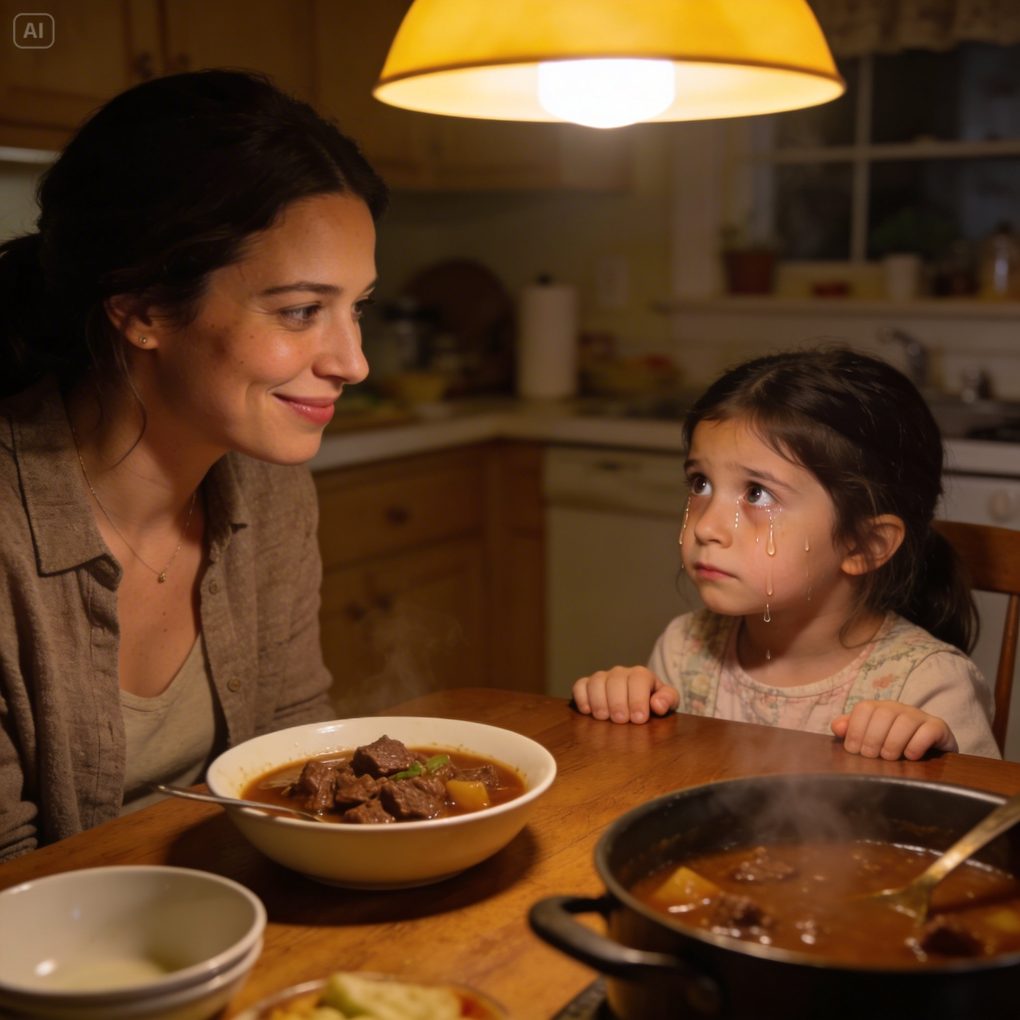
My sister went on a business trip, so I took care of my five-year-old niece for a few days. I made beef stew for dinner, but she only stared at it. When I asked, “Why aren’t you eating?” she whispered, “Am I allowed to eat today?” I smiled and said, “Of course you are.” The moment she heard that, she burst into tears.
My sister Jenna went on a business trip, so I took care of my five-year-old niece Maisie for a few days. It was supposed to be simple—cartoons in the morning, playground after lunch, bedtime stories at night. Jenna had packed Maisie’s suitcase with perfect little outfits, labeled snack bags, and a list of “easy dinners” written in neat handwriting like she was trying to make sure nothing could go wrong.
Maisie was quiet when Jenna left. Not clingy, not crying—just quiet, watching the door close like she was memorizing what it felt like to be left behind.
I tried to make the first day fun. We built a blanket fort. We painted messy watercolors. She laughed once, a small bright sound, then immediately looked around like she’d laughed too loudly.
That night, I made beef stew—real comfort food with carrots and potatoes and soft bread on the side. The smell filled the kitchen. I set the bowl in front of her with a spoon and a napkin, expecting her to dig in like any hungry kid.
Maisie didn’t move.
She stared at the stew like it was a test.
“Hey,” I said gently, sitting across from her. “Why aren’t you eating?”
Her fingers tightened around the edge of the table. She glanced at the clock on the microwave, then at me, then down at her lap. Her voice came out so small I barely heard it.
“Am I allowed to eat today?”
For a second I thought I’d misheard. “Allowed?” I repeated softly.
Maisie nodded once without looking up. Her mouth trembled like she was trying hard not to cry.
My stomach went cold.
I forced a smile because five-year-olds read faces like weather. “Of course you are,” I said, keeping my voice warm. “You never need permission to eat when you’re hungry. Food is not something you have to earn.”
The moment she heard that, Maisie’s face crumpled.
She burst into tears—deep, shaking sobs that seemed too big for her little body, like she’d been holding them back for a long time. She didn’t even wipe her face. She just cried over the bowl like the answer had broken something open.
I moved to her side and wrapped my arms around her carefully. “Maisie… sweetheart,” I whispered, “what’s going on?”
She clung to my shirt with both hands and sobbed, “I was good today. I didn’t make noise. I didn’t spill. I—”
“You don’t have to be perfect,” I whispered, heart pounding.
Maisie shook her head, tears soaking my sleeve. “Mom says… if I’m bad, I don’t get dinner,” she cried. “Sometimes it’s… sometimes it’s a whole day.”
My blood ran cold.
Because this wasn’t picky eating.
This was fear of hunger as punishment.
I didn’t ask a hundred questions right away. I wanted to. Every protective instinct in me was screaming to dig for details, to call Jenna and confront her, to do something loud and immediate.
But Maisie was shaking so hard she could barely breathe. So I did the first, most important thing: I made her feel safe in that moment.
“Look at me,” I said softly, tilting her chin up. “You are allowed to eat. Every day. No matter what. And you are safe here.”
Maisie sniffed, wiped her nose with her sleeve, and whispered, “Will you get mad?”
“No,” I promised. “Never for being hungry.”
 Part3: My sister went on a business trip, so I took care of my five-year-old niece for a few days. I made beef stew for dinner, but she only stared at it. When I asked, “Why aren’t you eating?” she whispered, “Am I allowed to eat today?” I smiled and said, “Of course you are.” The moment she heard that, she burst into tears.