Just people who understood, in the marrow of their experience, what it meant to be where I was.
Ruth had given me shelter. But Ruth’s life was small and quiet in ways that over time began to feel like a kind of soft pressure. She worried about me constantly. She asked how I was sleeping too many times a day. Her care was real, but it was also quietly one more form of being managed.
It was Clare who mentioned, almost offhandedly, that there was a support group that met on Wednesday evenings in Hartford. Women over 60, navigating major life transitions, often including late-life divorce. She said she had mentioned it to other clients. She said nothing more about it.
I went the following Wednesday.
There were eleven women in the group. They ranged in age from 62 to 81. They met in the community room of a library branch near downtown Hartford, folding chairs arranged in a rough circle, a table with a coffee urn and a box of cookies that was always the same brand, a facilitator named Donna who was a retired social worker with a quiet authority that I found immediately reassuring.
I was not accustomed to speaking about my life in a group.
But I listened first.
And what I heard was a kind of testimony.
Women who had been dismissed and surprised and diminished, who had rebuilt not through some cinematic surge of strength, but through the slow, often boring work of continuing to show up for themselves. A woman named Bev, who was 73, had left an abusive marriage at 68 and now ran a small dog-grooming business. A woman named Harriet, 79, was fighting her late husband’s family over an estate they had tried to exclude her from entirely.
After the third meeting, Bev walked out with me to the parking lot and said, “You’ve got that look.”
“What look?” I asked.
“The one where you’re still in the thick of it, but you’ve already decided you’re going to come out the other side,” she said. “I recognize it. I had it.”
I drove back to Ruth’s house that night and sat in the dark car for a few minutes before going in.
Had I already decided?
Yes, I supposed I had.
And knowing it was written on my face somehow made it more real, like a promise I had made not just to myself, but to the version of myself those women in that circle could already see.
I was not alone.
That was the thing I had forgotten.
I was not alone.
They came on a Sunday in May, Patricia and Douglas together, which told me they had coordinated carefully. They called ahead this time, a courtesy that felt, under the circumstances, more like a warning than a kindness. Ruth offered to stay in the house, but I asked her to take her walk as planned.
This was mine to handle.
We sat in Ruth’s small living room. Patricia brought flowers, yellow tulips, which struck me as a strange choice, cheerful in a way that felt performative. Douglas sat with his arms crossed in the way he had since adolescence, physical armor he was never fully aware of. I made tea. I set out cups. I performed the rituals of hospitality because they steadied me.
Patricia spoke first.
“Mom, we’ve been talking a lot as a family, and we want you to know that whatever happens legally, we love you, and we want to find a way through this together.”
I let the sentence settle.
“That’s kind,” I said.
“Dad is willing to speak with you directly,” Douglas said, without attorneys. “He thinks you could reach an agreement that works for everyone if you were willing to talk to him.”
Ah.
There it was.
Harold, unable to come himself, perhaps on legal advice, perhaps simply unwilling to face me, had sent the children to arrange a private negotiation outside the formal proceedings.
Anything agreed in such a meeting would exist in a gray zone, pressure applied without witnesses, and would likely be framed afterward however Harold chose to frame it.
“Dad’s attorneys made me an offer through my attorney last month,” I said. “I declined it through proper channels. If he has a new offer, that’s the appropriate route.”
“Mom…” Patricia’s voice shifted, shading into something I recognized, the tone she used to manage disagreements in her professional life, level and just slightly condescending. “This level of conflict isn’t good for anyone. Dad is 78. The stress of prolonged litigation.”
“Patricia,” I said, “your father was not concerned about stress when he spent eighteen months restructuring our finances before he filed for divorce.”
She paused.
“He says that’s not accurate.”
“There are emails,” I said, “dated and authenticated.”
Something flickered in Douglas’s expression. A brief break in the performance that told me he hadn’t known about the emails, or hadn’t known they were that specific. He glanced at Patricia. Patricia looked at her tulips.
“We’re asking you to consider the family,” Douglas said, and his voice was different now, less managed, more raw. “Susan’s kids ask about you. The grandchildren don’t understand what’s happening.”
That one landed. He knew it would. I felt it in my chest the way you feel the cold through a windowpane. Present. Real. Not to be underestimated.
I missed my grandchildren with a physical constancy that I had not fully admitted to myself.
“Douglas,” I said, keeping my voice very steady, “if your father wanted me to have a relationship with my grandchildren, he would not have said in open court that I would never see them again. He made that choice, not me.”
“He said that out of anger,” Patricia said quickly.
“He said it while smiling,” I said.
No answer to that.
“I love you both,” I said. “I want you in my life. But I am not going to drop a legally valid fraud claim because it makes family gatherings easier. That is not a choice I am willing to make.”
They stayed another forty minutes. They cycled back through the same appeals — the grandchildren, Harold’s age, the cost and exhaustion of litigation, the idea that I might be being influenced by attorneys who had a financial interest in prolonging the case.
That last one was clever. It was designed to make me doubt Clare, to introduce a wedge between me and the one professional who was genuinely on my side. I noted it without showing that I’d noted it.
When they left, Patricia hugged me in the doorway again, the same stiff embrace as before. Douglas kissed my cheek. Neither of them looked me in the eye on the way out.
I watched their car until it disappeared.
Then I went inside and sat down in Ruth’s armchair and let myself feel what was underneath all the steadiness I had performed for the last two hours.
It was fear.
A real, sizable fear.
Not of Harold.
Not of the lawsuit.
But of the possibility that I would win everything legally and lose my children in the process. That the price of being right would be a silence where my family used to be.
I sat with that fear for a long time.
And then something happened that I had experienced before in difficult years.
The fear began to change into something else.
It hardened, the way candied sugar hardens when the temperature drops, into a clarity that was almost uncomfortable in its precision. I had not created this situation. I had not deceived anyone, restructured any assets, or recruited my children to deliver strategic messages. I had been acted upon.
And I had chosen to respond.
The fear was real.
But so was everything else.
I picked up my phone and called Bev from the support group. She answered on the second ring, and I told her what had happened. She listened without interrupting.
“Good,” she said when I finished. “You held.”
“I held,” I said.
“That’s all it takes,” she said. “Every single time.”
September arrived slowly and then all at once, the way important things do. Clare and I had spent the preceding months building our case with a thoroughness that I found, unexpectedly, to be its own kind of comfort. Discovery had yielded more than the January emails. It had produced bank transfer records, LLC operating agreement amendments, and communications between Harold and Karen Whitfield that left very little ambiguous.
Karen had been involved in advising Harold on the property restructuring from the beginning. She was a real estate consultant, and her fingerprints, professionally speaking, were on the valuation strategy that had been used to minimize the house’s accessible marital value.
Clare had engaged a forensic accountant, a quiet, meticulous man named Dr. Richard Cole, who had prepared a 40-page analysis of Harold’s financial activities over the thirty months preceding the divorce filing. The picture it painted was detailed and damning — a systematic, deliberate effort to remove the primary marital asset from the estate before the divorce was filed, undertaken with full knowledge of the legal consequences and with the assistance of professionals who should have advised otherwise.
I had read every page of Dr. Cole’s report. I had asked Clare to explain the sections I didn’t follow.
I walked into that September hearing knowing the case better than I had known almost anything in the preceding two years.
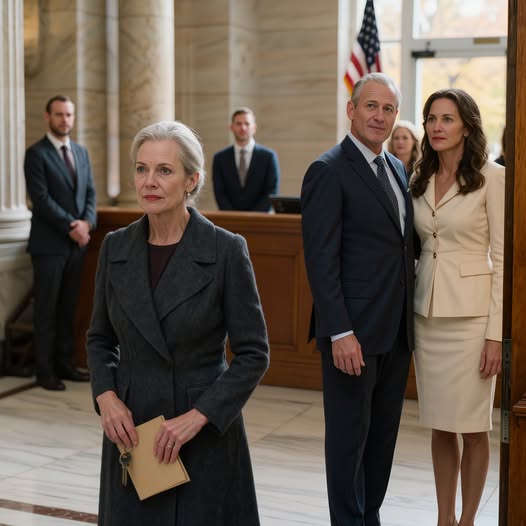
The courthouse was the same one where the original hearing had been held. I wore the charcoal wool coat again. It was too warm for September, but I wore it anyway. Some decisions aren’t about weather.
Harold arrived with Franklin Tate and a younger attorney I hadn’t seen before, a woman, which I suspected was a strategic choice designed to soften the optics of what was essentially a case of an elderly man defrauding his elderly wife. He looked older than he had in March. The thinness had progressed. He walked more carefully. He glanced at me when he entered.
This time, he did not look away immediately.
His expression was controlled, but underneath the control was something I recognized, the calculation of a man who had realized, perhaps recently, that the outcome was no longer certain.
The hearing lasted four hours.
Clare presented the evidence methodically. The timeline. The emails. Dr. Cole’s financial analysis. The LLC formation documents. The parallel communications with Karen Whitfield. Each exhibit was entered calmly, explained clearly, connected to the next.
I sat and watched and thought about how different this was from the original proceeding, where Gerald Marsh had done his earnest, insufficient best and Harold’s team had run the table.
Franklin Tate’s defense was that Harold had formed the LLC for legitimate estate planning purposes unrelated to the divorce and that the January emails were being taken out of context. He produced a letter from an estate planning attorney, not Harold’s divorce attorney, suggesting that the restructuring had been recommended for tax purposes.
The judge, the Honorable Andrea Marsh, no relation to Gerald, had been reading as the testimony proceeded. She was in her mid-50s, methodical in the way that bench veterans often are, and she asked questions with the precision of someone who had already identified the relevant inconsistencies.
She asked Franklin Tate, “If the LLC had been formed for estate-planning purposes, why had Harold’s communications about it focused on ensuring the property was outside the marital estate prior to filing?”
Tate answered that this was a misreading of the communication.
The judge asked him to clarify what reading he believed was correct.
Tate explained.
The judge asked a follow-up.
Tate answered.
The judge’s questions became more specific, narrowing toward a corner that Tate was visibly struggling to find a way out of.
And then Harold did something I had not anticipated.
He leaned over and interrupted his own attorney mid-sentence.
It was quiet enough that I might not have caught it from across the room, except the courtroom had gone very still.
“Tell her it was mine,” Harold said, not quietly enough. “I built that house. I paid for it. It was mine.”
The judge heard it.
She looked at Harold directly.
“Mr. Caldwell,” she said, “your attorney is addressing the court.”
Harold straightened. Tate touched his arm, a brief urgent gesture. Harold shook it off with a small, sharp movement. The younger attorney leaned in and whispered something. Harold shook his head.
Judge Marsh watched all of this with an expression that revealed nothing and recorded everything.
“Continue, Mr. Tate,” she said.
Tate continued, but the rhythm had been broken. He stumbled twice in the following ten minutes, misreferencing an exhibit number, then catching himself, then referring to an argument he had already made as if it were new. Harold sat beside him with his hands flat on the table, jaw set, and I could see from thirty feet away that he was furious.
Not at the proceedings.
At the recognition that they were not going the way he had expected them to go.
I did not look away.
When Clare gave her closing argument, she was measured and clean and left nothing out. She cited the law, the evidence, the specific harm, and the remedy she was seeking: vacatur of the original settlement and a new division of marital assets that reflected what had actually existed.
I sat with my hands folded in my lap the same way I had sat at the original hearing, but I was not the same woman.
After the session adjourned, Judge Marsh announced she would issue her written ruling within thirty days.
Clare walked me out. Neither of us spoke until we were on the sidewalk.
“He handed it to us,” she said.
“He always thought he was the only one paying attention,” I said.
She looked at me for a moment.
“He was wrong about that.”
“Yes,” I said. “He was.”
The ruling came in twenty-two days.
It was a Thursday, and I was at Ruth’s kitchen table drinking coffee when Clare called. She had received the written opinion from the court at 8:30 in the morning and had read it through twice before calling me at nine.
I will tell you what she told me in the order she told it.
She told me Judge Andrea Marsh had found, by clear and convincing evidence, that Harold Caldwell had engaged in fraudulent conveyance of marital property prior to the divorce filing with intent to deprive Margaret Caldwell of her equitable share of the marital estate.
The formation of Birwood Holdings LLC was found to have been undertaken in bad faith, with full knowledge of its impact on the divorce proceedings. The January emails were cited extensively in the opinion.
The original settlement was vacated.
The house on Birwood Lane and all assets held within Birwood Holdings LLC were ordered returned to the marital estate for proper equitable distribution.
Based on Connecticut’s equitable distribution standards, Harold was ordered to pay Margaret sixty percent of the total marital estate, a figure which, after accounting for all assets, came to approximately $3.1 million, including the house or its equivalent cash value if it were to be sold.
Franklin Tate was referred to the Connecticut Bar’s disciplinary committee for review in connection with his role in the original asset-transfer strategy.
Karen Whitfield was named as a knowing participant in the fraudulent conveyance scheme and was ordered to provide an accounting of all professional services she had rendered to Harold during the period in question. A separate civil claim against her was possible, Clare noted, if I chose to pursue it.
I sat at Ruth’s kitchen table with the phone to my ear and looked out the window at the field behind her house where the light was coming through the trees at the angle it only does in early autumn.
“Margaret,” Clare said, “did you hear all of that?”
“Yes,” I said. “I heard every word.”
I thanked her. I told her she had been extraordinary. She said the evidence had been extraordinary and that my own preparation had made her job considerably easier. We agreed to speak again the following day to discuss implementation steps.
I set the phone down.
Ruth was in the doorway.
She had heard enough.
I stood up and she crossed the kitchen and we held each other the way sisters do. Not elegantly.
Just completely.
And I felt, for the first time in what seemed like a very long time, the specific relief of a burden that has been set down after being carried for so long you had stopped noticing its weight.
We didn’t speak for a long moment. There was nothing that needed saying that the silence couldn’t hold better.
Ruth finally pulled back and looked at me. Really looked, the way she had been doing since we were girls, and her eyes were bright and her chin was steady and she said very quietly:
“Mom would have been proud of you.”
I had to look away after that, not because it hurt, but because it was too large to receive all at once.
I went to the window and stood there for a while, watching the field. The goldenrod was still out, late for September, bending slightly in the wind. The maple at the edge of the property had just begun to turn. I thought about the maple on Birwood Lane, the one Harold had planted the year Douglas was born, whether anyone would notice when it peaked this year, whether anyone in that house would think to look.
And then I let the thought go.
Some things you release not because they stop mattering, but because holding them no longer serves you.
I made us both a fresh cup of coffee. We sat back down at the table. Ruth put her hand over mine and left it there, and we watched the light move across the field for a long time without saying anything at all.
That was a Thursday.
On the following Monday at 9:47 in the morning, my phone rang with a number I did not recognize.
A 203 area code.
Connecticut.
I answered.
The man on the line identified himself as a physician at Bridgeport Hospital. He spoke carefully, in the way hospitals train people to deliver news. Harold had been found at the house on Birwood Lane by a neighbor who had seen the front door standing open for two days. He had suffered a massive cardiac event. He had been transported, but there had been nothing to be done. He was 78 years old. He had died on Saturday morning, the day after the ruling was received by his attorneys.
Karen Whitfield had not been there.
Douglas had told the hospital that she had left for a trip to the Berkshires the previous week and had not responded to messages.
I stood in Ruth’s hallway with the phone in my hand after the call ended and stood very still for a long time.
What do you feel when the man who wronged you dies?
I have thought about this question many times since.
The answer is not simple, and I am not going to make it simple for the purposes of this story.
I felt grief. Real, complicated grief for the man he had been before he became the man he was at the end. I felt the particular hollowness of anger that has no longer any object to act upon. I felt, underneath both of those things, a sober recognition that the ruling stood.
Harold’s estate was now subject to the same legal obligations he had been. His death did not erase the judgment. It complicated the implementation, but Clare had assured me in a follow-up call that afternoon that the estate proceedings would honor the court’s order.
I went back to Ruth’s kitchen table. I poured a fresh cup of coffee. I sat with all of it, the grief, the relief, the strangeness, and did not try to resolve it into something neater than it was.
Some things cannot be made neat.
That doesn’t mean they cannot be survived.
The estate proceedings took eleven months. Harold’s death had not simplified things. It rarely does. But it had not undermined them either. His estate was administered by an executive appointed by the probate court, and the executive was legally obligated to honor the judgment against the estate.
Birwood Lane was listed for sale in the spring.
It sold in June.
Four point seven million dollars.
Twenty thousand above the initial ask.
And from the proceeds, my court-ordered share was transferred to my account: $3,100,000.
After eleven months of estate proceedings and legal fees and the kind of patience that you discover you are capable of only when there is no alternative to being capable of it, I was 77 years old.
I had, once again, a future.
I did not stay in Connecticut. I had made that decision somewhere in the long months of waiting, quietly, without drama. The house was sold. Harold was buried in the cemetery where his parents were buried. And I attended the graveside service briefly and at a distance, because fifty-two years required some acknowledgement, and I am not a woman who refuses acknowledgement.
I stood at the edge and said goodbye to the man I had married, which was not the same man who had died.
And then I got in my car and drove away.
I moved to Sarasota, Florida.
I had visited once years before and remembered the quality of the light, the way it came off the Gulf of Mexico in the evenings, less sharp than New England light, more generous. I rented a one-bedroom apartment in a building near the waterfront while I figured out what I wanted to own. I walked every morning along the bay. I found a library branch where I became a regular. I found a church with a small choir that needed an alto, and I joined it, though I had not sung regularly since my forties.
I found Donna, the support-group facilitator, had a colleague in Sarasota who ran a similar group. I became, in time, a member of that circle too and then eventually a volunteer, sitting with women who were in the early terrible stages of what I had been through, listening the way Bev had listened to me.
I made a friend named Louisa, 74, a retired pediatrician originally from Georgia, with a laugh that came from deep and arrived unexpectedly like weather. We walked together three mornings a week and went to the farmers market on Saturdays and argued about books with the cheerful viciousness of people who take literature seriously.
It was ordinary.
It was sustaining.
It was enough.
My children and I found a cautious middle ground. Not the warmth I had hoped for. Not the estrangement I had feared. But something workable and honest. Douglas called once a month. Patricia and I exchanged emails. Susan, who had stayed furthest from all of it, eventually called to apologize. Not for anything specific, which was its own kind of statement, but an apology nonetheless.
I accepted it.
The grandchildren began to reappear gradually. A video call here. A visit there. Tentative on all sides.
I did not press.
I let it come at whatever pace it came.
As for Karen Whitfield, the civil claim against her for her role in the fraudulent conveyance proceeded. She had retained her own attorneys and contested vigorously, but the court ordered her to return the professional fees Harold had paid her during the period in question, plus damages, a total of $340,000. She was also censured by the Connecticut Real Estate Licensing Board and placed on probation. I was told her consulting practice had lost several major clients after the case became known in professional circles.
She had expected to inherit, or at least to benefit substantially from Harold’s estate.
She received nothing.
Harold’s will had been drafted before he died. Karen was named. But the will could not supersede the court judgment, which was a senior claim on the estate. By the time the judgment and legal fees and estate costs were settled, the residual estate was modest. Karen hired attorneys to challenge this.
She lost.
I did not feel satisfaction exactly when I heard this. What I felt was something more neutral. The recognition that outcomes eventually tend to reflect the choices that produce them.
Not always.
Not reliably.
But sometimes.
And this was one of those times.
I bought a small house on a quiet street in Sarasota in the spring of my 78th year. It had a garden somewhat overgrown and a screened porch where the evenings were long and the light came through the trees in a way that reminded me unexpectedly, the first time I noticed it, of the old maple on Birchwood Lane.
I planted a tree in the corner of the garden. Nothing so ambitious as a maple. A citrus. A Meyer lemon, which blooms in late winter and fills the whole yard with a fragrance that is among the best things I have ever encountered.
I sat on my porch on a Tuesday evening in March with a glass of iced tea and a book I had been meaning to read for years, and I thought:
This is mine.
All of it.
The difficulty that produced it and the peace that followed.
All mine.
That was enough.
More than enough.
Here is what I know now that I did not know at 76.
Age is not weakness.
Grief is not the end of strategy.
And the people who count on your silence are almost always undone by your voice.
I am not a remarkable woman. I am a woman who decided, when it mattered most, to pay attention.
What would you have done in my place?
Would you have taken the $800,000 and been done with it?
I’ve wondered.
I don’t judge the answer.
If this story stayed with you, leave a comment, subscribe, and thank you, truly, for listening.