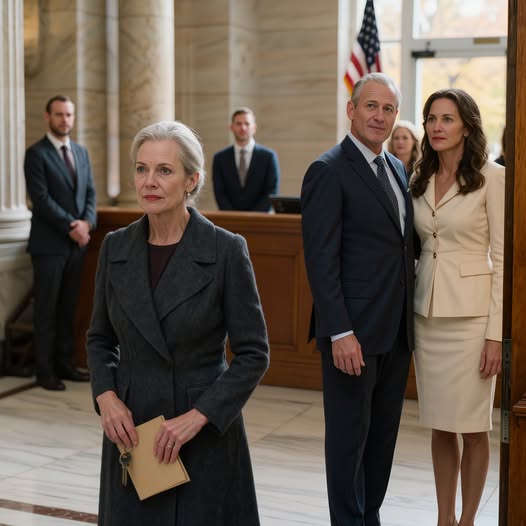
My Husband Divorced Me At 78, Taking Our $4.5 Million House. “You’ll Never See The Kids Again”…
MY HUSBAND DIVORCED
ΜΕ ΑΤ 78, TAKING OUR $4.5 MILLION HOUSE: “YOU’LLO NEVER SEE THE KIDS AGAIN”. HE LAUGHED, I LEFT. A MONTH LATER AN UNKNOWN NUMBER CALLED ME: “MA’AM, YOUR HUSBAND FOUND DEAD…
My Husband Divorced Me At 78, Taking Our $4.5 Million House. “You’ll Never See The Kids Again”…
My husband divorced me at 78, taking our $4.5 million house.
“You’ll never see the kids again,” he laughed in court.
I left.
But a month later, an unknown number called me.
“Ma’am, your husband was found dead.”
Good day, dear listeners. It’s Clara again. I’m glad you’re here with me. Please like this video and listen to my story till the end, and let me know which city you’re listening from. That way I can see how far my story has traveled.
People always ask me how I managed to stay married for 52 years. I used to laugh and say it was stubbornness and good coffee. The truth was simpler than that. I loved Harold. I loved the way he folded his newspaper in thirds before reading it. I loved how he called our golden retriever the senator because the dog had a way of walking into a room like he owned it. I loved the house on Birwood Lane in Connecticut. Four bedrooms, a wraparound porch, the old maple tree Harold planted the year our son was born. We had built something real, or so I believed.
My name is Margaret Elaine Caldwell. I was 76 years old when the ground beneath my feet began to shift. Harold was 78. We had three children, our son Douglas, who lived in Phoenix with his wife Renee, and our two daughters, Patricia and Susan, both in the Boston area. Six grandchildren between them. Every Thanksgiving, the house smelled like cornbread and cinnamon. That was the life I knew. That was the life I thought was permanent.
The first sign came on a Tuesday in late October. I remember because the leaves had just peaked, that particular orange and gold Connecticut does better than anywhere on earth. I had gone to the pharmacy to pick up Harold’s blood pressure medication and mine, and the pharmacist told me Harold had called ahead to change the billing address on his account. Not ours. His. A post office box in Westport I had never heard of.
I told myself it was a mistake. Harold was forgetful. He was 78. These things happen.
But then I noticed he had started closing his laptop when I entered the room. Harold, who had spent 30 years as a civil engineer and claimed he would never understand computers, was suddenly protective of a screen. He took phone calls in the garage. He began driving to the hardware store on Saturday mornings and returning two hours later without a single bag. Once, I smelled perfume on his jacket collar, something young and synthetic, nothing I recognized.
I did not confront him immediately. I am not by nature a dramatic woman. I watched. I listened. I told myself there were explanations. We had been through difficult seasons before. The year Douglas nearly lost his business. The year I had a cancer scare that turned out to be nothing. We had always come through.
But one evening in December, I found a card in his coat pocket while I was taking it to the dry cleaner. It was a Christmas card, unsigned, but the handwriting was feminine and careful. It said, “Every day with you is a gift.”
K.
I stood in the hallway of the house on Birwood Lane, the house Harold and I had bought in 1987, the house where I had raised three children and buried two dogs and grown a garden that was written up once in the local paper, and I felt something cold pass through me.
K, just a letter, but a letter is enough to end a world.
I said nothing that night or the next. I cooked dinner. I watched the evening news beside him on the sofa. I smiled when he made jokes. And all the while, I was memorizing his behavior the way you memorize a map when you know you are going to need it.
By February, I had confirmed what I already knew in my bones. Harold was seeing a woman named Karen Whitfield. She was 54 years old, 24 years younger than him, a real estate consultant from Westport. I found her name through a receipt I discovered in the recycling bin from a restaurant in Greenwich, neither Harold nor I had ever been to together.
When I tried to speak to him about it quietly one Sunday morning, he did not deny it. He looked at me across the breakfast table, the same table where we had eaten thousands of meals, and he said with a calm I had never heard from him before:
“Margaret, I want a divorce. My attorney will be in touch.”
That was all. No explanation. No apology. No grief on his face.
Fifty-two years.
And he said it the way you’d cancel a magazine subscription.
What followed was six months of legal proceedings I was wholly unprepared for. Harold had retained a team of attorneys, not one but three, specializing in asset protection. I later learned he had begun restructuring our finances 18 months before he filed. The house on Birwood Lane, valued at $4.5 million by that point, had been quietly transferred into an LLC he had formed without my knowledge. Our joint savings had been reduced to a figure that barely covered two years of modest living.
I hired an attorney of my own, a kind but underpowered man named Gerald Marsh, who had handled mostly wills and minor estate work. He did his best.
It wasn’t enough.
The day of the final hearing, Harold sat across the courtroom looking healthy and calm, Karen Whitfield waiting in the hallway outside. When the judge finalized the settlement, giving Harold the house and leaving me with a fraction of what I was owed, Harold turned to look at me, and he laughed. It wasn’t a loud laugh. It was quiet and satisfied, the kind that doesn’t need an audience.
“You’ll never see the kids again,” he said, low enough that only I could hear. “I’ve made sure of that.”
I did not cry. I sat very still, my hands folded in my lap, and I looked at him, this man I had loved for over half a century. And I memorized his face the same way I had memorized everything else.
Then I left Connecticut.
I drove to my sister Ruth’s house in Vermont. It took 3 hours and 20 minutes, and I cried for the first hour and was numb for the rest. Ruth was 71, widowed, and she lived in a small farmhouse outside Montpelier that smelled like wood smoke and dried lavender. She opened the door before I even knocked. She always knew when I was coming, the way older sisters do.
I stayed in her guest room for three weeks. I slept badly. I ate toast and soup and let Ruth’s two cats sleep on my feet, which helped more than I expected. I made lists. That was always how I processed things. I made lists.
On a yellow legal pad I found in Ruth’s kitchen drawer, I wrote down everything I had lost.
The house first. Birwood Lane. The wraparound porch. The maple tree.
Then the money. Our joint savings account had been drained legally through Harold’s restructuring, and my share of the settlement came to $310,000 after attorney fees. That sounds like a sum until you are 76 years old with no income, no property, and the medical expenses that come with age.
Then I wrote down the children. Douglas had called me once after the hearing. He said:
“Mom, Dad explained everything. I think you need to give him space.”
He hung up before I could respond.
Patricia had not called at all.
Susan sent a text message. A text message that said she was staying out of it.
These were my children. I had sat with every one of their fevers. I had driven them to soccer practice and SAT tutoring and emergency rooms. I had loved them without condition for decades, and they were staying out of it.
I wrote their names on the list too. Not out of bitterness, not yet. Just to acknowledge what was real.
For the first two weeks, I told myself I simply needed to survive, find a place to live, figure out the money, breathe. Ruth offered to let me stay as long as I needed, and I was grateful. But I also knew that Ruth’s house was Ruth’s life, and I was not a woman who survived by borrowing someone else’s space indefinitely.
But somewhere in the third week, while I was sitting at Ruth’s kitchen table with my legal pad and a cup of tea gone cold, something shifted. I had been so focused on what had been done to me that I hadn’t stopped to ask a different question.
What had been done exactly?
And was it legal?
I am not a lawyer. I never finished my degree. I left college in 1969 to marry Harold, which was what women did then, a decision I made freely and never fully regretted until now.
But I was not unintelligent.
I had managed our household finances for decades. I had balanced budgets and negotiated with contractors. And once, when Harold was hospitalized for a week, I had managed his small engineering firm’s payroll myself without a single error. I understood documents. I understood numbers. And the more I thought about the timeline, the LLC, the account restructuring, the 18 months of preparation Harold had done before filing, the more I thought:
Gerald Marsh never looked closely enough.
I called Gerald from Ruth’s kitchen. He was polite and sympathetic and confirmed that he had reviewed Harold’s financial disclosures as filed. I asked him one question. Had he independently verified that the asset transfers to the LLC preceded Harold’s intention to divorce, or had they happened after the decision was made? Because if Harold had transferred marital assets after deciding to seek divorce but before filing, that could constitute fraudulent transfer of marital property.
There was a long pause on the line.
“Mrs. Caldwell,” Gerald said, “that’s a very specific question.”
“I know,” I said. “Can you answer it?”
He could not.
He had not looked.
That was the moment my plan was born.
Not out of anger, though anger was there, steady as a pilot light, but out of something colder and more useful. The recognition that the game had not been played fairly, and that unfairly played games could sometimes be replayed.
I needed a different attorney. I needed someone who understood asset concealment and fraudulent conveyance in the context of divorce. I needed financial records I didn’t currently have. And I needed, most importantly, to understand what Harold had actually done, not what he had claimed on his disclosures, but what he had actually done.
I opened my laptop, the small one I’d bought myself three years ago to video-call the grandchildren, and I began to research. I found the name of a firm in Hartford, Brennan and Associates, that specialized in high-asset divorce litigation with a focus on financial misconduct. I found that Connecticut law allowed for post-judgment motions if fraud could be demonstrated in the original proceedings. I found that LLC transfers made within two years of a divorce filing could be scrutinized if the intent to defraud could be shown.
I wrote all of this down in my yellow legal pad in my careful, even handwriting. Then I called Brennan and Associates and made an appointment for the following Tuesday.
I told Ruth that evening over dinner. She set down her fork and looked at me with an expression I recognized, the same one she’d given me at 17 when I told her I was going to try out for the school play despite being terrified of audiences.
“You’re going to fight him,” she said.
It wasn’t a question.
“I’m going to find out the truth first,” I said. “And then I’m going to fight him.”
The drive to Hartford took just over an hour from Ruth’s house. I wore my Goodwill coat, charcoal gray, bought years ago for a faculty dinner Harold had dragged me to, because I believed in showing up to serious meetings as seriously as they deserved. I had my legal pad, a folder of every document from my original divorce proceedings, and the receipt from the Greenwich restaurant I had kept folded inside my wallet for months.
Brennan and Associates occupied the fourth floor of a building near the state capital. The attorney who met with me was not Mr. Brennan himself, but a woman named Clare Nguyen, mid-40s, efficient, with the kind of stillness that I associated with people who spent their days in rooms where a great deal depended on staying calm.
She shook my hand and did not speak to me the way some younger people speak to women my age, with that slight elevation of volume and simplification of vocabulary.
She simply asked me to start from the beginning.
I did.
I talked for almost ninety minutes. She took notes. She did not interrupt except to ask precise, useful questions — exact dates, dollar amounts, names of entities. When I finished, she sat back and looked at what she had written.
“The LLC formation date,” she said. “Do you know it?”
“I know it was registered in Delaware,” I said. “I don’t know the exact date.”
“That’s the first thing we need.” She said, “If it was formed after Harold made the decision to divorce, and there are ways to establish that, you have grounds for a fraud claim that could reopen the settlement entirely.”
“What would that require?” I asked.
“A subpoena for his financial records, the LLC’s formation documents, and his attorney-client communications to the extent they reveal intent.” She paused. “This is not a fast process, Mrs. Caldwell. And Harold will fight it.”
“I know,” I said. “He has resources.”
“So do we,” she said simply.
I retained Clare Nguyen that afternoon. It cost me $8,000 upfront, nearly a third of what I had readily accessible, and I paid it without hesitation.
Some expenditures are not expenses.
They are decisions.
Clare filed the post-judgment motion within the week, citing potential fraudulent conveyance and requesting full discovery of Harold’s financial records from the prior 36 months. The motion was accepted by the court and formal discovery notices were sent to Harold’s attorneys.
I know the moment Harold found out because Douglas called me. It was a Thursday evening, and I was back at Ruth’s house eating leftover chicken soup when my phone rang with Douglas’s number, the first time he had called since that single disappointing call after the hearing. His voice was tight in the way it got when he was performing calm over agitation.
“Mom. Dad says you’ve hired new lawyers. He says you’re trying to reopen the divorce.”
“I’ve filed a post-judgment motion,” I said. “That’s accurate.”
“Mom…”
A breath.
“This is just going to drag everything out and cost you money you don’t have.”
“Douglas,” I said, “did your father ask you to make this call?”
Silence, which was its own answer.
“Tell him I said hello,” I said, and I ended the call.
After I hung up, I sat quietly for a moment in Ruth’s kitchen and recognized what had just happened. Harold had reached out through our son, a man I had raised, to pressure me into dropping a legal action. He had recruited Douglas as a messenger.
The implications of that were not lost on me.
The evidence came six weeks later, delivered in a thick envelope from Clare’s office. The LLC, Birwood Holdings, LLC, had been incorporated in Delaware on March 14th. Harold’s divorce filing had been submitted to the court on September 9th of the same year. That six-month gap seemed to suggest on its face that Harold had planned the transfer well in advance.
But the document that mattered most was a series of emails recovered during discovery, communications between Harold and his lead attorney, a man named Franklin Tate, dating from the previous January. In those emails, Harold had written explicitly:
“I want to be sure the property is outside the marital estate before I file. Karen says the Westport market is peaking and I want to move quickly.”
January. Eight months before he filed.
While we were still sleeping in the same house, eating at the same table, watching the evening news side by side on the same sofa.
I read that email sitting in Clare’s office on a gray February afternoon and felt something crystallize inside me.
Not rage.
I had moved past rage into something more architectural, a structure of intention that was solid and load-bearing.
“Is this enough?” I asked Clare.
She allowed herself a small, controlled smile.
“It’s a very good start,” she said.
I walked out of that building into the cold Hartford air and stood on the sidewalk for a moment, breathing it in.
Was this the moment everything changed?
In some ways, it already had. Harold had thought he was dealing with a woman who would grieve quietly and disappear. He had miscalculated the way powerful people often do by assuming that age and loss had diminished me.
They had not.
Clare moved quickly after that. She filed a formal motion to vacate the divorce settlement on grounds of fraudulent conveyance, attaching the emails as Exhibit A. She also filed a separate request for a temporary injunction preventing any sale or further transfer of Birwood Holdings LLC assets while the motion was pending, which meant Harold could not sell the house or move money out of the entity while the case was active.
The injunction was granted within seventy-two hours.
I heard nothing from Harold directly.
What I heard came in pieces through channels he had apparently decided were safer for him.
The first came from Patricia. She arrived at Ruth’s farmhouse on a Saturday morning without calling ahead, a three-hour drive from Boston, which told me the trip had been planned with some urgency. Patricia was 50 years old, an educator with Harold’s high forehead and his habit of pressing her lips together when she was calculating what to say next.
She sat across from me at Ruth’s kitchen table and folded her hands on the surface.
And I thought, she has been coached.
“Mom,” she said, “we’ve been talking a lot as a family, and we want you to know that whatever happens legally, we love you and we want to find a way through this together.”
I let the sentence settle.
“That’s kind,” I said.
“Dad is willing to speak with you directly,” Douglas said.
No — that was later. Patricia came alone first.
“Dad is willing to speak with you directly,” she said, “without attorneys. He thinks you could reach an agreement that works for everyone if you were willing to talk to him.”
Ah.
There it was.
Harold, unable to come himself, perhaps on legal advice, perhaps simply unwilling to face me, had sent the children to arrange a private negotiation outside the formal proceedings. Anything agreed in such a meeting would exist in a gray zone, pressure applied without witnesses, and would likely be framed afterward however Harold chose to frame it.
“Dad’s attorneys made me an offer through my attorney last month,” I said. “I declined it through proper channels. If he has a new offer, that’s the appropriate route.”
“Mom…” Patricia’s voice shifted, shading into something I recognized, the tone she used to manage disagreements in her professional life — level and just slightly condescending. “This level of conflict isn’t good for anyone. Dad is 78. The stress of prolonged litigation…”
“Patricia,” I said, “your father was not concerned about stress when he spent eighteen months restructuring our finances before he filed for divorce.”
She paused.
“He says that’s not accurate.”
“There are emails,” I said, “dated and authenticated.”
Something flickered in Patricia’s expression, a brief flash of surprise, or perhaps the realization that I knew more than she had expected.
“Dad says those emails are being misrepresented.”
“Then his attorneys can explain that in court.”
She stayed another hour, circling the same points. She never raised her voice. Neither did I. When she left, she hugged me in the doorway, a stiff, obligatory embrace, and I watched her car disappear down Ruth’s gravel drive and felt a specific sadness that was different from anger.
My daughter had come not to support me.
But to manage me.
That was who she had become, or perhaps who she had always been when tested.
The more aggressive response came four days later. Harold’s lead attorney, Franklin Tate, sent a letter to Clare threatening a counter-motion alleging that my post-judgment filing was frivolous and constituted harassment and that they would seek attorneys’ fees as sanctions. It was a standard intimidation maneuver, Clare told me, designed to make the cost of continuing feel prohibitive.
She responded with a twelve-page brief citing case law and the specific statutory basis for our fraud claim.
That same week, Douglas called again. This time, his approach was different, less dutiful, more pointed. He told me that if I continued the legal action, the family relationship as it stood could not be maintained. He said the grandchildren had been confused and upset. He said Karen Whitfield, and the use of her name was deliberate, I understood, meant to signal that she was now a permanent fixture, had been unfairly maligned, and he hoped I would consider everyone’s feelings.
I listened to all of it.
Then I said, “Douglas, I hope you kept a copy of everything your father told you to say, because if this reaches court, the jury will want to understand the full picture of how Harold communicated with his family during these proceedings.”
The line went very quiet.
“I’m not threatening you,” I said. “I’m informing you. There’s a difference.”
He didn’t call again after that.
Not for a long time.
The court hearing on the injunction was held in mid-March. Harold appeared in person, the first time I had seen him since the original hearing. He looked well, slightly thinner, but well. He sat with Franklin Tate and two other attorneys and did not look at me once during the proceeding. The judge reviewed the exhibits, heard arguments from both sides, and maintained the injunction. It was not a final ruling. The full hearing on the fraud motion was scheduled for September, but maintaining the injunction was significant. It meant the court took our case seriously enough to preserve the status quo.
When we left the courthouse, Harold passed within five feet of me in the corridor. He still didn’t look at me. I noticed his hands were clenched.
Clare walked me to my car.
“They’ll try something else before September,” she said. “They always do.”
“Let them,” I said.
And I meant it.
But I was also tired in a way that went deeper than a night’s sleep could fix. I drove back to Ruth’s house and spent three days doing very little, reading old paperbacks Ruth had stacked in the hallway, walking the field behind her house in the early mornings, letting myself be simply a person who was cold and tired and who had done everything she could for now.
I needed those days.
The hardest parts were still ahead.
The offer came through Clare’s office in early April. Harold’s attorneys proposed a revised settlement. They would transfer $800,000 to me in exchange for my dropping all litigation and signing a comprehensive release of claims. That was roughly $490,000 more than I had received originally. They framed it as a gesture of goodwill.
Clare brought it to me without recommendation, which I respected. She laid the documents on her desk and let me read them in silence. I read carefully. The release language was thorough. It covered not only the current fraud motion, but any potential future claims against Harold personally, against Birwood Holdings LLC, and against Karen Whitfield. It included a non-disparagement clause that would have prevented me from discussing the circumstances of my divorce with anyone.
It required me to sign within fourteen days.
I set the papers down.
“He’s worried,” I said.
“Yes,” Clare said. “If he weren’t worried, he’d be offering nothing.”
I thought about $800,000. I thought about it genuinely. I was not a fool, and I was not so righteous that I would dismiss the practical reality of money when you are 76 years old with no income and mounting legal costs. Eight hundred thousand dollars would secure the rest of my life comfortably. It would relieve the anxiety that woke me at 3:00 in the morning some nights, the quiet arithmetic of how long my savings would last.
But the non-disparagement clause. The release that covered Karen Whitfield.
Those weren’t provisions designed to give me a fair outcome. They were provisions designed to seal a fraudulent transaction behind a legal wall so that no one, not now, not ever, could examine what Harold had actually done.
And underneath the practical calculation was something I had not expected to feel so clearly. It mattered to me that the truth existed on the record, not just in my memory or Ruth’s kitchen or Clare’s files, but in a court document. Acknowledged. Established. Real.
That mattered.
I had spent 52 years being Harold Caldwell’s wife, and for the last of those years, I had been managed and deceived and legally outmaneuvered while he smiled across the breakfast table. I wanted the record to say what had happened.
I wanted that more than $800,000.
“I’m declining,” I said.
Clare nodded.
She did not look surprised.
I asked her to send a formal rejection within the hour.
What I did not expect in the weeks that followed was how much I needed other people. Not counsel. Not strategists.