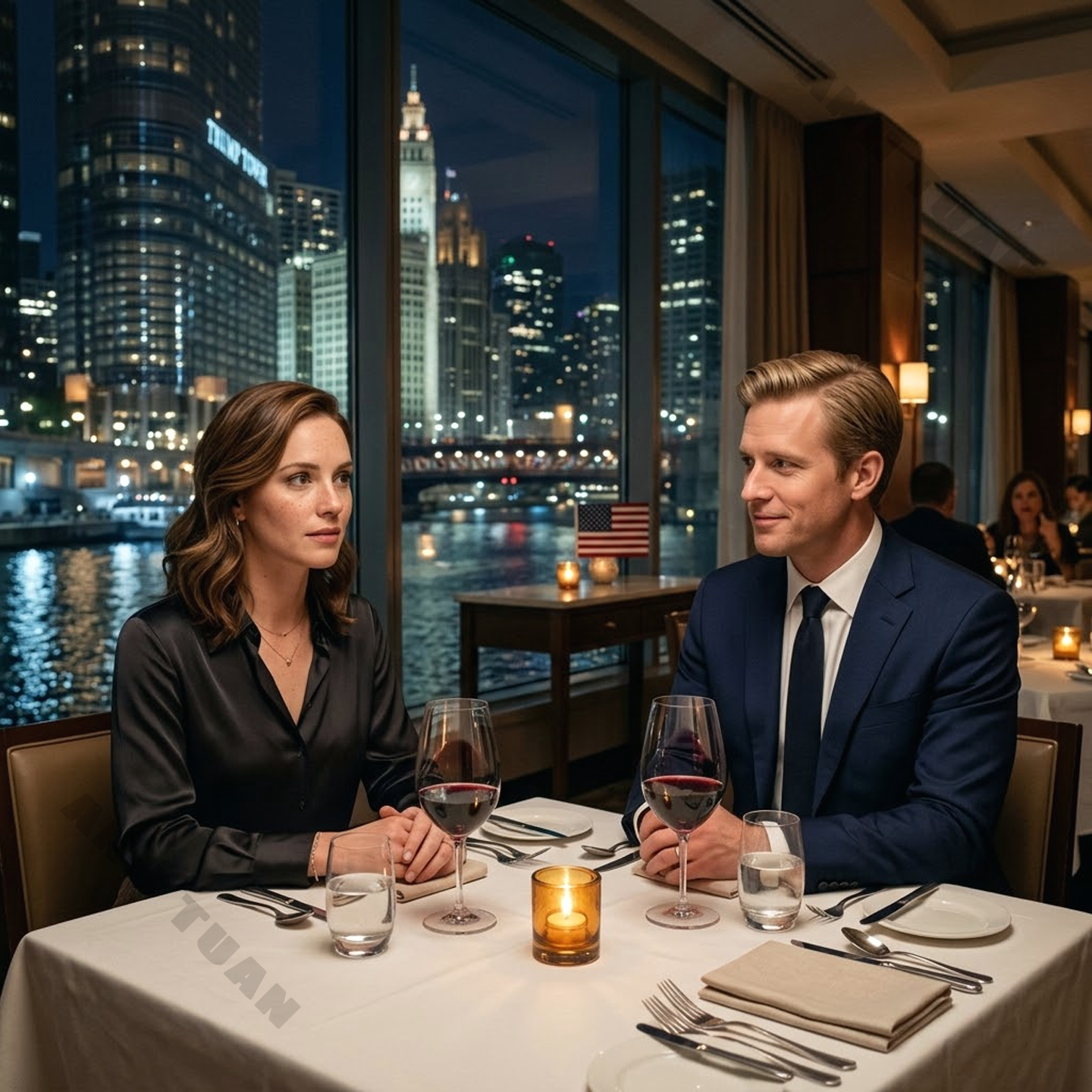
On the night of their tenth anniversary, Claire Bennett sat across from her husband in a candlelit restaurant overlooking the Chicago River and watched him smile like a man who believed the world still belonged to him.
It was early spring, the kind of Chicago evening when the wind off the water still carried the last hard memory of winter, even though the city had already decided to pretend it was done with cold. Outside the tall windows, the river held the reflection of office towers and restaurant lights in wavering bands of gold and white. A sightseeing boat moved slowly beneath the bridge, its deck strung with tiny bulbs, tourists lifting phones to photograph a skyline Claire had once loved for its steel confidence and now saw only as a polished shell. Inside, everything was soft in the way expensive places always tried to be soft: white tablecloths, low jazz, polished silver, the low murmur of people celebrating engagements, promotions, reconciliations, the private theater of money and optimism.
Ethan had chosen the place himself. Of course he had. He always understood staging. He understood what people noticed and, more importantly, what they didn’t. He knew how to create an image that could survive scrutiny because it invited no scrutiny at all. He had arrived in a navy suit that still held the crisp lines of the dry cleaner’s press, his blond hair neatly parted, his cuff links understated, his smile gentle and practiced. To anyone watching from another table, he looked like the kind of husband women pointed out to their friends with a little wistfulness in their voice. He looked patient, attractive, settled. He looked like a man who had brought his wife out to apologize without ever having to say the word sorry.
Claire remembered, with a strange distant clarity, how that smile had once been enough to make her feel safe.
He lifted his glass first.
“To us,” he said.
The candle between them threw a warm ribbon of light over the bowl of his wineglass. He held her gaze as he spoke, and there was such ease in him, such immaculate calm, that if she had not known what she knew she might have mistaken the evening for the beginning of a second chance. The waiter had just cleared the appetizer plates. A pianist near the bar was moving through an old standard with the patience of someone who understood that in places like this, music was not meant to be heard so much as absorbed. The neighboring table, a younger couple in their thirties, laughed over something private and foolish. Somewhere deeper in the dining room, someone set down a fork and it rang softly against porcelain.
Claire raised her glass.
She did not yet bring it fully to her lips. She tipped it enough to wet them, no more. The cabernet was rich and dry and expensive, chosen, Ethan had said, because it had been served at their wedding. Ten years. She could almost hear the shape of those years in the word itself, something solid and proven, something that ought to have meant more than a number.
Then Ethan leaned forward across the table.
His smile did not move. That was what made it terrible. Not that his voice dropped, but that his face stayed exactly as it had been, as if the muscles required for affection and for cruelty had long ago learned to work together.
“It’s laced,” he whispered. “Say your goodbyes.”
For one suspended second, the room fell away.
Not literally. She knew, even then, that the pianist had not stopped, that the silverware still touched china, that the waiter carrying a tray of desserts had not frozen in place like a scene in a film. But for Claire, everything outside the circumference of that table vanished. The candlelight sharpened. Ethan’s pupils looked blacker. She heard her own heartbeat, heavy and deliberate, not racing the way fear is often described, but slow, as though some deeper part of her had been bracing for this very moment and was almost relieved that the waiting had ended.
She set the glass down with exquisite care.
Ethan’s eyes changed first. Not his face. His eyes. They narrowed with a kind of alert impatience, as if he had expected a different reaction and was annoyed by the delay. He had expected panic. Maybe bargaining. Maybe tears. Maybe the ugly humiliation of watching her understand, all at once, that the marriage had not only been over but weaponized against her.
Instead Claire looked at him with a calm so complete that it reached across the table and unsettled him.
“You should have checked the glasses,” she said.
For the first time that evening, his composure slipped.
It happened fast, fast enough that someone not looking directly at him might have missed it. His expression did not merely falter; it changed shape. The easy warmth left him. A thin, stunned blankness entered its place. Then his gaze dropped to the table. Two crystal stems. Two identical servings of dark red wine. One of them sat near Claire’s right hand, untouched. The other was in his own. The faint lipstick mark at the rim was not on hers.
It was on his.
Claire had switched them when the waiter came with the appetizers and Ethan turned slightly to sign the bill folder. A tiny interruption. A tiny angle. The sort of ordinary restaurant motion no one would ever remember later because it had looked like nothing. A quiet slide of glass across white linen. Her wrist steady, her face neutral, her mind operating with a cold precision she would later fail to recognize as her own. Ethan had not noticed because he had never imagined she could see him clearly enough to need to defend herself.
He pushed back from the table so suddenly that the chair legs shrieked across the tile.
One hand flew to his throat. The other reached toward her, not in love, not in appeal, not even in anger, but in raw disbelief. His chest hitched as though he had inhaled the wrong world. The color drained from his face in a rush that looked almost theatrical, except there was nothing staged in the terror rising there now. The wineglass fell from his fingers and shattered against the floor. Guests turned at the sound. A woman near the window gasped. Someone farther back screamed when Ethan stumbled, caught himself against the edge of the table, and then failed entirely, collapsing onto one knee and then sideways beside the white tablecloth that had been chosen, no doubt, for romance.
He looked up at Claire from the floor, horror opening across his face as his breath came in ragged, shallow pulls.
For one strange instant, she could see the question forming in him. Not why me. Not how could you. The question was simpler, more naked than that.
How did you know?
Claire stood.
Her napkin slid from her lap. Her hands hung loosely at her sides, steady now in a way they had not been in months. The room had fractured into motion around them. A server rushed over. Another backed away toward the manager’s station. Someone was already shouting for an ambulance. But inside Claire there was a hard, bright stillness, as if the entire night had narrowed to a single merciless point.
“You deceived me in love,” she said, her voice low but clear. “Now see the end.”
It was not a line she had practiced. That was what would trouble her later. She had not planned those exact words. They rose from somewhere beneath language, from the layer where betrayal stops being a concept and becomes a physical climate. She did not say them loudly. She did not need to. Ethan heard. The expression in his eyes confirmed that.
The manager was on the phone with emergency services by then. A busser knelt beside Ethan and asked him something twice, receiving only a wet, broken effort at speech in return. Claire stepped back, reached into her purse, and removed her phone with movements so measured that a woman near the bar would later tell police it was the calmest she had ever seen anyone in a crisis. Claire did not feel calm. She felt precise. There was a difference.
By the time the first officer arrived, she was already holding the phone out in front of her.
“My husband tried to kill me tonight,” she said. “And I can prove he planned it.”
Outside, sirens flooded the street with red and blue light. Their reflections swung over the restaurant windows and broke into the river beyond. People had gathered under the awning, coats half-buttoned, mouths open, phones out, breath fogging in the chilly air. Inside, beneath the anniversary candles Ethan himself had requested and the flowers he had paid extra to have arranged at the table, he fought for breath while strangers pressed napkins to broken glass and watched the romance drain out of the evening like spilled wine.
Claire did not cry.
Not there. Not when they loaded him onto the stretcher. Not when one of the paramedics asked what he had ingested and she answered, with exactness, “The poison he intended for me.” Not when the officer led her through the dining room past turned heads and parted chairs. Not when she stepped outside and the wind off the river struck her bare face hard enough to sting.
She had thought, in the abstract, that survival would feel like relief.
Instead, it felt like standing at the lip of something much larger than fear. Something she had already entered without meaning to, months ago perhaps, and had only now been forced to name.
At Northwestern Memorial, just after midnight, Detective Marcus Hale met Claire in a private waiting room on the sixth floor, where the coffee was terrible, the upholstery was too clean, and all human distress seemed to arrive in the same beige shades of fatigue.
He was a man in his late forties with the weathered face of someone who had spent too many winters standing in alleys behind crime scenes waiting for evidence techs to finish their work. He did not look theatrical or hard-boiled. He looked competent, which in Claire’s experience was rarer and more comforting. His tie was slightly crooked, his coat unbuttoned, his notebook already in hand. He sat across from her without unnecessary gentleness, and Claire was grateful for that. She had been receiving gentleness from strangers for the last hour and a half, and something in it felt almost unbearable.
Her coat was folded over her lap. Her hands were wrapped around a paper cup of untouched coffee that had long since stopped steaming. She knew what she must look like: not hysterical, which people always expected and often mistrusted in equal measure, but depleted. A woman who had been carrying a secret weight so long that the act of setting it down had left her weaker, not stronger.
“I need the whole story,” Hale said.
Claire nodded once, unlocked her phone, and slid it across the small table to him.
“It started three weeks ago,” she said.
That was not technically true. In another sense it had started years earlier, in small omissions and deflections, in the gentle acid erosion of being married to someone who made you doubt your own patterns of noticing. But three weeks ago was when the hidden life became visible enough to document, and documentation, Claire had learned, mattered more than intuition in the world outside your own bones.
The first image on her phone showed Ethan in a parking garage, photographed from the shadowed interior of another car. He was kissing a woman with dark hair and a camel coat, one hand at the back of her neck, his body angled toward her with the easy greed of familiarity. Hale enlarged the photo slightly. Concrete pillar. Level marker. Time stamp. Chicago license plates blurred in the distance.
The second image showed the same woman entering a condominium building downtown with Ethan half a step behind her. The building was in River North, sleek and anonymous and expensive in the sterile way of newer luxury towers. The camera angle had come from across the street. A private investigator’s work, Hale assumed immediately.
Then came the screenshots.
Bank transfers from a joint account Claire admitted she rarely checked anymore because Ethan handled most of their finances and had spent years training her to interpret questions as distrust. Hotel reservations under his name and, once, under an alias so transparent it almost looked insulting. Messages recovered from a tablet synced to his phone, discovered by accident when Claire had gone into his home office looking for tax documents and found the device still charging beneath a stack of market reports. Ethan had been careless, or arrogant, or perhaps by then so deep inside his own story that he had stopped imagining consequences entirely.
The messages were between Ethan and the woman in the photos. Vanessa Cole. Real estate agent. Thirty-four. Divorced. Licenses in Illinois and Florida. Hale would later learn all of that before sunrise.
Some of the texts were romantic in the shallow, inflated way secret affairs often are, all fantasy and projection and rehearsed resentment. But then the tone changed. Practical. Chilling. Thinly coded in places, naked in others. Hale scrolled more slowly.
Once the policy clears, we can disappear somewhere warm.
She suspects nothing.
Just one clean night and it’s done.
He lifted his eyes from the phone.
“Insurance policy?”
Claire’s mouth tightened. “A two-million-dollar life insurance policy he pushed me to sign in January. He said it was normal. Financial planning. Security.”
“And you signed.”
“I did.”
“You didn’t think it was strange?”
“I thought a lot of things were strange,” Claire said. “At the time, I hadn’t yet learned which ones were dangerous.”
That answer made Hale close his notebook for a second and simply look at her.
Claire had the kind of face people often mistook for softness. Fine-boned, composed, the features of a woman who had learned from girlhood that restraint could be read as elegance. But there was nothing soft in her now. She was exhausted to the marrow, yes, and pale in the fluorescent hospital light, but every sentence she spoke had been burned down to essentials. Hale had interviewed enough victims to know the difference between confusion and decision. Claire Bennett was past confusion.
“And you stayed?” he asked.
“I stayed quiet,” she said. “That’s different.”
Then she told him everything, piece by piece, with the strange discipline of someone who had rehearsed the facts alone in silence until they no longer felt like her life.
After finding the messages, she had hired a private investigator. Quietly, through a recommendation passed to her by a partner at the law firm where she worked in development. Not a friend, not someone with any reason to gossip. The investigator confirmed the affair within four days. Confirmed that the woman was Vanessa Cole. Confirmed that Ethan had been meeting her at a furnished condominium in River North rented under an LLC name. Confirmed hotel stays, cash withdrawals, and a pattern of lies that extended far beyond infidelity.
Then came the finances.
Claire had believed Ethan was successful because he had always looked successful. He spoke the language fluently, dressed for it, moved in the right rooms, kept the right subscriptions open on his laptop, cursed at market dips with convincing specificity. He had clients, or so he said. Consulting contracts. Investment relationships. Golf outings in the suburbs with men whose names sounded like firms. But the investigator dug into court filings, debt notices, and loan histories and surfaced with a far uglier picture. Ethan Bennett, financial consultant, was drowning. Gambling debt. Credit lines stacked on credit lines. Personal loans from men who did not operate through ordinary institutions and who were unlikely to be patient about repayment. He had not been living richly because he was secure. He had been performing solvency while the floor gave way beneath him.
Claire also learned that he had quietly increased her life insurance policy and listed himself as sole beneficiary.
She had wanted to leave the same day she learned that.
In her retelling at the hospital, she did not dramatize this part. She did not describe sitting in her parked car in the garage below her office, one hand over her mouth, rereading those words until the letters seemed to detach from their meanings. She did not tell Hale about the dry heaving, or about the long minute in which she had considered driving west without a bag and without telling anyone and never coming back. She simply said, “I was preparing to leave.”
Then she found one more message. Sent the day before the anniversary dinner.
Tomorrow night. Riverfront Grill. I’ll bring it.
Hale leaned back in his chair.
“So you thought he was going to use the dinner.”
Claire held his gaze. “I knew he was.”
“You could’ve gone to the police before tonight.”
“I contacted a lawyer first,” Claire said. “I was planning to go to the police in the morning with all of it. My attorney wanted the records organized. But Ethan moved first. He made the reservation, sent flowers to my office, talked about wanting to start over. If I refused dinner, I thought he’d change the setting. Or postpone. Or choose something private. I wanted witnesses.”
Hale let that sit between them.
The hospital hummed in its usual after-midnight register: rolling carts in the hall, distant intercoms, the squeak of rubber soles on polished floors, grief and urgency filtered through drywall. Somewhere nearby a monitor alarmed twice and was silenced. The paper cup in Claire’s hands had gone cold enough to make her fingers ache, but she didn’t set it down.
“And you switched the glasses,” Hale said at last.
“Yes.”
“You understood he could die.”
Claire was quiet for a moment, but it was not hesitation. It was the kind of pause people take when the honest answer has no soft edges.
“He understood that too,” she said.
There it was. The line a prosecutor would circle. The line a jury might turn over for hours. Hale heard it as clearly as she did.
At 2:17 a.m., a doctor entered the waiting room. Youngish, tired, with the controlled expression of someone who had already delivered too many versions of maybe tonight. Ethan Bennett was alive, but barely. He had gone into respiratory distress and developed severe cardiac instability. Toxicology was being expedited. He had been intubated and placed under heavy sedation. If he survived the next few hours, there might be answers by morning. Or not. Medicine, the doctor made plain without quite saying it, was not in the habit of honoring narrative timing.
Hale thanked him and waited until the door shut again before turning back to Claire.
“There’s one problem,” he said. “From a prosecutor’s point of view, you didn’t just defend yourself. You let him drink it.”
The fluorescent light above them gave a faint electric buzz. Claire’s eyes did not leave his.
“He poured the trap,” she said. “He set the table. He chose the night. I changed one detail.”
Hale studied her for several seconds. Not because he doubted her, exactly. Because he knew too well how law and morality parted company under pressure. Self-defense, preemption, intent, imminence, proportionality. The law preferred cleaner moments than real life usually offered. Real life arrived with text messages, insurance policies, delayed reports, and a poisoned glass no one was supposed to survive long enough to explain.
Then he opened his notebook again.
“Then I need every message, every bank record, every report from your investigator, and the name of your lawyer.”
Claire gave him all of it.
By sunrise, the restaurant was sealed as a crime scene. The wine bottle had been collected. The broken stemware had been bagged. Staff were interviewed one by one in the private event room off the main dining area. The sommelier insisted the bottle had been opened tableside. The server remembered leaving the table briefly after delivering appetizers. A couple seated two tables away described hearing the husband whisper something before the wife set down her glass. A busser recalled the husband’s panic seeming to begin before anyone else at the table understood there was a medical emergency. Security footage showed angles, interruptions, partial movements, enough to support the broad outline and leave room for argument in the details.
The toxicology report came back before noon. A fast-acting compound, difficult but not impossible to obtain, severe enough in the amount found in Ethan’s system that the emergency physician later said another five to seven minutes without intervention might have made the difference permanent.