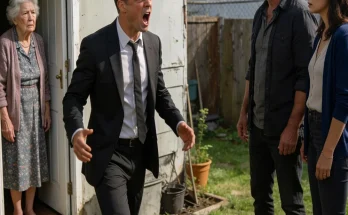
Lauren blinked, confusion turning into something closer to panic.
“And one more condition,” Michael added. “If anyone contests this will without valid cause, they receive one dollar.”
For the first time, Lauren looked afraid.
Andrew turned to her slowly, his expression hollow, unfamiliar.
“Did you do it?” he asked.
Tears filled her eyes instantly. “I was trying to protect us.”
“You called my mother’s funeral a holiday,” he said quietly. “Was that part of protecting us too?”
She reached for him.
He pulled away.
The chair behind her scraped loudly against the floor as she stumbled back.
“Fine,” she snapped, her voice sharp with anger. “Stay here with your grief and your money.”
And she walked out.
Andrew didn’t follow.
He remained seated, staring at the letter in his hands, as if everything he believed had just been erased.
But it still wasn’t over.
Michael placed a small silver key on the table.
“There’s one final instruction,” he said.
At the bank, we opened Emily’s safety deposit box.
Inside were pieces of our life—jewelry, documents, photographs, a USB drive. And another letter.
“If you are reading this together,” it began, “then we are still a family.”
Andrew broke down completely.
Among the contents were not just memories, but evidence—enough to take legal action if we chose to.
But the hardest part was the video.
We played it in silence.
Emily appeared on the screen, thinner, weaker—but calm. Her eyes were still the same, steady and full of quiet strength.
“Andy,” she said softly, “love doesn’t mean closing your eyes to the truth. Real love never uses pain as an excuse to hurt others.”
Andrew cried harder than I had ever seen.
Emily gave him a choice.
Let Lauren walk away quietly—if she returned everything.
Or pursue justice.
Andrew didn’t answer immediately. He sat there, breathing heavily, processing everything.
Then, finally, he chose.
Not anger.
Clarity.
He called Lauren.
“Return everything and sign the papers,” he said. “Or we go to court.”
She tried to persuade him. Then manipulate him. And when that failed—her anger surfaced, sharp and undeniable.
Two days later, she signed.
No shouting. No scene.
Just the quiet collapse of something that had already been broken for a long time.
Months passed.
Andrew began therapy. Slowly, piece by piece, he started to rebuild himself. We honored Emily’s memory, creating a scholarship in her name—something meaningful, something lasting.
And I learned something I will never forget.
It isn’t inheritance that destroys families.
It’s the truth it reveals.
And grief—no matter how heavy—will always weigh less than betrayal.
But it has a way of showing you, with absolute clarity, who truly belongs in your life… and who never did.