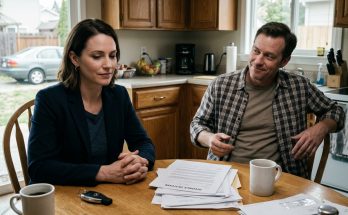
The sentence cut my life in two before I even made it to the dining room.
I was carrying a pumpkin pie down the hallway of my parents’ house outside Pittsburgh, both hands wrapped around the cold tin, trying not to drop it on the carpet my mother had made such a big deal about replacing.
The air smelled like glazed ham, cloves, butter, and the cinnamon candle she saved for company.
The Steelers game was roaring from the den.
My father’s ice clicked in a glass.
The cheap gold garland around the kitchen doorway scratched against the trim every time the heat kicked on.
Then I heard my mother say, “She owes us.”
I stopped so fast the pie shifted in my hands.
My Aunt Sandra said something soft, almost a laugh, the kind people use when they want to sound harmless.
“Well,” Sandra said, “Emily’s done pretty well for herself.”
“She should,” my mother answered. “We fed her for eighteen years.”
That was all.
One sentence.
One ordinary sentence said in an ordinary kitchen while the ham stayed warm and the football announcers kept yelling from another room.
But it landed in me like a receipt for my whole life.
I set the pie down on the hallway table because my hands were starting to shake.
For fifteen years, I had sent my parents $4,000 every month.
Not almost every month.
Not when I could spare it.
Every month.
The transfer had gone out like a second rent payment, so regular and so expected that nobody in my family spoke of it as help anymore.
It was simply something that happened, like the electric bill clearing, or the mortgage draft, or the trash getting picked up on Wednesday.
I started when I was twenty-three.
My father, Richard Bennett, had hurt his back at the steel plant, and my mother called me from their kitchen crying so hard I could barely understand her.
They were three months behind on the mortgage.
There were late notices.
There were pills my father needed.
There was a fear in my mother’s voice I had never heard before.
I had just gotten my first paralegal job in Boston.
My apartment was small enough that I could touch the counter and the stove without moving my feet.
I remember standing there in socks, staring at a packet of ramen, and telling my mother it would only be temporary.
I believed that when I said it.
I believed a lot of things at twenty-three.
Temporary became one year.
Then five.
Then ten.
Then fifteen.
The mortgage got current.
The roof needed replacing.
The prescriptions went up.
The property taxes were due.
The insurance premium jumped.
The old SUV became “unsafe,” so a newer one appeared in their driveway, and somehow I knew about the payment before I knew about the color.
Then the kitchen cabinets were “falling apart.”
They had looked perfectly fine to me, but my mother cried and said she was embarrassed to have people over.
So I sent extra.
That became the kitchen update I was standing inside when she told my aunt I owed her for being fed as a child.
Some families only call it sacrifice when they are standing on the receiving end.
The moment you stop bleeding quietly, they call it selfish.
At dinner that Christmas night, I did not confront her.
I passed the mashed potatoes.
I smiled at my father’s joke about the Steelers.
I asked Sandra if she wanted whipped cream with her pie.
I kissed my mother’s cheek when she asked me to get more gravy.
My voice stayed calm.
That calm frightened me more than rage would have.
Rage would have been easy to explain.
Calm meant something in me had already stepped back.
At 10:14 p.m., I locked the guest room door and opened my banking app.
The floral wallpaper looked yellow in the bedside lamp.
My suitcase sat open on the chair.
I had not even changed out of my dinner clothes.
After rent, credit card minimums, and the last-minute flight home, I had $611.83 left.
I stared at the number for so long it stopped looking real.
My next automatic transfer to my parents was scheduled for January first.
Four thousand dollars.
More than six times what I had left.
I called Claire.
Claire was my financial adviser, but that title sounds colder than what she had actually been to me.
For a year, she had been the person across a conference table telling me, gently and repeatedly, that I could not rescue people by drowning myself.
She had shown me charts.
She had asked me about retirement.
She had watched me explain away every crisis my mother sent to my phone.
That night, when she picked up, I whispered, “Stop the transfer.”
There was a pause.
Then she said, “Emily, are you sure?”
“Shut down the family account,” I said. “Effective tonight.”
She asked again, softer that time.
I looked at the wallpaper my mother had chosen during the remodel I paid for.
“For the first time in fifteen years,” I said, “I am.”
The next morning, my mother handed me a shopping list before I left for the airport.
She did not ask whether I had slept.
She did not ask why my eyes looked swollen.
She stood at the sink with her coffee and said, “If you get a chance after your flight, order that air fryer your father wanted.”
Then she added, “The good one, not the cheap one.”
I folded the list once and put it in my coat pocket.
I did not trust myself to speak.
On the plane back to Boston, my phone buzzed before we even pulled away from the gate.
Don’t forget January might need to hit early because of the holiday.
I read it twice.
There was no “Can you send it?”
There was no “Are you okay?”
There was no “Thank you for fifteen years of keeping us afloat.”
Just a reminder.
Like I was a utility bill with a daughter’s name attached.
When I got home, I did not unpack.
I put my suitcase by the door, made coffee I barely tasted, and sat at my kitchen table with my laptop open.
Then I started pulling records.
Bank statements.
Wire confirmations.
Mortgage transfers.
Prescription reimbursements.
Insurance payments.
Credit card balances.
Screenshots of text messages.
The transfer history exported by date, amount, and receiving account.
The recurring-payment schedule from the banking app.
The mortgage-servicer confirmations that showed the months I had covered.
I labeled the folders by year.
I wrote notes in the margins.
I documented everything because guilt gets blurry until numbers make it sit still.
By midnight, the recurring monthly transfers alone totaled $720,000.
That did not include the extra roof payment.
It did not include the kitchen.
It did not include the SUV help.
It did not include flights home or gifts or the emergencies that had always somehow arrived right after I got paid.
Seven hundred and twenty thousand dollars.
And I had $611.83 to my name.
Not because I had been reckless.
Not because I had bought designer bags.
Not because I had taken luxury vacations.
Because I had obeyed.
On December 29, my mother texted again.
Did you send it?
A minute later, another bubble appeared.
Mortgage drafts before the holiday weekend.
Then another.
And I already put the deposit down for New Year’s Eve food.
I looked at those three messages for a long time.
Three dots appeared.
Then disappeared.
Then appeared again.
I typed, I can’t anymore.
Her answer came back almost instantly.
Can’t or won’t?
That was the moment I knew she had been waiting with the phone in her hand.
I did not answer her.
I printed everything instead.
On New Year’s Eve, I drove back to Pittsburgh with the folder on the passenger seat and my old black coat buttoned over the torn lining.
The road was gray.
The sky hung low over the highway.
Every mile felt like I was driving toward a version of myself I should have met years earlier.
My mother opened the door looking annoyed first and surprised second.
“You should have called,” she said.
“I know.”
She stepped back because there was nothing else to do.
The house was warm with noise.
My father was in the den.
Sandra stood in the kitchen arranging appetizers on the remodeled counters.
The cinnamon candle was burning again.
The same candle.
The same kitchen.
The same little performance of family comfort.
My mother opened her mouth like she was about to ask whether I had brought wine.
Instead, I walked past her into the dining room and laid the folder in the middle of her holiday spread.
“What is this?” she asked.
I looked straight at her.
“Since we’re talking about what I owe,” I said, “I thought we should finally do the math.”
My father came in frowning.
Sandra followed with a paper napkin still in her hand.
My mother’s face tightened the second she saw the first transfer record.
That was how I knew she understood before anyone else did.
I spread out page after page.
Mortgage payments.
Monthly deposits.
The roof year.
The SUV year.
The kitchen year.
The prescription year.
Then I slid my current bank balance across the table.
$611.83.
The room froze.
A fork rested halfway off a dessert plate.
Sandra’s hand hovered over a stack of napkins.
My mother’s thumb stopped on the edge of a statement.
From the den, the football game kept shouting like another family, somewhere else, was still having a normal holiday.
Nobody moved.
My father picked up the summary page.
I watched his eyes move down the column.
I watched him reach the total.
All the color drained out of his face.
“Patty,” he said quietly, “what exactly have you been taking from her?”
My mother did not look at him.
She looked at me.
That hurt more than I expected.
Not because she looked sorry.
Because she looked betrayed.
As if I had done something cruel by putting the truth on paper.
I pulled out the last sheet from the folder.
“No,” I said. “The real question is what you think I still owe after this, because if we’re counting everything tonight, then you haven’t even seen the part that shows the transfer was already canceled.”
My mother’s hand froze.
Sandra made a small sound and covered her mouth.
My father looked at me so sharply that I thought, for one second, he might be angry.
Instead, he sank into the chair.
“You canceled January?” my mother said.
Her voice was thin and hard.
“I canceled every automatic deposit,” I said.
“You can’t do that before the mortgage draft.”
“I already did.”
“You don’t get to just cut us off.”
“I didn’t cut you off,” I said. “I stopped paying a bill no one ever admitted belonged to me.”
She stood there with all her holiday food around her and no sentence ready.
That was new.
My mother had always had sentences.
She had sentences for bills.
Sentences for neighbors.
Sentences for why my father needed help.
Sentences for why I should understand.
Sentences for why temporary needed to last just a little longer.
My father held the page with both hands.
“How long did you know?” he asked her.
She turned on him then.
“Don’t you start,” she said.
His face changed.
It was not loud.
It was not dramatic.
But something in him seemed to sit up straighter.
“Patty,” he said, “answer me.”
She looked toward Sandra.
Sandra looked down at the napkin in her hands.
Nobody rescued her.
That was the first real consequence I saw.
Not shouting.
Not punishment.
Just the silence of people finally refusing to make her version of things comfortable.
“I handled the bills,” my mother said.
That was all.
Three words that covered fifteen years of my life.
My father’s voice shook. “I thought Emily was helping sometimes.”
I almost laughed.
Not because it was funny.
Because sometimes is such a gentle word for a wound that has a schedule.
“Dad,” I said, “it was four thousand dollars every month.”
He looked at me then.
Really looked.
At my coat with the torn lining.
At the circles under my eyes.
At the printed balance.
His mouth opened and closed.
“I didn’t know,” he said.
I believed him halfway.
That was the hardest part.
My father had not made the calls.
He had not texted me mortgage reminders.
He had not asked for the air fryer.
But he had lived inside the comfort my money bought.
There are different kinds of not knowing.
Some are innocent.
Some are convenient.
Sandra pulled out a chair and sat down slowly.
“Emily,” she said, “honey, why didn’t you say something?”
I looked at her.
Then at my mother.
Then at the pages covering the table.
“I did,” I said. “For fifteen years. I said it every month in dollars.”
No one answered.
My mother’s eyes shone, but the tears did not fall.
I knew those tears.
They had raised money from me before.
This time, they met paperwork.
“I am not sending January,” I said.
My mother sucked in a breath.
“I am not sending February,” I continued. “I am not sending March. The account is closed. Claire has the confirmation. I will help Dad review what bills are necessary and what can be sold, canceled, refinanced, or handled without me. But the monthly transfers are over.”
My father stared at the papers.
Sandra whispered, “Patricia.”
My mother snapped, “Don’t.”
That one word cracked across the room.
For one ugly heartbeat, I wanted to shout.
I wanted to list every birthday I had spent alone because flights were too expensive.
I wanted to tell her about the winter coat.
I wanted to tell her about the man named David who had asked me what I wanted our life to look like and how I had let him go because I could not imagine building a future with an invisible mortgage sitting between us.
I wanted her to hurt the way I had hurt quietly.
Instead, I placed the folded shopping list on the table.
The air fryer was still written on the third line.
My mother stared at it.
My father looked at it, too.
That tiny piece of paper did what the $720,000 had not.
It made the room ordinary again.
It made the cruelty small enough to understand.
“You gave me this the morning after Christmas,” I said. “After I flew home. After I had paid for the kitchen you were standing in. After you told Sandra I owed you for feeding me.”
My mother’s face changed.
There it was.
Not guilt exactly.
Recognition.
“I didn’t mean it like that,” she said.
“Yes,” I said. “You did.”
The sentence sat between us.
No one touched it.
My father put the summary page down carefully, like it was something breakable.
“I’m sorry,” he said.
I waited.
He swallowed.
“I should have asked more questions.”
That was not enough.
It was also the first honest thing anyone at that table had said to me in years.
I nodded once.
My mother wiped at one eye.
“So what,” she said, “you’re just leaving us to lose the house?”
There she was again.
The old door.
The old guilt.
The old room I had lived in for fifteen years.
“No,” I said. “You are going to decide what you can afford. Dad is going to see the full budget. If the SUV has to go, it goes. If the house is too much, you talk to the mortgage company. If the kitchen remodel made you feel rich, you can sit in it while you learn what rich actually costs.”
Sandra looked down at the table.
My father closed his eyes.
My mother whispered, “You sound cold.”
“I am not cold,” I said. “I am tired.”
That was the truth under everything.
Under the anger.
Under the folder.
Under the $611.83.
I was tired.
Not for a week.
Not for a season.
For fifteen years.
I gathered the pages slowly, but I left the copies on the table.
My father asked if I would stay.
My mother did not.
I looked around that dining room with its holiday plates and warm lights and the little American flag magnet on the refrigerator in the kitchen behind it.
It looked like family.
It smelled like family.
For years, I had confused that with being safe.
“I’m going back to Boston tonight,” I said.
Sandra stood.
“Emily, it’s New Year’s Eve.”
“I know.”
My father tried to hand me the summary page.
I shook my head.
“Keep it.”
He looked at the total again.
His hands trembled.
My mother finally sat down.
She did not apologize.
Not then.
Maybe she did not know how to say sorry without turning it into a bill.
I walked to the front door.
The porch light was on.
My car was cold when I got inside.
For a minute, I sat in the driveway and let myself shake.
Then my phone buzzed.
It was Claire.
You okay?
I looked through the windshield at the house I had helped keep standing for almost half my life.
Then I typed back, Not yet. But I’m done paying to pretend I am.
On January first, no transfer went out.
The world did not end.
The mortgage company did not call me.
My mother did, seven times.
I let each call go to voicemail.
By afternoon, my father texted me a photo of the dining table.
The papers were still there.
Under the photo, he wrote, I’m going through them.
I cried when I read that.
Not because everything was fixed.
Nothing was fixed.
But for the first time, the truth had stopped living only in my bank account.
A week later, my father called and asked me how to export statements.
My mother did not get on the phone.
I heard her in the background once, moving dishes around too loudly.
I did not ask to speak to her.
Healing does not always begin with forgiveness.
Sometimes it begins with a stopped payment.
Sometimes it begins with a folder on a dining room table and a father finally seeing the total.
Sometimes it begins with a daughter admitting that love had become a monthly withdrawal, and that she was allowed to close the account.
For fifteen years, I had been sending my parents $4,000 every month.
Last Christmas, I heard my mother say I owed her because she fed me for eighteen years.
By New Year’s Eve, they finally understood how broke I really was.
And by New Year’s Day, so did I.
Not just broke in money.
Broke in the places where a daughter keeps hoping one more sacrifice will finally make her loved correctly.
That was the part no bank statement could show.
But the statements did one thing love had never managed to do in that house.
They made everyone count……………………..
# PART 2: THE LINE ITEM
My father took the page from my hand.
Not quickly.
Not angrily.
Carefully.
The way people pick up something fragile when they are afraid it might already be broken.
The room had gone so quiet I could hear the refrigerator humming in the kitchen.
Outside, somewhere down the street, fireworks had already started.
New Year’s Eve.
A new year waiting outside the windows while fifteen years sat on the dining room table between us.
My father adjusted his glasses.
He read the line once.
Then again.
His face changed.
Not all at once.
Slowly.
Like a man watching a familiar road disappear beneath fog.
“Patty,” he said quietly.
My mother didn’t answer.
He looked up.
“Why does this say the mortgage was paid off in March three years ago?”
The room stopped breathing.
Sandra’s hand flew to her mouth.
My own heart stuttered so hard I thought I had heard him wrong.
Paid off?
No.
That wasn’t possible.
I had sent money every month after that.
Every month.
Four thousand dollars.
Without fail.
I reached for the statement and read the line myself.
Mortgage Satisfaction Filed.
March 14.
Three years earlier.
My knees nearly gave out.
I looked at my mother.
She was staring at the table.
Not surprised.
Not confused.
Cornered.
My father’s voice cracked.
“Patty?”
Still no answer.
“Patty,” he repeated, louder this time. “Answer me.”
My mother folded her arms.
The same way she had folded them when I was sixteen and came home after missing curfew.
Defensive.
Certain.
Prepared to be right.
“I handled the finances,” she said.
The words landed like stones.
My father blinked.
“Handled them?” he asked. “Emily kept sending money for three more years.”
My mother’s jaw tightened.
“We still had expenses.”
“Expenses?” Sandra whispered.
My mother turned sharply toward her sister.
“Don’t start.”
But Sandra wasn’t looking at her.
She was looking at me.
And for the first time in my life, I saw pity in her eyes.
Not for my mother.
For me.
My father flipped through the pages again.
His hands were trembling now.
“Three years,” he whispered.
I did the math automatically.
Three years.
Thirty-six months.
One hundred forty-four thousand dollars.
After the mortgage had already been paid.
The number hit me harder than the total ever had.
Because the first years had been sacrifice.
These years felt different.
These years felt like something else.
My mother finally lifted her chin.
“I saved some of it.”
The room went silent again.
Saved.
Not used for bills.
Not used for emergencies.
Saved.
My father stared at her as if he had never seen her before.
“Saved where?” he asked.
She didn’t answer.
And then Sandra said softly:
“Richard… there’s another account.”
My father’s head turned.
“What account?”
Sandra swallowed.
The color had drained from her face.
“The one Patricia asked me not to mention.”
My mother’s eyes widened.
For the first time that night—
she looked afraid.
And suddenly I understood.
The canceled transfer had not been the end of the story.
It had only opened the first door.
Because somewhere out there—
my mother had been keeping money that wasn’t supposed to exist.
And judging by the look on my father’s face—
he had never known about it either.
The fireworks outside grew louder.
Midnight was less than an hour away.
But in our dining room, an entirely different countdown had just begun.
# PART 3: THE OTHER ACCOUNT
No one moved.
The fireworks outside kept bursting over the neighborhood, bright flashes leaking through the curtains like another family somewhere else was celebrating.
Inside our dining room, the air had gone thin.
My father stared at Sandra.
“What account?”
His voice was quiet.
Too quiet.
The kind of quiet that comes right before something breaks.
Sandra looked at my mother first.
Old habits.
Forty years of sisterhood don’t disappear in a single night.
“Patty…” she whispered.
My mother’s face hardened.
“Stay out of this.”
But something had shifted.
Not just in me.
In everyone.
Because secrets survive on silence, and silence had finally run out.
Sandra swallowed.
“Last spring,” she said carefully, “Patricia asked me to drive her to First Allegheny Credit Union.”
My father’s brow furrowed.
“The credit union on Grant Street?”
Sandra nodded.
My mother stood abruptly.
“Richard, this isn’t anyone’s business.”
My father slowly rose from his chair.
For the first time in my life, I realized something strange:
my father was afraid of conflict.
My mother wasn’t.
That explained more about our family than years of therapy ever could.
“What account, Patty?” he asked again.
His voice shook.
Not with anger.
With hurt.
My mother crossed her arms.
“It was savings.”
Savings.
The word landed like ice water.
Savings.
While I had worn the same winter coat for seven years.
Savings.
While I had eaten ramen after being laid off.
Savings.
While I sat in my Boston apartment staring at $611.83.
I heard myself laugh.
A small sound.
Not happy.
Just exhausted.
“How much?” I asked.
My mother looked at me.
Then away.
That was answer enough.
My father’s face had gone pale.
“Patty,” he whispered. “How much?”
No answer.
He took out his phone.
“Open the banking app.”
My mother’s head snapped up.
“No.”
The room froze.
No.
Not “I don’t remember.”
Not “Later.”
Just no.
My father stared at her.
And suddenly he looked older than I had ever seen him.
Not physically.
Spiritually.
Like a man discovering he had lived inside a story written by someone else.
“Patty,” he said quietly, “open it.”
She didn’t move.
Sandra slowly sat down.
I noticed her hands trembling.
Then she said something that changed everything.
“Richard… I thought you knew.”
My father turned.
“Knew what?”
Sandra closed her eyes briefly.
“The account statements came to my house for almost two years.”
My mother’s face went white.
My heart stopped.
“What statements?” my father asked.
Sandra’s voice barely rose above a whisper.
“The savings account.”
Silence.
Deep.
Heavy.
Terrible silence.
Then my father asked the question every person in the room was thinking.
“How much money is in it?”
My mother looked toward the window.
Toward the fireworks.
Toward anywhere except us.
Finally, she spoke.
Her voice was so quiet I almost missed it.
“A little over two hundred thousand.”
The room shattered.
My father sat down so hard the chair groaned beneath him.
Sandra gasped.
I simply stared.
Two hundred thousand dollars.
More money than I had in retirement.
More money than I had ever allowed myself to imagine keeping.
Money I thought had become medicine.
Bills.
Survival.
Family.
Two hundred thousand dollars.
My father looked at her like a stranger.
“You saved two hundred thousand dollars…”
He swallowed.
“…while our daughter had six hundred left?”
My mother finally cried.
Real tears this time.
Or maybe not.
After fifteen years, I wasn’t sure I knew the difference anymore.
“I was protecting us,” she whispered.
Us.
Not her.
Us.
Funny how that word always changes shape depending on who’s using it.
I stood slowly.
My legs felt unsteady.
Not from anger.
From grief.
Because the hardest betrayal isn’t learning someone took your money.
It’s learning they never believed your life was worth protecting too.
I picked up my coat.
The same black coat.
The one with the torn lining under the arm.
My father looked up.
“Emily…”
His voice broke on my name.
I paused.
Then he asked the question I had secretly wanted for fifteen years.
“Did you ever go without because of us?”
I looked around the dining room.
At the kitchen.
At the house.
At the remodeled counters.
At my mother.
At the folder.
At fifteen years.
And for the first time—
I told the truth.
“More times than you know.”
My father’s eyes filled.
Not with guilt.
With realization.
And sometimes realization hurts more.
I reached for the doorknob.
Behind me, my mother finally spoke.
Her voice trembled.
“Emily, wait.”
I stopped.
Then she said seven words that changed the direction of the entire night.
“I need to tell you something.”
I turned around.
She wasn’t looking at me.
She was looking at my father.
And when she opened her mouth again—
I realized the money wasn’t the biggest secret she had been keeping.
# PART 4: THE THING SHE NEVER TOLD HIM
My hand remained on the doorknob.
Outside, another burst of fireworks lit the front window blue and gold.
Inside, no one moved.
Not my father.
Not Sandra.
Not even my mother.
The room had reached that strange point where the truth becomes heavier than furniture.
My mother wasn’t looking at me.
She was looking at my father.
That frightened me more than the money.
Because for fifteen years, every difficult conversation in our family had somehow found its way back to me.
This one hadn’t.
“Patty,” my father said quietly. “What is it?”
She pressed her lips together.
I knew that look.
It was the look she wore right before deciding which version of a story people were allowed to hear.
But tonight there were too many witnesses.
Too many papers.
Too many years.
Finally, she sat down.
Not gracefully.
Just suddenly, like her legs had stopped cooperating.
“I didn’t tell you because I was trying to protect this family.”
There it was again.
Protect.
Family.
Two words that had built and broken half my life.
My father didn’t react.
He only asked, “Protect us from what?”
My mother looked down at her hands.
For the first time in my memory, she looked old.
Not because of wrinkles.
Because of wear.
The kind people carry when they’ve been holding something too long.
“When you hurt your back,” she said softly, “the doctors called me before they called you.”
My father frowned.
“What?”
She swallowed.
“The specialist.”
His face changed.
“The Pittsburgh specialist?”
She nodded once.
I stared.
Dad had seen three specialists after the accident at the steel plant.
I remembered the pills.
The braces.
The physical therapy.
The fear.
I remembered all of it.
My mother’s voice shook.
“He told me the damage wasn’t as severe as we thought.”
My father blinked.
“What are you saying?”
Her eyes filled.
Not dramatic tears.
Tired ones.
“The doctor said you could probably return to light-duty work within a year.”
The room went silent.
My father’s mouth opened.
Then closed.
Then opened again.
“No.”
Just one word.
No.
Not angry.
Wounded.
Like a man discovering someone had quietly rewritten his future.
My mother looked at him.
“I was scared.”
My father stood so abruptly the chair nearly tipped over.
“Scared of what?”
Her answer came so softly I almost missed it.
“Of losing you.”
The fireworks outside exploded again.
Inside, nobody even flinched.
My father stared at her.
“I don’t understand.”
She took a breath.
The kind people take before jumping.
“You hated the plant.”
He froze.
Even I froze.
Because she was right.
Dad had hated that steel plant.
Hated the shifts.
Hated the noise.
Hated coming home exhausted and covered in grime.
He had worked there because families need money more than dreams.
My mother wiped her eyes.
“If you went back… I thought you’d leave.”
Sandra’s hand flew to her chest.
“What?”
My mother looked ashamed for the first time all evening.
“You talked about retiring early.”
My father stared at her.
“You told me the doctors said I’d never work again.”
Her silence answered.
My heart began pounding.
No.
No.
No.
Surely not.
My father whispered, “Patty…”
He looked smaller somehow.
Not physically.
Emotionally.
As if fifteen years had suddenly shifted beneath his feet.
“You lied to me?”
She shook her head quickly.
“I only wanted to keep us safe.”
Safe.
That word again.
Always safe.
Never free.
Never honest.
My father laughed.
Not because anything was funny.
Because sometimes pain leaves the body looking like laughter.
“I gave up everything.”
His voice cracked.
“I thought I couldn’t provide anymore.”
He pressed his hands against his eyes.
“I thought I failed my family.”
My chest tightened.
Because suddenly I understood something terrible.
For fifteen years, there hadn’t been one victim in this house.
There had been two.
My father sat down heavily.
Older.
Much older.
Not in age.
In truth.
Then he looked at me.
Really looked.
And I saw it happen.
The arithmetic of regret.
Fifteen years.
One daughter.
Seven hundred and twenty thousand dollars.
A retirement stolen not by strangers—
but by fear.
His voice trembled.
“Emily…”
I met his eyes.
“I’m sorry.”
Simple words.
Late words.
But real.
And sometimes real matters more than perfect.
Tears burned behind my eyes.
Not forgiveness.
Not yet.
Just grief for the family we might have been.
Then my father turned toward my mother.
When he spoke again, his voice had changed.
Not louder.
Harder.
“Tomorrow morning,” he said quietly, “I want access to every account.”
My mother’s face went pale.
Every account.
Not just the one.
Every account.
And the fear in her eyes told me something before she ever said a word.
There was more.
Much more.
Because a woman who hid one secret rarely stops at one.
And when midnight struck twelve that night—
the year changed.
But our family changed with it.
For the first time in fifteen years—
my father had started asking questions.
And my mother looked terrified of the answers.
# PART 5: THE AUDIT
I did not stay the night.
At 11:47 p.m., I drove back to Boston while fireworks bloomed over western Pennsylvania like the sky had forgotten that some endings don’t sound like celebration.
I spent New Year’s Day asleep on my couch with my phone on silent.
When I finally turned it on that evening, I had twelve missed calls.
Nine from my mother.
Two from Sandra.
One from my father.
There was also a text from Claire.
**Proud of you. Boundaries are expensive at first. Then they become priceless.**
I read it three times.
Then I opened my father’s voicemail.
For a moment, there was only breathing.
Not words.
Just breathing.
My father had always been a man who fixed things with his hands. He built shelves. Changed tires. Repaired leaking faucets.
Words had never been his tools.
When he finally spoke, his voice sounded older.
“Emily… call me when you’re ready.”
He paused.
Then came six words I had waited half my life to hear.
**”You shouldn’t have carried this alone.”**
I cried before the message even ended.
Not because everything was fixed.
Nothing was fixed.
But grief changes shape when someone finally names it.
The next morning, I called him.
He answered on the first ring.
“Hi, Dad.”
His voice caught.
“Hi, kiddo.”
Kiddo.
I hadn’t heard that in years.
Not since before the accident.
Not since before money had quietly become the language our family spoke best.
We sat in silence for a few seconds.
Neither of us knew how to begin fifteen years late.
Finally, he said, “I’m at the bank.”
I straightened.
“The bank?”
“Patricia gave me access.”
My heart skipped.
She actually did it.
Or maybe she had realized there was no longer a version of this story she could control.
Dad exhaled heavily.
“Em… I think you should sit down.”
I was already sitting.
Suddenly, I wished I wasn’t.
“What is it?”
Paper rustled on his end.
The sound of statements.
Numbers.
Evidence.
Truth.
“The savings account wasn’t the only one.”
My stomach dropped.
Of course it wasn’t.
Secrets rarely travel alone.
“How many?” I asked quietly.
He didn’t answer immediately.
When he finally did, his voice was barely above a whisper.
“Four.”
Four.
The word echoed through my apartment.
Four accounts.
Not one.
Not two.
Four.
I closed my eyes.
Some betrayals arrive like lightning.
Others arrive like arithmetic.
Dad continued.
“There was the savings account.”
Paper shifted.
“Another investment account.”
Another page.
“A certificate of deposit.”
Then silence.
Long silence.
The kind that tells you the last answer is the worst one.
“Dad?”
His voice broke.
“There was a retirement account.”
My breath caught.
Retirement.
Not theirs.
Mine.
At least, it should have been.
“How much?” I whispered.
I wasn’t sure I wanted to know.
The answer came anyway.
“A little over three hundred and eighty thousand.”
The room disappeared.
Not literally.
But that’s how shock works.
It empties the world of furniture.
Three hundred and eighty thousand dollars.
I did the math without meaning to.
Three years after the mortgage was paid.
Extra transfers.
The account growth.
The investment returns.
My chest tightened.
Because money is strange.
It’s never just money.
Three hundred and eighty thousand dollars was:
The house I never bought.
The children I never had.
The vacations I never took.
The life I kept postponing.
My father began crying quietly.
Not loudly.
Not dramatically.
The sound of a man discovering what his comfort had cost someone else.
“I didn’t know,” he kept saying.
“I swear to God, Emily, I didn’t know.”
I believed him more today than I had two nights earlier.
Because guilt sounds different from surprise.
And this sounded like grief.
Then he said something that made me stop breathing.
“There’s another name on one of the transfers.”
I frowned.
“What name?”
Paper rustled again.
He read it slowly.
As if he couldn’t quite believe it himself.
**DAVID MARSHALL.**
The coffee mug slipped from my hand.
It hit the kitchen floor and shattered.
Because I knew that name.
Of course I knew it.
David Marshall wasn’t a stranger.
David Marshall was the man I almost married.
And suddenly I understood—
this story had never only been about money.
Because some betrayals steal your savings.
Others steal your future.
And somehow—
my mother had managed to do both…………………….