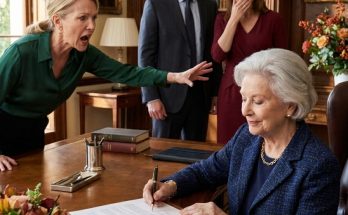
Mom died when I was forty-three.
Cancer.
Not Rachel’s cancer.
Different.
Fast enough to shock.
Slow enough for conversations.
She had six months.
In those months, she did something I will always respect.
She asked Lily whether Lily wanted one final meeting.
Not assumed.
Lily said yes.
They met at Mom’s house.
I was not there.
Claire was not there.
Later, each told me small pieces.
Mom apologized again for treating Lily as extension of betrayal.
Lily told Mom she did not consider her family exactly, but she no longer carried active anger.
Mom accepted.
Then Lily asked one thing:
“Do you have anything of Daniel’s that belongs with me?”
Mom cried.
Of course.
Dad’s belongings had sat in her house for decades.
Watch.
Letters.
Tools.
Photographs.
Some were mine by default because I was the recognized son.
But “default” was exactly what secrecy had created.
Mom told Lily:
“Yes.”
They went through a box.
Lily chose three things.
Dad’s high-school yearbook.
One photograph of him at twenty.
A small pocketknife.
Nothing expensive.
Mom offered more.
Lily said no.
Important.
She was not claiming half the house.
She wanted tangible connection.
Mom later told me:
“I should have done that years ago.”
“Yes.”
No need to comfort.
At death, Mom’s will left most estate to me.
She had updated after Lily entered our lives.
She left Lily a defined cash gift and a letter.
Not equal.
Why?
Mom’s estate came from her own work, savings, house, and assets accumulated with Dad but inherited by her after his death.
Lily was not Mom’s child.
Equal inheritance was not automatically appropriate.
We consulted estate attorney before Mom finalized.
No simplistic fairness.
Lily knew broad plan before death because Mom asked whether she was comfortable being named.
Good.
No surprises.
After funeral, estate administration proceeded.
I inherited Dad’s remaining personal items too.
That created discomfort.
The law and will were clear.
Emotion less.
I called Lily.
“Do you want to go through Dad’s things with me?”
She paused.
“Yes.”
We spent a Saturday.
Tools.
Old shirts.
Military? No, Dad had never served. Work badges.
Baseball glove.
Records.
Photos.
We divided by meaning, not equal count.
Lily wanted a photo of Dad holding her as baby.
I had never seen it.
She already had a copy but wanted original.
Of course.
I wanted Dad’s old camera.
Lily did not care.
His watch?
I offered.
She declined.
“Mark gave me Dad’s watch.”
Meaning Mark.
Her father.
That sentence was perfect.
No competition.
Then we found the unsent eighteenth-birthday letter.
Original.
Mom had kept it.
I asked Lily:
“Do you want this?”
She stared for a long time.
Then:
“No.”
I was surprised.
“Why?”
“I know what it says.”
“Do you want me to keep it?”
“Do whatever you want.”
I kept it for several years.
Then later asked again.
Still no.
Eventually I scanned for family archive and destroyed paper.
Not because Dad’s regret was unimportant.
Because an unsent apology should not become sacred relic simply because sender died.
Lily had lived without it.
She did not need to carry his cowardice physically.
That choice taught me something about inheritance.
Objects can carry meaning but also burden.
Not every artifact deserves preservation.
Mom’s estate closed without conflict.
Lily received her gift.
She donated part to an ovarian-cancer charity in Rachel’s name.
Used some for Sophie’s education account.
Her choice.
I used part of inheritance to pay down mortgage on a home Claire and I had bought together after marriage.
Joint property.
Clear.
Some went to retirement.
Some to travel.
No guilt.
Mom’s money became our future rather than memorial punishment.
After her death, I felt strangely untethered.
Both parents gone.
The people who knew the original story from inside were mostly dead.
Rachel.
Daniel.
Susan.
Claire remained.
Paul.
Lily.
But the central triangle was gone.
That made me think about narrative control.
If I wanted, I could now tell the story making Mom villain.
Or Dad.
Or Rachel.
No one could fully contradict.
Dangerous.
So I wrote a factual family history for myself.
Not public.
Dates.
Known facts.
What came from letters.
What Mom said.
What Claire said.
Where accounts differed.
No verdict.
Why?
Because memory edits.
I wanted future me not to confuse interpretation with fact.
Claire teased me.
“Of course you made a document.”
I married a woman who understood me.
The document later became useful when Sophie, at eighteen, asked about the family history.
Lily decided she was old enough.
We sat together.
Lily told her own story.
I told mine.
Claire answered only her part.
No one narrated Rachel beyond what letters supported.
Sophie listened.
Then asked:
“So Grandpa Daniel was kind of a coward?”
We all looked at each other.
Lily said:
“Sometimes.”
Good.
No hero destruction.
No sanitizing.
Sophie then asked:
“Why did everyone lie so much?”
Harder.
Fear.
Shame.
Protecting marriage.
Protecting children.
Protecting image.
Avoiding rejection.
Everyone had a reason.
Reasons multiplied secrecy.
Sophie said:
“That sounds exhausting.”
Exactly.
She grew up in a family where the secret was history, not active structure.
That was progress.
After Mom died, Claire feared I might finally resent her more because the connection she created had brought so much upheaval.
Instead, I felt the opposite.
I was still angry about how she began.
But Lily had become my sister independently.
Mom had faced truth before death.
Extended family adjusted.
The deception had consequences, yet the relationships that followed became real on their own.
Good outcomes did not justify the method.
They did prevent me from reducing the whole story to damage.
I could hate how the door opened and still value where I walked after.
That was perhaps the most mature version of forgiveness I reached.
Mom’s final months also gave me a chance to see how much she had changed around control.
Early in her illness, I wanted every detail.
Appointments.
Test results.
Medication.
She said:
“Ethan, I will tell you what you need to know.”
That irritated me.
Then I realized I was repeating the same mistake from opposite side.
Her illness did not erase her privacy.
I was her son.
Not owner of her medical chart.
We agreed I would attend major oncology appointments when she asked.
She kept some conversations private with doctor.
Fine.
As disease progressed, she shared more.
Choice adjusted.
Lily visited once during hospice only after Mom asked whether she would.
That meeting was quiet.
Mom apologized no more.
Important.
Repeated apology can become demand for reassurance.
She simply said:
“Thank you for coming.”
Lily replied:
“I wanted to.”
Good.
They watched television for an hour.
No historical summit.
Mom died days later.
That ordinary final interaction meant more than another confession would have.
She had spent enough years trying to repair with words.
By then, respecting Lily’s presence without extracting forgiveness was the repair.
Watching Mom die also changed how I later cared for Claire.
I learned that dying people still have preferences unrelated to family closure.
Food.
Light.
Who visits.
Whether they want to talk.
We should stop turning final days into our opportunity for answers.
If important questions exist, ask while people are alive and capable.
Do not wait for hospice.
That became one reason Claire and I had difficult conversations early.
Death is a poor scheduling tool for truth.
Click here to continue reading: PART 15: As Claire entered her seventies and I entered my fifties, we stopped pretending the future would be equal and built a marriage where care had limits without becoming conditional love
The photograph under Claire’s couch proved our Tinder match was not an accident, and the words on the back tied her to a part of my childhood I barely remembered
Part 14 of 16