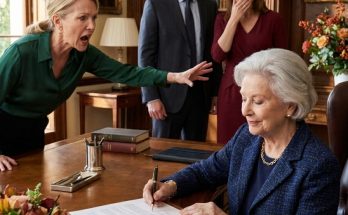
Claire was eighty-four when she stopped recognizing me consistently.
I was sixty-four.
Her cognitive decline had accelerated after an infection and hospitalization.
Not overnight.
But enough.
Some mornings she knew exactly who I was.
Some afternoons she called me Daniel.
That hurt in a way I had not prepared for.
The first time, I corrected sharply.
“I’m Ethan.”
Claire looked frightened.
I immediately regretted tone.
The memory-care specialist said:
“Correct gently when useful. Do not turn every error into a test.”
Good.
So when she called me Daniel later, I sometimes said:
“I’m Ethan, your husband.”
Sometimes:
“I’m here.”
Identity without interrogation.
Claire eventually moved into memory care because home support became unsafe.
I had promised myself I would not treat professional care as abandonment.
Still felt like failure.
Lily came with me on move day.
Sophie too.
We decorated Claire’s room with photographs.
Rachel.
Lily.
Me.
Trips.
Wedding.
No old couch photograph initially.
I was unsure.
Then Claire asked where it was.
She still remembered sometimes.
So I brought it.
Eight-year-old me in red jacket.
Back:
Ethan Mercer — eight years old. Daniel’s boy. I wonder if he’ll ever know.
Underneath:
He knows.
The photo sat in her drawer, not prominently.
Personal.
Claire’s final years were not a neat romantic lesson.
Dementia can be cruel.
Agitation.
Confusion.
Moments of clarity that create grief all over.
She sometimes asked for Rachel.
We said Rachel had died.
Then Claire mourned anew.
Eventually we learned not to repeat painful death every time unless necessary.
We said:
“Rachel isn’t here right now.”
Kindness can look different when cognition changes.
Truth remains important, but context matters.
That philosophical tension fascinated and hurt me.
Our entire marriage had been rebuilt on telling truth.
Now clinical guidance sometimes favored reassurance over repeatedly delivering distressing facts someone could not retain.
Was that deception?
Not the same.
Intent and capacity matter.
Claire could no longer use information to make long-term choices in the same way.
Our job became comfort consistent with her known values.
The documents she made while capable guided us.
Again, past Claire protecting future Claire.
That was agency extended through planning.
Lily visited regularly.
Their relationship became gentler.
No family-history debates.
She painted Claire’s nails.
Read magazines.
Sometimes Claire thought Lily was Rachel.
Lily cried afterward.
Then returned.
One day Claire looked at Lily and said clearly:
“You’re Rachel’s girl.”
Lily smiled.
“Yes.”
“And Ethan?”
“My brother.”
Claire looked across room at me.
For a second, perfect recognition.
“I made a mess.”
I laughed through tears.
“Yes.”
She smiled.
“Worth it?”
What a question.
I took her hand.
“You were worth knowing.”
That was true without calling deception worthwhile.
Claire nodded.
Maybe understood.
Maybe not.
She died at eighty-six.
Pneumonia.
Comfort-focused care.
I was sixty-six.
Lily sat with me.
Sophie came.
Mara.
A few friends.
No dramatic final confession.
Claire had confessed while alive enough to answer questions decades earlier.
That was one of the greatest mercies.
After death, estate administration was simple.
Our documents worked.
I remained financially secure.
Lily received the gift and personal items Claire designated.
Sophie received some jewelry.
Charities received bequests.
No hidden letters designed to explode.
Except one note Claire had left me years earlier, which I already knew existed and chose to read after death.
It said:
Ethan,
If you are reading this, then I am gone or no longer able to say this clearly.
I began our relationship by taking away information you needed to choose freely. I spent the rest of our life trying not to do that again.
Please do not turn staying with me into proof that what I did was acceptable. You forgave me because you chose to. Another person could have left and been right too.
I loved you before I deserved your trust, and I loved you after you gave some back.
Keep Lily. Keep your own life. Do not make grief your last loyalty to me.
Claire.
I read it twice.
Then put it away.
She understood.
The marriage did not need to become propaganda for forgiveness.
Staying had been my choice.
Leaving would have been legitimate.
That distinction protected the truth.
After Claire’s death, Lily and I became closer in a different way.
We were the two people left who shared both sides of the family story most directly.
Mark had died years earlier.
Paul too.
Mom and Dad gone.
Rachel gone.
Claire gone.
We did not spend every visit discussing them.
That would be exhausting.
We went to dinner.
Travel.
Sophie married.
I attended.
When the officiant asked for family photographs, I stood with Lily.
No one explained why.
We were siblings.
That was enough.
At seventy, I retired.
I had no children.
That had become my life, not a regret defining it.
Did I ever wonder?
Yes.
Claire and I had chosen without certainty.
Some years, I imagined a son.
Some years, I felt relieved by freedom.
Human decisions can contain grief for alternatives without being mistakes.
I stopped demanding one emotion.
I became close to Sophie and later her children.
Not substitute fatherhood.
Uncle.
Great-uncle.
Enough.
Lily once asked:
“If you could go back to the moment before your phone fell, would you want to know?”
I thought.
“Yes.”
“Even knowing what it did?”
“Yes.”
Then:
“But I wish Claire had told me.”
Important.
I did not romanticize accident.
Truth belonged to me before discovery.
Years later, I returned to Claire’s old townhouse neighborhood.
Different owner.
The couch long gone.
I did not knock.
No reason.
I sat at a nearby café and remembered first coffee.
Four hours.
Was it fake?
No.
That question had haunted me early.
If Claire approached because of hidden motive, was the conversation fake?
The motive was compromised.
Her enjoyment was real.
My enjoyment real.
Relationships can begin wrongly and contain genuine moments.
That complexity is uncomfortable.
Still true.
I stopped trying to classify six months as entirely false.
Claire listened because she was curious partly for bad reason.
Then because she cared.
Both.
The ethical failure remained:
She withheld information relevant to my choice.
Everything else could be evaluated separately.
That precision helped me forgive without rewriting.
Lily eventually gave me one more box after moving houses.
Rachel’s originals.
She had digitized what she wanted.
“Do you want any?”
We sorted together.
There were letters I had seen.
Photos.
The block-party original.
I stared at eight-year-old me.
Then at Rachel’s handwriting.
I wonder if he’ll ever know.
Lily said:
“Mom was dramatic.”
I laughed.
“So is Claire.”
“Was.”
We both went quiet.
Then smiled.
I kept the original photograph.
Not because I wanted shrine.
Because it had become part of my history.
Years later, when my memory began slipping slightly, I wrote labels on the back of family photographs.
Names.
Dates.
Relationships.
Not because I expected severe dementia.
Because Claire taught me memory is not guaranteed.
On the block-party photo, beneath Rachel’s line and my old pencil note, I added:
I found this at twenty-five in Claire Bennett’s couch. It led me to Lily Mercer Radek, my half-sister. Claire later became my wife.
That sentence looked impossible.
Still true.
No need for all drama.
Facts enough.
At eighty, I updated estate plan.
Lily was primary family beneficiary if she survived me.
Sophie next.
Charities.
No secret conditions.
Professional executor.
Medical directive.
No one should learn their place in my life only after death.
I told Lily broad structure.
She objected:
“You don’t owe me anything.”
“I know.”
There was that sentence again.
Choice.
I asked what personal items she wanted.
The photograph.
Of course.
I promised.
Then Lily died before me.
She was eighty-six? Wait. She was six years older than me. If I was eighty, she was eighty-six. Yes.
A stroke.
Fast.
I was devastated.
For the first time, the sibling relationship I discovered late ended.
We had forty-nine years.
Not childhood.
Still a lifetime of its own.
At her funeral, Sophie asked me to speak.
I said:
“I met Lily when I was twenty-five and she was thirty-one. Biologically, we had always been siblings. Relationally, we became siblings one cup of coffee, one phone call, one ordinary day at a time.”
That was enough.
I did not tell crowd about affair.
Not relevant.
Sophie inherited the original photo temporarily because Lily had it? Wait, I had kept it. After Lily died, she had requested it in estate, but I was alive. She had not received it. I still owned it.
After funeral, I showed Sophie.
She smiled.
“Mom loved that picture.”
“I know.”
“Can I have it someday?”
“Yes.”
No secret inheritance.
Direct.
At eighty-three, I moved into an independent senior community.
Not because Claire had been older.
Because I was older now too.
Time had closed the gap in an odd way.
When I was twenty-five and Claire forty-five, twenty years seemed enormous.
When I was sixty-six and she eighty-six, it felt enormous differently.
After she died, I continued aging.
Eventually I reached ages I once thought belonged to her, not me.
Forty-five.
Fifty.
Sixty.
Seventy.
Eighty.
Each milestone changed my understanding.
At forty-five, I realized Claire had not been ancient when we met.
She had been middle-aged.
Still uncertain.
Still capable of foolish decisions.
I had unconsciously treated her age as evidence she should have known better in every way.
She should have known better about the deception.
True.
But forty-five does not grant perfect emotional maturity.
At sixty, I understood my mother more too.
Fear feels young inside old bodies.
No excuse.
Context.
At eighty, I understood Dad’s fear of rejection differently.
Still cowardly.
Also recognizably human.
Aging did not absolve anyone.
It made motives less alien.
That changed compassion.
Not facts.
Sophie visited often.
Her children knew me as Uncle Ethan.
One great-nephew asked why I never had kids.
I answered:
“My life went another way.”
Enough.
At eighty-five, Sophie brought me the photograph after having it professionally scanned. Wait, I still had it. Better: she asked again and I gave it to her early.
I handed it over.
“I thought you were leaving it to me.”
“I am. Early.”
She laughed.
I had learned not to use death as delivery service.
Mom had.
Claire had.
We all learned eventually.
Sophie framed a copy for me and kept original safely.
Good.
One afternoon, I asked her to read the back aloud because my vision was worse.
She did.
Ethan Mercer — eight years old. Daniel’s boy. I wonder if he’ll ever know.
Then:
He knows.
Then my later note.
She smiled.
“That picture did a lot.”
“Yes.”
“Was Claire wrong to swipe on you?”
“Yes.”
Immediate.
“Are you glad she did?”
I thought.
“Yes.”
Sophie laughed.
“That makes no sense.”
“It does.”
A wrong choice can lead to things you value.
The valued things do not make the choice right.
Life is full of that.
If a driver takes a wrong road and finds a beautiful town, the road was still wrong for the destination.
Maybe bad analogy.
Still.
I was grateful for Lily.
For Claire.
For decades of love.
I also wished the first coffee had begun with:
Before we do this, there’s something you should know.
Both.
That became the final lesson I gave anyone who asked about relationships.
Do not protect people from choices that belong to them.
Tell the truth early enough that the other person still has room to say no.
Not every detail immediately.
Privacy exists.
But if information would reasonably change consent to the relationship, hiding it because you fear rejection is not protection.
It is control.
Claire learned.
I learned.
Mom learned.
Dad never fully did.
Rachel sometimes did and sometimes did not.
Lily lived the lesson best.
She gave people space to choose.
Maybe because choice had been denied around her from before birth.
Near the end of my life, I dreamed about the first coffee occasionally.
Claire across table.
Forty-five.
Confident.
Funny.
Already knowing.
In the dream, she tells me immediately.
“My sister had a daughter with your father.”
Dream-Ethan stands up.
Sometimes leaves.
Sometimes stays.
I never know which.
That is honest.
Maybe I would have walked out and never returned.
Maybe curiosity would have won.
Maybe Lily and I would have met sooner without romance.
No one can know.
That uncertainty is exactly why Claire had no right to choose for me.
But reality took the path it took.
And once I had the truth, every important step afterward became mine.
Meeting Lily.
Listening to Mom.
Trying again with Claire.
Marrying.
Not having children.
Caring through illness.
Staying.
Forgiving.
Those choices belonged to me.
That is why the story no longer felt like something that happened to me by the end.
It became something I participated in shaping after the secret broke.
The photograph under the couch opened a door.
The people behind that door were flawed.
Afraid.
Loving.
Cowardly.
Generous.
Selfish.
Human.
So was I.
Truth did not make us perfect.
It made our choices visible.
And once they were visible, we could finally own them.
THE END
The End
Read more original stories on Feel Every Story.
The photograph under Claire’s couch proved our Tinder match was not an accident, and the words on the back tied her to a part of my childhood I barely remembered
Part 16 of 16