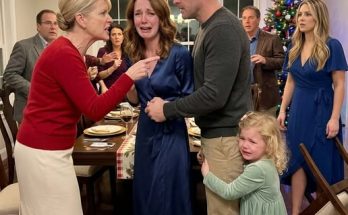
Linda was seventy-one when she asked to see me.
Years had passed.
Derek’s second marriage was over.
He lived in another state.
No known contact with me.
Paige wrote:
Mom has cancer. She is not asking forgiveness. She wants to apologize in person if you’re willing.
I felt nothing at first.
Then too much.
Linda in my old kitchen.
Knife in pie.
Eyes down.
She had not hit me.
She had helped violence survive through silence.
Was that something I needed to revisit?
Dr. Morris asked:
“What would make the meeting useful for you?”
Not for Linda.
For me.
I wanted to ask one question.
Why did you laugh?
That tiny uneasy sound after Derek said he slapped me.
I had remembered it for years.
Maybe incorrectly.
Maybe it was shock.
I wanted to know.
We met in a counseling office.
Neutral.
Paige drove Linda but waited outside.
Daniel knew where I was.
No need for police.
No active threat.
Linda looked small.
Cancer treatment had thinned her hair.
I did not hug her.
She said:
“Thank you for coming.”
I nodded.
Then asked immediately:
“Why did you laugh?”
She closed her eyes.
“I was scared.”
“Of Dad?”
“No. Of what Derek had just admitted.”
“Then why laugh?”
“Because I used to laugh when his father said horrible things too.”
That surprised me.
She explained.
A nervous appeasement response.
Make the violent man feel the room is still with him.
Reduce tension.
Keep him from escalating.
A survival habit from her own marriage.
She had carried it into mine.
That made terrible sense.
Then she said:
“But the reason doesn’t make it less awful.”
Good.
“I should have stood up.”
“Yes.”
“I should have helped you sooner.”
“Yes.”
“I’m sorry.”
I believed her.
That did not mean I wanted a mother-daughter relationship.
I said:
“I accept the apology.”
She cried.
Then:
“Do you forgive me?”
I hated the question.
It turned apology into a transaction.
Give me forgiveness.
I paused.
“I don’t know.”
She nodded.
Good.
Then I said:
“I’m not angry every day anymore.”
That was true.
Maybe enough.
Linda told me Derek had once apologized to her for “putting her in the middle.”
Not for hitting me.
Even years later, his framing centered inconvenience around the abuse.
That saddened me.
I did not ask more.
His growth was not my project.
Linda said she had attended a family-support program for relatives of abusive people.
Learned not to rescue Derek from consequences.
When his second marriage ended, she refused to call Rachel or blame her.
Good.
Changed behavior.
Late.
Still.
I asked:
“Do you still see Derek?”
“Yes.”
Honest.
“He’s my son.”
I understood.
Relationships can remain without endorsement.
A mother may love an adult child who did terrible things.
The question is whether love becomes concealment.
Linda said:
“I don’t lie for him anymore.”
That mattered.
We talked forty minutes.
Then stopped.
No childhood stories.
No future plans.
I left.
Two months later, Paige told me Linda had died.
I attended no funeral.
Sent flowers? That felt ironic. I sent a short condolence card to Paige.
No guilt.
No need to prove forgiveness by showing up.
Linda’s apology had done what it could.
My absence did not undo it.
That experience helped me understand one of the hardest truths about repair.
Not every repaired relationship resumes.
Sometimes repair means the truth is finally spoken, the harm is acknowledged, and both people go back to separate lives.
That is still repair.
Less cinematic.
More honest.
After Linda’s apology, I noticed I no longer needed everyone to agree about her.
Paige loved her.
Of course.
Some relatives called Linda a victim too.
Others called her an enabler.
Both labels captured parts and missed others.
I did not need to settle the family verdict.
That was freeing.
For years, I wanted a clean moral map.
Derek bad.
Linda complicit.
Dad good.
Me harmed.
Reality kept adding detail.
Dad had blind spots.
I lied to him.
Linda had been abused and enabled abuse.
Derek had once been tender and later violent.
I had sometimes shouted too.
Complexity does not create moral equivalence.
That was the key.
Two people can both have flaws while one is still using coercion and violence.
Understanding everyone’s humanity should sharpen judgment, not blur it.
The final meeting with Linda helped because she no longer used complexity as excuse.
She did not say:
We all made mistakes.
That phrase can flatten power.
She said:
I failed to protect you when I knew he was hurting you.
Specific.
That is why I believed her apology.
Good apologies preserve asymmetry where asymmetry existed.
They do not turn harm into shared misunderstanding.
I carried that lesson into my own apologies later.
Name what I did.
Do not dilute it with everyone’s imperfections.
After Linda died, Paige and I had one final conversation about family loyalty.
She said:
“I spent years thinking supporting my brother meant believing him.”
That was the trap.
Support and endorsement had merged.
She had eventually learned another model.
Love him.
Encourage treatment.
Refuse lies.
Do not pressure victims.
Do not pay legal bills automatically.
Do not cover consequences.
That distinction helped Paige remain his sister without becoming his shield.
I respected that.
We never became close.
Still, her change mattered.
It showed me family loyalty does not have to choose between cruelty and abandonment.
There is a middle path:
Care about the person while staying aligned with truth.
Harder than blind defense.
Much healthier.
One question stayed with me after meeting Linda:
What would I have wanted her to do back then?
Not fight Derek physically.
Not drag me from the house.
Not give me an ultimatum.
I think I wanted one clear sentence.
“This is not normal, and if you ever want help leaving, call me.”
That is all.
No judgment.
No pressure.
A door.
Linda had never offered one.
Years later, when a younger woman at work confided that her boyfriend had grabbed her wrist, I remembered.
I did not say:
Leave him now.
I did not say:
Maybe it was stress.
I said:
“That is not okay. If you want help thinking through safety or resources, I’ll help you find someone qualified.”
Then I stopped.
She thanked me.
I never learned every detail.
She eventually transferred offices.
That was fine.
Support does not require ownership of the ending.
That lesson came directly from what Linda failed to give me and what I later chose to give others differently.
It was one of the few useful things I could carry forward without turning my past into a permanent public identity.
Click here to continue reading: PART 12: Emily became a stepmother late in life and refused to let her past turn normal teenage conflict into surveillance, proving that safety and control are not the same thing even when fear feels justified
My father did not hit Derek — he did something that frightened my husband more, because for the first time an adult refused to treat his violence as a private family matter
Part 11 of 16