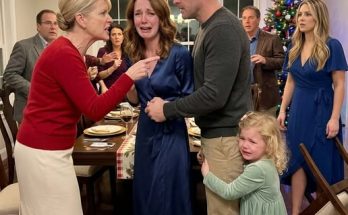
I was eighty-seven when Max asked me to tell the whole story.
Not for gossip.
He had a daughter.
My great-granddaughter, Sophie.
Twelve.
A friend at school had started talking about a boyfriend who checked her phone and told her what to wear.
Max wanted to know what our family should teach without terrifying children.
Good question.
We sat in the common room of my assisted-living wing.
By then, I needed help with medication and showers on bad arthritis days.
My mind was mostly clear.
Enough.
I told him from the beginning.
Birthday.
Cake.
Bruises.
Derek’s laugh.
Dad’s watch.
Rolled sleeves.
Back porch.
Police.
Court.
Divorce.
Linda.
Years.
I left out intimate details that belonged to me.
A full story does not mean no privacy.
Max listened.
Then said:
“I always thought Great-Grandpa beat Derek up.”
I laughed.
“Family storytelling.”
“So he didn’t touch him?”
“No.”
“Why do people say he did?”
“Because violence makes a cleaner story.”
That was true.
People like revenge.
Father sees bruised daughter.
Destroys husband.
Audience cheers.
But if Dad had hit Derek, what then?
Maybe arrest.
Maybe injury.
Maybe Derek used it to cast himself as victim.
Maybe I panicked.
Maybe the legal case became muddier.
Maybe nothing changed.
We do not know.
What we do know:
Dad called police.
Got me safe.
Did not make me manage his anger.
That was the stronger act.
I told Max:
“Teach Sophie that someone checking her phone constantly is not automatically proof of future violence. It is a reason to ask whether she feels pressured and whether no is respected.”
“Specific behavior.”
“Yes.”
“Not monsters.”
“Yes.”
He smiled.
“You sound like a therapist.”
“Expensive years of training.”
We laughed.
Then Sophie came in carrying vending-machine chips.
She sat beside me.
“What are you talking about?”
Max looked at me.
I let him answer.
“Relationships.”
She groaned.
“Ew.”
Perfect.
Children deserve not to be recruited into adult gravity before they need it.
Later, when she was older, she would hear more.
Maybe.
Her father could decide with her.
Not my job to make trauma hereditary.
That became one of my last important choices.
At eighty-eight, my health declined after pneumonia.
Not dying immediately.
Enough to move from assisted living to higher care.
Chloe handled logistics according to my documents.
She asked whenever I could decide.
One afternoon, I accused her of moving me because it was easier.
She cried.
I felt terrible later.
But at the time, fear was real.
Losing mobility felt like losing authority.
Chloe did not say:
After everything I do for you.
She said:
“Do you want Denise from care planning to come explain the reasons again?”
Yes.
We reviewed.
Falls.
Medication errors.
Night confusion after infection.
Need.
Evidence.
I still disliked the move.
Agreed it was safer.
Both.
That mattered.
A decision can be right and still feel like loss.
I had learned that from my house sale decades earlier.
The principles held.
No one took my glasses.
No one hid forms.
No one pretended sadness meant consent.
They explained.
I asked questions.
When I could no longer make some decisions consistently, the people and systems I had chosen stepped in.
Not perfectly.
Human systems never are.
But with records.
Oversight.
Defined authority.
That was enough.
Chloe once asked:
“Do you think you became obsessed with control because of Derek?”
I corrected her.
“Choice.”
“Difference?”
“Big.”
Control says:
Everything must go my way.
Choice says:
I should have a real say where it belongs.
Sometimes the answer is no.
Sometimes another person’s rights limit me.
Sometimes illness limits me.
Sometimes law.
Autonomy is not getting everything you want.
It is being treated as a participant in your own life.
That was what Derek took.
Not only through hitting.
Through fear.
Money.
Silence.
The belief that his anger decided what was possible.
Leaving rebuilt participation.
Decision by decision.
That was the story.
Not the bruises alone.
Derek had died years earlier.
Linda too.
Dad too.
Daniel.
So many people gone.
I no longer felt anger most days.
That did not mean what happened became acceptable.
Time can reduce emotional heat without changing moral fact.
I was grateful for that.
Permanent rage would have been another prison.
One evening, Max brought Sophie, now seventeen.
By then, Sophie had her own boyfriend, Eli.
She said:
“Dad told me your rule.”
“What rule?”
“If someone punishes your no, pay attention.”
I smiled.
Good rule.
Not perfect.
No single rule is.
But useful.
She asked:
“Did you forgive Derek?”
Everyone wants that question.
I said:
“No.”
She looked surprised.
“Never?”
“I stopped wanting anything from him.”
“Isn’t that forgiveness?”
“Maybe to some people.”
I shrugged.
Words matter less than outcome.
I did not need revenge.
Did not need reunion.
Did not need him miserable.
Did not need him absolved.
I needed my life.
I got it back.
That was enough.
Sophie thought.
Then:
“What happened to the cake?”
I laughed.
Of all details.
“Your great-great-grandfather and I froze it and ate it later.”
“Was it gross?”
“A little.”
She grinned.
That was the story I wanted her to carry too.
Not only violence.
Soggy cake.
Dad joking.
Life after.
Years earlier, I had thought healing might mean the birthday no longer hurt.
Wrong.
Some years it still did.
Less.
Then barely.
Then one year I forgot until evening.
That surprised me.
Trauma anniversaries can shrink without permission.
The body gets new calendars.
New birthdays.
New people.
At ninety, my birthday was simple.
Chloe.
Max.
Sophie.
Strawberry shortcake.
They insisted.
No balloons.
I wore a blue cardigan.
On the table beside me sat Dad’s old watch? I had given it to Max. Max wore it after repairing? Nice.
Max had repaired Dad’s silver watch and wore it.
I noticed.
“Works?”
“Mostly.”
“Like us.”
He laughed.
We ate cake.
Sophie asked whether I wanted candles.
“No.”
“Why?”
“Fire hazard.”
Everyone laughed.
No secret meaning.
Just age.
That was the final victory.
Not every ordinary choice needed to symbolize Derek.
My life had become large enough that cake could be cake again.
A week later, I had a minor stroke.
Recovered partly.
Speech slower.
Walking harder.
The family followed the plan.
No crisis takeover.
No emotional bargaining.
Chloe managed health decisions when I could not.
Professional fiduciary handled money.
Max visited.
Sophie read to me sometimes.
Nobody asked what they would inherit.
Good.
My remaining money paid for my care.
Also good.
I had no children of my own, but Chloe had become family by choice and years.
My estate reflected that.
Some to her.
Some to Max.
Some charitable gifts to the domestic-violence program that once gave me Mara’s number.
Not because I wanted my identity tied forever to abuse.
Because practical help had mattered.
No foundation in my name.
No plaque.
Just money.
Use it.
My final letter to family was short.
I wrote it while I still could.
It said:
If you remember one thing about me, please do not make it the bruises.
Remember that I liked terrible cereal for exactly one bowl.
Remember your grandfather’s soup.
Remember Daniel’s bad dancing.
Remember I changed my mind often and survived it.
And if you love someone who is afraid, help them hear their own voice again. Do not replace it with yours.
That was all.
No mention of Derek by name.
He already had enough pages.
I died at ninety-one.
Quietly, according to Chloe.
She and Max were there.
Sophie arrived later.
No dramatic last words.
No need.
The story had already ended in the years before.
When Dad walked into my kitchen on my thirty-second birthday, everyone expected the important moment to be what he did to Derek.
The important moment was what he did not do.
He did not make violence the answer.
He did not tell me what my life had to become.
He created enough safety for me to begin choosing.
Then I had to do the rest.
Police could remove Derek for a night.
A protective order could create distance.
A divorce decree could end a marriage.
A therapist could help me understand patterns.
My father could stand beside me.
None of them could live for me.
That part was mine.
I rebuilt finances.
Friendships.
Work.
Love.
Family.
Old age.
I learned that no is useful only when it can exist without punishment.
That an apology matters most when behavior changes afterward.
That understanding someone’s history does not require accepting their harm.
That help can become control when the helper’s fear matters more than the other person’s choice.
That accountability needs consequences and also, eventually, an endpoint.
That people are more than the worst thing they did without being less responsible for it.
Derek had once smirked and announced he hit me because he believed the room would absorb his cruelty.
Linda would look down.
I would stay quiet.
Dad would be polite.
Life would continue.
He was wrong about one thing that morning.
Silence is not permission.
Sometimes silence is fear.
Sometimes shock.
Sometimes survival.
And sometimes, after enough safety returns, silence ends.
Mine did.
Not all at once.
One statement.
One signature.
One locked door.
One bank account.
One no.
One yes.
One ordinary birthday at a time.
One final thing became clear to me as I aged: boundaries are strongest when they are ordinary.
Not delivered as threats.
Not saved for emergencies.
Just part of how relationships work.
Ask before entering.
Ask before borrowing.
Ask before making plans on someone else’s behalf.
Accept no without punishment.
If a person changes their mind, discuss it without turning that change into betrayal.
Those habits sound small.
They are the opposite of coercion.
Derek’s violence had been the loudest part of the marriage, but the deeper damage came from years of teaching me that his preference carried more weight than mine.
Recovery reversed that lesson through repetition.
Safe people asked.
I answered.
Sometimes yes.
Sometimes no.
Nothing exploded.
That normality rebuilt trust in my own voice more than any dramatic confrontation ever could.
By the end of my life, I no longer thought of boundaries as walls.
They were doors with handles on both sides, opened by choice instead of force.
That was the life I wanted younger Emily to know was possible.
And because those boundaries had become ordinary, they no longer felt like reactions to Derek. They felt like mine. That distinction was the last piece. A life rebuilt only in opposition to an abuser still gives him too much influence. Mine eventually stopped being about proving I was free. I simply was. I made plans, changed them, trusted people, disappointed people, accepted help, refused help, loved again, grieved again, and grew old. Freedom became ordinary enough that I no longer noticed it every day. That was when I knew the rebuilding was complete.
THE END
The End
Read more original stories on Feel Every Story.
My father did not hit Derek — he did something that frightened my husband more, because for the first time an adult refused to treat his violence as a private family matter
Part 16 of 16