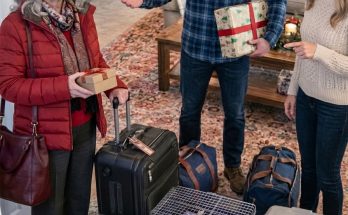
I came home after nine months.
Not permanently.
The ship had a scheduled break and itinerary change in California.
I flew to Arizona for ten days.
Austin offered to pick me up.
I said yes.
At the airport, he hugged me.
A real hug.
Long enough to feel awkward.
I liked it.
“You look different.”
“So do you.”
“I lost twelve pounds.”
“I got tan.”
“You got old-person tan.”
“I can still put you in my will badly.”
He laughed.
That joke would have been dangerous months earlier.
Now it worked.
Chloe waited at the apartment with my grandson.
He ran toward me.
That nearly broke me.
Children change in nine months.
Words.
Height.
Face.
I had missed things.
Freedom has costs too.
I did not regret going.
But I refused to romanticize it.
We ate dinner.
The apartment was smaller and warm.
The cat wandered freely.
The rabbit had a proper enclosure.
The birds were obnoxiously healthy.
Chloe smiled when she caught me checking.
“Everyone survived.”
“Yes.”
“So did we.”
That mattered.
The next morning, I went to my house.
Ruth met me there.
Nothing dramatic had happened.
The fence was repaired.
A faucet needed replacing.
Dust existed.
Ernest’s chair was still in the living room.
That undid me.
I sat in it and cried for twenty minutes.
Travel had not made the house neutral.
It was still our house in my body.
Then I opened windows.
Washed sheets.
Called the plumber.
Life resumed.
Austin came over later.
He stood in the doorway.
“Can I come in?”
I looked at him.
He had once walked in without knocking.
Now he asked.
“Yes.”
That small question meant more than he knew.
We walked room to room.
He looked at his father’s workshop.
Touched a screwdriver.
Then asked, “What are you going to do with the house?”
Same question.
Different tone.
This time, I answered.
“I don’t know.”
He nodded.
“No rush.”
I looked at him.
“Thank you.”
We sat at the kitchen table.
I told him I had updated estate documents temporarily.
He became tense.
“Am I out?”
“No.”
“Okay.”
“But I need you to understand inheritance is not a plan for your life.”
He looked embarrassed.
“I know.”
“Do you?”
“Yes.”
He told me he had thought about the house because their housing costs frightened him.
And because losing Ernest made him think suddenly about death, property, what happens next.
“That doesn’t excuse asking at the cemetery.”
“No.”
“I’m sorry.”
Another specific apology.
I accepted.
Then I told him something he did not know.
Ernest and I had planned to eventually sell the house.
“Dad wanted to sell?”
“Yes.”
“When?”
“When maintaining it got annoying.”
Austin laughed.
“That sounds like him.”
“He wanted a smaller place near water.”
“Seriously?”
“Yes.”
The house was not sacred to Ernest.
That surprised Austin.
Maybe it freed him too.
During my ten days home, I did not babysit automatically.
I did babysit once.
Because I wanted to.
Austin asked.
Chloe asked.
They gave me start and end times.
They brought dinner.
When they returned, Austin said, “Thanks.”
I said, “You’re welcome.”
No resentment.
That was how it was supposed to feel.
On the ninth day, Chloe asked if I was sad to leave again.
“Yes.”
“Then why go?”
“Because sad and wrong are not the same thing.”
She nodded.
I had learned that at sea.
I flew back to rejoin the ship.
At the gate, Austin hugged me again.
“Come back eventually.”
“I will.”
“Not because we need you.”
I looked at him.
“Good.”
“Because we miss you.”
That was the sentence I had been waiting my whole adult motherhood to hear.
During my short visit home, one thing almost triggered a full relapse into old habits.
Austin came by with laundry.
Not intentionally for me.
He had picked up the grandchildren and realized the bag was in his trunk.
He set it inside while we talked.
I saw shirts spilling out.
My hands practically moved on their own.
Sort.
Wash.
Fold.
I had done his laundry until he was twenty-two.
Then whenever he stayed over.
Then baby clothes during Chloe’s recovery.
I picked up one shirt.
Stopped.
Austin noticed.
“What?”
“Nothing.”
I put it back in the bag.
He laughed.
“You almost did my laundry.”
“Yes.”
“Do you want to?”
“No.”
“Then don’t.”
We both laughed.
That moment sounds stupid.
It was not.
Patterns live in muscle memory.
You can understand a boundary intellectually and still find yourself reaching for the detergent.
Austin took the bag home.
Nobody suffered.
The next morning, I noticed how light the laundry room felt without anyone else’s clothes in it.
The visit home also gave me a chance to see Ernest’s grave.
I had dreaded it.
The funeral was the last time I had been there.
Travel made me feel guilty for not visiting some imaginary required number of times.
At the cemetery, I brought no flowers.
Ernest hated cut flowers.
I sat on the ground.
Told him everything.
The animals.
The ship.
The broken ankle.
Austin’s smaller apartment.
Chloe’s apology.
The yellow scarf.
Then I said, “I’m still angry you left.”
That was the first time I said it out loud.
Death is not a choice in most cases.
Still, grief contains irrational anger.
I had been ashamed of mine.
The cemetery did not collapse.
Ernest did not become less loved.
I sat there until the sun became uncomfortable.
Then went home.
Not healed.
Lighter.
Before rejoining the ship, I gave Ruth a spare key again and thanked her properly. She said, “Do not make me the new you.” I laughed. She meant it. Friendship also needed limits. She would check after storms and call if something looked wrong. She would not become unpaid property management because I was traveling. We agreed clearly, and the agreement made the favor feel safe.
At the airport before I flew back to the ship, my grandson cried because he wanted to come with me. I nearly canceled. The instinct was that strong. Chloe knelt beside him and said, “Grandma is going on her trip. We’ll see her soon.” She did not ask me to stay. She taught him that loving someone does not mean stopping them from leaving. I never forgot that.
When I left Arizona again, I put the house key back into Ruth’s hand instead of hiding it in the planter like I used to. “Emergencies only,” I said. “I know,” she replied. Clear agreements are kinder than hoping people guess what access means.
Back onboard, I slept badly the first night because home suddenly felt close again. Then the ship moved. The familiar vibration under the floor returned, and I remembered I could belong in more than one place without betraying either.
Click here to continue reading: PART 9: The Final Months of the Cruise Taught Theresa That Reinvention Was Not Becoming Someone New but Finally Making Room for Herself
The Morning My Son Left Three Pet Cages Beside Ernest’s Memorial, I Finally Stopped Being Everyone’s Automatic Backup Plan
Part 8 of 16