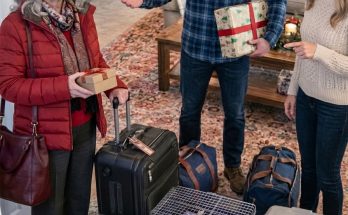
The morning I returned, Austin did not enter the house.
He knocked.
Three times.
I stood behind the door smiling like an idiot.
Then opened it.
He held flowers.
Chloe stood beside him holding a casserole.
My grandson carried a card he had colored mostly outside the lines.
No cages.
No bags.
No list of instructions.
“Welcome home,” Austin said.
I hugged him.
Then Chloe.
Then my grandson.
The house smelled different after a year.
Closed wood.
Cleaning solution.
Dust no matter how good the property manager had been.
Ruth had opened windows.
The living room looked nearly the same.
Ernest’s photograph remained on the mantel.
His memorial candle was gone.
That was right.
Memorials are not meant to become permanent household weather.
We ate at the kitchen table.
Austin asked about Japan.
Chloe asked about the fracture.
My grandson asked whether whales could eat ships.
Nobody asked what I planned to do with the house.
That was progress.
After lunch, Chloe stood.
“We should go. You’re probably exhausted.”
I stared at her.
Old Chloe would have stayed until I cooked dinner.
“Thank you.”
At the door, Austin said, “Call if you need anything.”
Not: We’ll come by.
Call.
Choice.
The house was quiet after they left.
I sat in Ernest’s chair.
This time, I did not cry.
I put my hand on the armrest.
“I’m back,” I said.
Maybe that was silly.
Maybe grief needs silly rituals.
Over the next weeks, I returned to ordinary life.
Doctor appointment.
Insurance.
Groceries.
Mail.
The plumber.
Travel did not eliminate administration.
It simply gave me a better attitude toward it.
Austin visited once a week at first.
Then less.
Our relationship felt healthier without urgency.
Chloe invited me to dinner.
I accepted.
Another time, I declined.
Nobody sulked.
That was new.
My grandson began staying over once every few weeks.
Not because his parents needed emergency childcare.
Because we wanted time together.
I built a small shelf of toys.
Bought a toothbrush.
Made pancakes.
He once asked, “Grandma, do you live on a boat?”
“Not anymore.”
“Why?”
“Because I wanted an adventure.”
“Can I have one?”
“When you’re older.”
He thought about that.
“Tomorrow?”
Close enough.
The biggest decision remained the house.
I had spent a year imagining it as both anchor and burden.
Now I saw it clearly.
Three bedrooms I rarely used.
A yard Ernest had loved more than I did.
High maintenance.
Memories everywhere.
Good memories.
Painful ones.
I met with a real-estate agent.
Only for information.
The house had appreciated substantially.
Selling could free enough equity for a smaller home, long-term travel, and more financial flexibility.
I told Austin before listing anything.
Not because he had ownership.
Because this house had been his childhood home too.
He went quiet.
Then said, “I’ll be sad.”
“So will I.”
“Are you asking permission?”
“No.”
He smiled.
“Good.”
“I’m asking if there are things here you want to go through before I decide.”
“That’s fair.”
We spent two weekends sorting Ernest’s workshop.
Tools.
Fishing gear.
Old papers.
A box of Austin’s school projects I had forgotten.
He laughed at his handwriting.
I cried over a Father’s Day card.
We kept some.
Donated some.
Threw away more than I expected.
Objects are terrible at knowing when their meaning has expired.
People have to decide.
When we finished, Austin looked around the almost-empty workshop.
“I think Dad would’ve sold.”
“I know.”
“So do whatever you want.”
That blessing was not legally necessary.
Emotionally, it mattered.
Returning home also exposed a practical problem I had avoided.
My driver’s license would expire the following year.
The townhouse decision was not yet made.
Medical providers needed updated contacts.
Travel insurance ended.
Life became administrative again.
For a few days, I resented it.
On the ship, someone else handled meals, repairs, transportation, and emergencies.
At home, freedom included chores.
That was healthy to remember.
Independence is not being served.
It is being able to choose, manage, and ask for help when needed.
I reorganized my finances.
Automatic bill pay.
Paperless statements.
A separate travel account.
Home maintenance reserve.
No joint accounts with Austin.
Not because I distrusted him.
Because clean ownership prevents confusion.
I added him as emergency contact, not co-owner.
That difference mattered.
Martin approved of the clarity.
He also suggested I keep a written household information sheet in case of hospitalization.
Utilities.
Insurance.
Doctor.
Medication.
Property manager.
Not passwords scattered everywhere.
Just enough information for someone to help without taking over.
That became my model for aging.
Prepare for help.
Do not surrender independence early out of fear.
The property manager also gave me a final report when I returned.
Minor roof maintenance.
Fence repair.
One plumbing issue.
No disasters.
I realized how much anxiety I had carried about leaving a house unattended.
The world did not punish me for going.
That sounds childish.
But people who have spent decades being responsible often believe absence itself causes failure.
If I am not here, something will go wrong.
If I do not handle it, nobody will.
The house contradicted that belief.
Professionals handled repairs.
Ruth checked after storms.
Austin helped when asked.
Systems worked.
I was not the only competent adult in Arizona.
That was humbling.
And freeing.
The first month home, I deliberately left some days empty. That was harder than travel because errands appeared instantly. Dentist. Bank. Family dinner. Repairs. I could have filled every hour by Wednesday. Instead I protected one day a week with nothing scheduled. Sometimes I wasted it gloriously. Sometimes I saw Paul later on. The point was that availability was no longer the default setting of my calendar.
Ruth later told me the neighborhood had talked about my trip. Some admired it. Some thought it irresponsible. One woman apparently said, “At her age?” Ruth asked whether I wanted names. I said no. That was another milestone. I did not need to know every judgment in order to live with my own decisions.
After returning, I joined a local walking group because I missed the promenade deck. The first week, nobody asked whose widow I was. They asked whether I preferred morning or evening routes. I liked being known through current choices instead of only through loss.
The walking group eventually became part of my week. Nobody needed me to organize it. I simply showed up. Being a participant instead of the responsible person was a role I had almost forgotten existed.
Click here to continue reading: PART 11: Selling the Family House Forced Austin to Grieve His Father Differently, but Theresa Refused to Let Nostalgia Become Another Obligation
The Morning My Son Left Three Pet Cages Beside Ernest’s Memorial, I Finally Stopped Being Everyone’s Automatic Backup Plan
Part 10 of 16