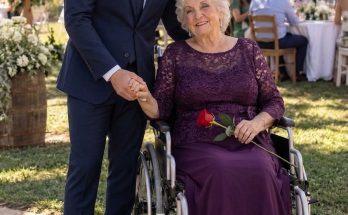
Ten years after Grandpa died, I went back to the old neighborhood.
Not for an anniversary.
Not for a legal matter.
Not because anyone had died.
The community college invited me to a scholarship luncheon.
Grandpa’s scholarship fund had grown.
Mr. Harrison retired years earlier.
Mrs. Collins moved to Arizona.
But the fund remained.
Investment returns.
Small donations from the hardware store.
A contribution I started making after my promotion.
The Harold Whitmore Continuing Education Scholarship helped adults returning to school after interruption.
That detail came from Grandpa.
He had taken night classes after the Army.
He believed second chances should come with bus fare.
That was almost certainly how he would have phrased it.
The scholarship recipient that year was a thirty-four-year-old father named Luis.
He worked maintenance at a school district.
He wanted an associate degree in electrical technology.
At the luncheon, he shook my hand.
“Mr. Whitmore was your grandfather?”
“Yes.”
“You must be proud.”
“I am.”
That word no longer hurt.
Afterward, I drove past the house.
The new owners had painted the front door blue.
Grandpa would have hated it.
The porch was repaired.
A bicycle lay in the grass.
Curtains moved in an upstairs window.
I did not stop.
That surprised me.
For years, I thought closure would require standing on the porch one last time.
It did not.
The house belonged to someone else.
That was good.
My life had moved.
So had theirs.
At forty-two, I had become regional director for three rehabilitation facilities.
I still kept a small clinical caseload because management meetings made me miss actual patients.
I owned the townhouse.
The lilac cutting Mom gave me had become a full shrub.
Every spring, it flowered.
Brianna and Marcus had two children now.
Lucy and Jonah.
They called me Aunt Em, which Grandpa would have found unbearably funny.
Mom and Dad were older.
Dad walked with a cane after his second knee surgery.
Mom complained about doctors and then followed every instruction.
We had Sunday dinner once a month.
Not every week.
That would have been too much for all of us.
The dinners rotated.
Sometimes Mom cooked.
Sometimes Brianna.
Sometimes me.
No one assigned me the work because I was “strong.”
No one asked me to surrender because someone else was “sensitive.”
Those phrases disappeared from our family vocabulary.
Not by rule.
By embarrassment.
At one dinner, Lucy asked the question we always knew would come.
She was eight.
Old enough to study photographs.
“Why are there no pictures of Aunt Emily with Grandma and Grandpa when she was a kid?”
The table went quiet.
Mom looked at me.
Not to make me answer.
To ask permission.
That small glance told me more about her change than any apology.
I nodded.
Mom put down her fork.
“Because when Aunt Emily was little, I made a very bad decision.”
Lucy frowned.
“What?”
“I let her live with Great-Grandpa Harold, and then I stayed away for a very long time.”
“Why?”
Mom breathed in.
“I was sick and scared at first.”
She looked at me.
“Then later I was ashamed. And instead of fixing what I had done, I kept avoiding it.”
Lucy considered this.
“That was mean.”
Brianna covered her mouth.
Dad stared at his plate.
Mom nodded.
“Yes.”
“Did Aunt Emily forgive you?”
Every adult at the table froze.
Children find the exact land mine.
I answered.
“Some parts.”
Lucy looked confused.
“You can forgive parts?”
“I can.”
“What parts?”
“I forgave Grandma for being afraid.”
Mom’s eyes filled.
“I forgave her for not knowing how to fix everything immediately.”
I paused.
“But I still think leaving me for seventeen years was wrong.”
Lucy looked at Mom.
Grandma nodded.
“It was.”
“And you still eat dinner together?”
“Yes.”
Lucy shrugged.
“Okay.”
Then she asked for more potatoes.
That was it.
No inspirational music.
No family collapse.
Truth entered the room and dinner continued.
I thought Grandpa would have loved that.
Later, Mom helped me wash dishes.
“You didn’t have to protect me.”
“I wasn’t.”
“I know.”
She dried a plate.
“That’s what made it better.”
Dad sat in the living room with Jonah building a wooden train track.
Brianna packed leftovers.
Marcus argued with Lucy about bedtime.
Ordinary.
The ordinary life I once thought had been stolen forever.
Not the same life.
A different one.
After everyone left, I opened Grandpa’s letter.
I still kept it in a fireproof box.
The paper had softened at the folds.
I read the line again.
Do not let the house make you cruel.
For years, I thought he meant my parents.
Do not use ownership to punish them.
Then I thought he meant the building.
Do not let memory trap you.
Now I understood something else.
He meant the whole inheritance.
Pain could become property too.
You could guard it.
Polish it.
Build identity around it.
Refuse to let anyone near it because it was the one thing nobody could dispute belonged to you.
I had been abandoned.
That was mine.
But it did not have to be the house I lived in forever.
The next week, I met Mom for coffee.
She arrived late.
Seven minutes.
I teased her.
“You abandoned me again.”
Her face went white.
I immediately regretted it.
Then she saw my expression.
And laughed.
Actually laughed.
“So we’re doing those jokes now?”
“Apparently not. Too soon.”
“It’s been thirty-seven years.”
“Still testing.”
She stirred her coffee.
Then looked at me.
“Your grandfather would have laughed.”
“He absolutely would.”
We sat near the window.
Outside, rain moved across the parking lot.
Warm spring rain.
I thought about the morning my parents returned.
Mom with garbage bags.
Dad directing movers.
Brianna claiming a bedroom.
Me in Grandpa’s flannel shirt, trying not to break apart one day after burying him.
At the time, I thought the great reveal would be the deed.
The trust.
The fact that the house was mine.
It wasn’t.
The real thing Grandpa left me was evidence that I did not have to argue for my own reality.
He had documented his choices.
He had protected my home.
Then he trusted me to decide what came after.
I did.
I kept the house.
I repaired it.
I changed it.
I sold it.
I built a career.
I learned my sister.
I let my parents tell the truth without allowing their truth to replace mine.
I accepted apologies that were specific.
Rejected excuses that were not.
I learned that forgiveness could be partial.
Access could be limited.
Love could exist beside accountability.
And family did not become real because everyone returned.
It became real because those who returned learned how to stay without taking over.
On Grandpa’s birthday that year, we all went to the cemetery.
Mom brought flowers.
Dad brought nothing and apologized to the grave for forgetting.
Brianna brought Lucy and Jonah.
I brought coffee.
Grandpa would have preferred that.
We stood there together.
Not the family we had been.
Not the family we should have been.
The family we had managed to become.
Before leaving, I touched the top of the stone.
“House is fine,” I said.
Brianna looked at me.
“You sold it ten years ago.”
“I know.”
Mom smiled.
Dad shook his head.
I looked at Grandpa’s name.
The house was not the building anymore.
Maybe it never had been.
It was the part of me he had raised to know that being wanted and being owned were not the same thing.
That love without behavior was not enough.
That boundaries did not make a person cruel.
And that sometimes the strongest thing you can inherit is the certainty that you are allowed to choose what happens next.
A few months after the scholarship luncheon, Mr. Harrison mailed me one final box from his retired office.
He had found it while clearing old estate files.
Inside was a copy of Grandpa’s first will from years before I came to live with him.
Everything had gone to Mom.
Simple.
One page.
No trust.
No scholarship.
No provisions for me.
I sat at the table staring at it.
Then I found the later drafts.
Changes appeared gradually.
After I had lived with him two years, he added a small education fund for me.
After five years, he gave me the right to remain in the house until age twenty-five if he died.
After ten years, he created the living trust.
After I turned eighteen, he amended it again.
The final version came three years before his death.
The plan had evolved as our lives did.
That moved me more than if he had written my name across everything immediately.
He had not treated inheritance as revenge.
He had responded to reality.
Mom was still included.
Brianna’s future children were included.
The scholarship existed.
He had balanced protection with relationship.
I called Mr. Harrison.
“You kept all these?”
“Of course.”
“Why send them?”
“Because Harold wanted the planning file released to you after ten years.”
I laughed.
“He planned a ten-year surprise?”
“He enjoyed deadlines.”
That was true.
“Did he say why?”
“Yes.”
Mr. Harrison paused.
“He said by then you’d know whether the house had become a gift or a burden.”
I looked around my townhouse.
The old house was long sold.
My answer was clear.
“It was a gift.”
“I thought so.”
After the call, I showed the documents to Mom.
We sat together at my table.
She read the first will.
Everything to her.
Her eyes filled.
“He trusted me once.”
“Yes.”
She read the next version.
Then the next.
Watched herself slowly become one beneficiary among several.
“I lost this one decision at a time.”
I did not correct her.
Grandpa’s estate plan had changed one decision at a time.
So had our family.
Mom touched the final trust summary.
“I used to think Dad changed his will because he was angry.”
“Maybe he was angry.”
“Yes.”
“But that wasn’t all.”
“No.”
She looked at me.
“He was building around what actually happened.”
Exactly.
That night, after Mom left, I added the planning drafts to the fireproof box.
Not because I expected another fight.
Because documents can become family history when people are ready to read them honestly.
Someday Lucy or Jonah might ask.
Someday I might forget details.
The papers would not tell the whole story.
But they would keep us from pretending there had only ever been one version.
That was enough.
The following spring, Luis—the scholarship recipient I had met at the luncheon—emailed me.
He had finished his first semester.
One B.
Two A’s.
And one electrical theory class that, in his words, “nearly killed me but apparently failed.”
He asked whether I would meet him for coffee.
I almost said no.
Not because I did not want to help.
Because I had spent years learning not to turn every request into responsibility.
Then I read his email again.
He was not asking for money.
He wanted advice about balancing work, school, and family.
So I said yes.
We met near the community college.
Luis arrived in his work uniform with grease on one sleeve.
He apologized.
“Came straight from the district.”
“Grandpa would have approved.”
He smiled.
“I wish I met him.”
“You would have gotten a lecture about buying used textbooks.”
“I already do that.”
“Then he’d like you.”
We talked for an hour.
He told me he had almost dropped out after missing two classes when his son got sick.
His wife worked nights.
His supervisor refused to change his schedule.
He felt selfish every time school took him away from home.
I listened.
Then I told him the thing Grandpa had told me when I was nineteen and wanted to quit community college because working full-time seemed more responsible.
“If you only build your life around emergencies, you never get to build anything permanent.”
Luis wrote it down.
I laughed.
“He would hate that.”
“Why?”
“Because now it sounds inspirational.”
We both smiled.
I did not solve his schedule.
I did not call anyone.
I did not offer money.
I helped him think through options.
Student services.
A different section.
Talking to his supervisor with a concrete request.
Asking his wife what burden was actually hardest instead of guessing.
He left with a plan that belonged to him.
That mattered.
On the drive home, I realized how much of my life had been shaped by people deciding things for other people.
Mom deciding I was better off with Grandpa.
Dad deciding silence protected his marriage.
Grandpa deciding the house needed legal protection.
Brianna being told I did not want her.
Even love had often arrived in our family as assumption.
I had spent adulthood learning a different way.
Ask.
Listen.
Document when needed.
Say yes deliberately.
Say no clearly.
Let other adults carry what belongs to them.
That evening, I called Mom.
“Random question.”
She laughed.
“Those are always dangerous.”
“If you could go back to when I was five, what would you do differently first?”
She did not answer immediately.
“I’d tell you the truth.”
“What truth?”
“That I was sick.”
I waited.
“And?”
“That staying with Grandpa was temporary because I needed help. Then I’d keep telling you what was happening instead of disappearing.”
That answer surprised me.
Not “I’d never leave you there.”
Maybe that would have been impossible at first.
The problem was not that she accepted help.
The problem was turning help into abandonment through silence.
“I think that’s right,” I said.
“What would you do?”
“I was five.”
“You know what I mean.”
I thought.
“I’d ask more questions.”
“You did.”
“I’d ask Grandpa harder.”
“He tried to protect you.”
“I know.”
A pause.
“Maybe there wasn’t a five-year-old thing I could have done.”
“No,” Mom said softly. “There wasn’t.”
That sentence landed somewhere deep.
For years, some part of me had still searched for the action I missed.
The phone call I should have made.
The behavior that might have made them return.
The way I could have been easier to love.
There was none.
I had been five.
That truth was obvious.
It still took decades to feel true.
Before hanging up, Mom said, “I’m glad Dad raised you.”
The sentence stunned me.
“I wish I had raised you too,” she added quickly. “Both things can be true.”
My eyes filled.
“Yes.”
Both things can be true.
That became one of the last lessons the whole story gave me.
Grandpa saved me.
My parents failed me.
My parents later changed.
I loved them.
I remained angry about parts of the past.
Brianna had been favored.
Brianna had also been controlled.
The house was a refuge.
The house eventually needed to be sold.
Inheritance protected me.
Inheritance did not define me.
Nothing had to become simpler just because time passed.
I could hold more than one truth without forcing them to cancel each other out.
THE END
The End
Read more original stories on Feel Every Story.
The Morning They Returned With a Moving Truck and Claimed the Home That Raised Me
Part 16 of 16