Before we left the courthouse, I had one more conversation with my attorney, Marisol Vega.
She stood beside me near the elevators while Raymond's relatives moved toward the parking garage.
“Remember what this order does and doesn't do,” she said.
“I remember.”
“Your relocation has been addressed in the judgment. The girls' contact with Raymond has specific dates. Financial support is enforceable under the order. But business ownership is a separate issue.”
“I know.”
She handed me a copy of the signed papers.
“Call me if communication about the children becomes hostile. Don't engage through their phones.”
I placed the papers in a waterproof envelope inside my carry-on bag.
For months I had been preparing for this day as though paperwork could make the hurt manageable.
I had arranged tickets, school records, prescription refills, and a place to stay.
I had made a spreadsheet with each daughter's favorite foods and the things we needed to buy in Phoenix.
Nothing on it had prepared me for Gaby's question outside the courthouse.
Did you never love us?
She had asked Raymond, but it kept echoing in my own head.
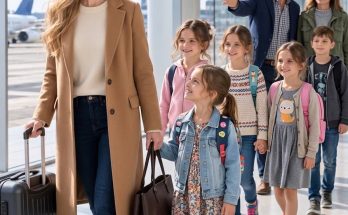
The taxi driver loaded our bags without asking why five people had so much luggage.
Zoey counted the suitcases aloud.
Paige corrected her twice.
Under other circumstances I might have asked them to stop arguing.
That morning the ordinary sound of sisters disagreeing was almost a comfort.
The gate agent asked whether we needed help with the smaller bags.
I said we were fine.
Then Zoey tried to lift a suitcase that was nearly as tall as she was.
I took it from her and thanked the woman.
Gaby stood beside the window, watching planes move along the runway.
She hadn't cried outside the courthouse.
She hadn't cried in the taxi.
But she was holding the strap of her backpack so tightly that the stitching had begun to bend.
“Mom, did Dad really say he won't give us anything except child support?”
“He said something cruel,” I answered. “You don't have to make sense of it tonight.”
“That's not what I asked.”
I crouched so she could see my face.
“Yes. He said it.”
She looked away again.
Paige had taken charge of Maya's boarding pass.
Eleven-year-old Maya was old enough to understand that something permanent had happened but young enough to believe we might reverse it if we found the right words.
She kept asking whether her bedroom would still be hers in San Diego.
I didn't know.
That uncertainty made me angrier than the divorce decree.
The judge had signed our parenting and support orders that morning.
Raymond had agreed in writing to our relocation to Phoenix, with scheduled calls, school-break visits, and transportation terms.
He had been eager to conclude the marriage.
He had not asked where the girls would sleep on their first night.
I showed the gate agent our tickets.
At the airport I checked each boarding pass one final time. Four daughters. Four different needs. I promised myself I would never ask them to become smaller just to make an adult more comfortable.
The five of us boarded together.
Before boarding, I had bought sandwiches even though nobody felt hungry.
Maya put hers aside and asked whether I still had the small wooden horse Walter had carved for her.
“Yes. It's wrapped in the blue blanket.”
“Grandpa said it took him three tries to make the ears right.”
“I remember.”
She looked at her hands.
“Do you think Grandma thinks the horse should belong to Leo?”
“No. It was a gift to you.”
“She said things that belong to the family have to go to boys.”
I sat beside her.
“Some people believed that for a very long time. They were wrong then, and they're wrong now. A wooden horse someone gave you doesn't belong to another child because he's a boy.”
Maya studied my expression.
“Does that mean I can still love Grandpa?”
“Yes.”
“You're not mad?”
“I'm angry at things adults have done. You aren't required to borrow my anger.”
She opened her sandwich.
It was a small victory.
On the plane Paige took out her new notebook and made a list called THINGS WE NEED IN PHOENIX.
At the top she wrote: a good fan.
Below that: bicycles, a library card, a desk, a place for Maya's rocks, a bakery that sells cinnamon rolls.
I added: five toothbrushes.
Paige rolled her eyes.
“We already packed those.”
“Then you're ahead of me.”
For a few minutes we were simply a family preparing to move.
Then Gaby's phone lit up with a picture from a cousin.
Florence stood beside the decorated garden table.
A gold ring lay on a velvet cushion.
Gaby turned the screen away before Zoey could see it.
“It's fine,” she said sharply when I asked.
I did not believe her.
But I also didn't demand that she talk in front of strangers.
I said we could discuss it after we arrived.
Zoey chose the window seat.
As we climbed above the coast, she pressed her forehead to the glass.
“Do you think Daddy is looking at the sky too?”
“Maybe,” I said.
She seemed satisfied.
I wasn't.
Teresa's message remained on my phone.
Tonight, I'm going to tell the truth.
I tried her number again after we landed.
It went directly to voicemail.
While we waited for our luggage in Phoenix, I found a message from my father.
He had heard we were safely on the ground.
Call me when the girls are settled, he wrote.
He didn't ask what Raymond's family was doing.
He asked whether everyone had eaten.
I replied that we had sandwiches and promised to call tomorrow.
My father's practicality had helped me when the company nearly failed.
Now it helped in a different way.
My sister, Nadia, was waiting outside the Phoenix terminal with a borrowed minivan and bags of groceries.
She hugged each girl before she embraced me.
“You don't have to explain anything in the parking garage,” she whispered.
I nearly cried then.
But Zoey needed a bathroom, Paige was hungry, and Gaby wanted to know whether her father had called.
He hadn't.
Nadia's spare house was small.
Two bedrooms, a narrow kitchen, and a patio that looked onto a dry wash.
She'd arranged air mattresses for the girls and cleared a dresser for me.
The room smelled of fresh laundry.
“It's temporary,” she said.
“Temporary is good.”
Gaby carried the bags inside without being asked.
When I thanked her, she shook her head.
“Don't make me the extra parent, Mom.”
I set down the groceries.
“You're right.”
I took the heavier bag back from her.
“You get to be fifteen.”
She stared at me, surprised, and went to find her sisters.
At Nadia's house, the first challenge was deciding where everyone would sleep.
Zoey wanted to be next to Maya.
Maya wanted her own corner to draw.
Paige said she needed space to read.
Gaby asked whether the living room sofa could be hers because she couldn't bear another night with someone breathing beside her.
Nadia offered us the bedrooms, but I declined.
She was already doing enough.
We rearranged the mattresses and hung a sheet to make a little privacy divider.
The arrangement looked temporary because it was.
The girls helped tape their drawings to the wall.
Zoey added a picture of the five of us on an airplane.
Raymond was not in the picture.
I noticed but said nothing.
That evening I made scrambled eggs because I couldn't face a full meal.
We ate around Nadia's little table.
Maya asked if Leo had been at the courthouse.
“No.”
“Does he know Dad has other children?”
“I don't know what he's been told.”
“Is he bad?”
“No,” I said immediately. “He's a child. None of this is his fault.”
I meant it.
Even then.
Especially then.
At Nadia's house I checked that each girl knew the street address and where to find me if she woke in the night.
Paige asked if she could keep a lamp on.
“Of course.”
Maya wanted the bedroom door open.
Zoey asked me to tell her the story about the little fox who lost his way.
I'd told that story since she was three.
This time the fox followed the sound of familiar voices until he found a warm place to sleep.
She was asleep before I finished.
I stayed beside her longer than necessary.
Tomorrow would bring attorneys, records, and difficult calls.
Tonight my job was to make sure she knew where her mother was.
At eight thirty, I received a photograph from Teresa.
It showed a yellow envelope on a kitchen counter.
The writing on the front was partly hidden beneath her hand.
I could make out one word.
Gavin.
Raymond's younger brother.
The one who had always resented my place at the factory.
A second message followed.
I kept this because I was afraid it would be destroyed.
Then a third.
Please don't call the police or the newspapers. I want to speak to Walter first.
I wrote back that she should be careful and leave if anyone became threatening.
I didn't ask her to confront anyone.
The girls were finally asleep when Nadia sat beside me on the patio.
“What did Raymond actually sign about the business?” she asked.
“Nothing today. The company shares weren't handed out in the divorce.”
“Good.”
“Good?”
“Good that you didn't confuse leaving him with surrendering your work.”
I looked at the pool of light beneath the porch lamp.
Sixteen years earlier I had helped rescue Pacific Oak Crafting with my savings and the proceeds my parents had contributed from selling their property.
Together it had amounted to nearly six million dollars over the period of our investment.
The company now ran two factories and employed more than one hundred and eighty people.
My forty-three percent was recorded on the shareholder register.
Walter held twenty-four percent.
Raymond held thirty-three.
Those numbers had not vanished when the judge dissolved our marriage.
My attorney had explained the distinction repeatedly.
Our divorce settlement dealt with the marriage.
Corporate rights still depended on the governing documents and applicable law.
I had asked her to examine the ownership terms after the divorce.
But the girls had needed to get away first.
At nine forty-six, Teresa finally called.
Her voice sounded thin.
“Mrs. Miller, the party has stopped.”
“Are you safe?”
“Yes. I'm outside.”
“What happened?”
She took a breath.
“Florence opened the envelope. Walter recognized the handwriting. Then Gavin said I had no right to bring it into their home.”
I heard a car door close behind her.
“What was in it, Teresa?”
“I need to tell you slowly. Because part of it concerns a boy who doesn't deserve to be embarrassed.”
I went inside and shut the patio door.
“I'm listening.”
That night Nadia found me rinsing a clean plate for the third time.
“Brenda, it's washed.”
“I know.”
“You've been standing here for ten minutes.”
I turned off the tap.
“I don't know how to be a person who isn't fixing something.”
She took the plate from me and placed it on the rack.
“Then tonight you can practice being a person who rests.”
I looked toward the mattresses where the girls slept.
Gaby's arm hung over the edge of the sofa.
Zoey had rolled out of her blanket and was using Maya's pillow.
Paige's notebook lay open beside her.
There was nothing graceful about the room.
It was warm.
They were together.
For that night, it was enough.
Click here to continue reading: PART 2: The envelope at the celebration and the first lie it could actually prove
The airport departure that left four daughters asking what their father had chosen
Part 1 of 12