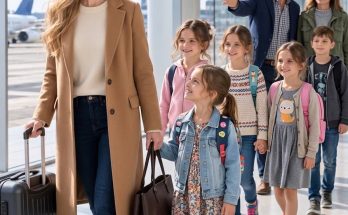
A year after our flight to Phoenix, I drove to the airport again.
This time I wasn't leaving a courthouse.
I was taking Gaby to visit a college art department during spring break.
She had a folder of sketches on her lap and questions written on her phone.
“Do you think they'll take me seriously?” she asked.
“You've done the work. Ask what you need to know.”
She smiled.
“That's such a Mom answer.”
“It's a good answer.”
She leaned against the window and watched the traffic.
A year earlier she had asked whether her father had ever loved her.
That question hadn't disappeared with one good weekend or a more reliable call schedule.
But she had begun to ask different questions about herself.
What could she make?
Where did she want to study?
What kind of person did she want to become?
Raymond had kept more of his scheduled calls during the past six months.
He still made mistakes.
He had missed Maya's school presentation after confusing the time zones.
This time he acknowledged the error and apologized without blaming me.
He watched the recording Maya chose to share and asked her to explain the project.
She accepted the apology but remained annoyed.
That was allowed.
The company, too, was still a work in progress.
The settlement with Alder Strategic Services required payments over several years.
The first installments had arrived on time.
Nina's quarterly reports showed stronger approval controls and fewer exceptions.
The independent directors were reviewing leadership succession.
Walter had announced he would retire from active management on a phased schedule.
His shares remained legally his.
There had been no magical transfer to a grandson or granddaughter.
He had retained estate-planning counsel and updated his documents through the normal process.
He told us that he wanted decisions about beneficiaries to reflect real relationships and informed judgment, not the gender of a child.
I didn't ask to see his private will.
My forty-three percent remained recorded in my name.
Raymond's thirty-three percent remained his.
Walter still held twenty-four.
Those figures had guided the company through its most difficult year without turning children into trophies.
The board appointed me to chair a governance committee.
I accepted after confirming that the workload would fit the girls' needs.
The role involved unglamorous tasks.
Reviewing policies.
Hiring advisers.
Checking internal reports.
Making sure family connections did not bypass normal approvals.
It suited me.
I had never wanted an heirloom ring.
I had wanted the business we'd built to behave responsibly.
Teresa was doing well at the hotel.
She sent me a photograph of a staff celebration.
She was smiling beside coworkers who had presented her with an award for service.
I called to congratulate her.
“You sound happy,” I said.
“I am. I still get tired, but I don't spend my shift wondering which family secret will land on my desk.”
We laughed.
Then she asked after the girls.
I told her about the art portfolio, the airplane plans, the woodworking club, and Zoey's newly learned bicycle trick.
“That's what I hoped for,” Teresa said.
“What?”
“That they would have ordinary things to be proud of.”
I understood.
Brenda Hale had moved into a small house closer to Leo's school.
She continued working with her lawyer to resolve the legal questions following the disputed parentage report.
Gavin had eventually participated in properly documented testing after taking advice.
The result supported him as Leo's biological father.
That did not, by itself, erase existing legal obligations or determine custody overnight.
The adults worked through the appropriate legal process, including the child's interests and the need for stable relationships.
I received only the information Brenda Hale chose to share.
I did not ask for copies of the tests.
Leo remained a child with a mother who cared for him, a school he attended, and a life bigger than the question of which man had provided his genes.
Florence had begun seeing him again with Brenda Hale's consent and clear boundaries.
She no longer called him the future owner of the factory.
She called him Leo.
For a while that was all I needed to know.
Walter's relationship with our girls improved slowly.
He called on birthdays, asked about schoolwork, and remembered details from earlier conversations.
He sometimes attended events when the girls invited him.
He didn't demand photographs afterward or turn every visit into a family announcement.
Florence's contact remained limited.
Gaby wasn't ready to see her.
Paige occasionally wrote back.
Maya sent a photograph of a wooden bookshelf she'd helped build.
Zoey drew a card with five trees and a very large sun.
I let the girls choose.
One evening Raymond asked whether we could discuss the future.
We met on a call arranged through our co-parenting platform.
He spoke about college costs and transportation for visits.
He asked whether Gaby wanted him to attend her portfolio exhibition.
“I'll ask her,” I said.
“Thank you.”
Then he paused.
“Brenda, I know I can't undo the things I said outside the courthouse.”
“No.”
“I also know sending support doesn't make me a good father.”
“It is one responsibility you must meet.”
He nodded.
“I want to keep doing better.”
“Then keep doing it.”
We ended the call without discussing our marriage.
That chapter was closed.
Later Gaby told me she would invite him to the exhibition, but only if he agreed not to bring Florence.
I passed along the condition.
He agreed.
I didn't call it a happy ending for everyone.
Some damage remained.
Some relationships had been changed permanently.
But the girls were growing into lives of their own.
The portfolio exhibition took place in a bright room at the community arts center.
Gaby wore a black blouse she'd chosen herself and kept checking whether her sketches were hanging straight.
I arrived early with Paige, Maya, and Zoey.
Raymond came at the agreed time.
He was alone.
I appreciated that he'd respected Gaby's condition without arguing about Florence.
He stopped in front of the drawing of four sisters on the plane.
For a long moment he said nothing.
Then he turned to Gaby.
“Will you tell me about this one?”
She described the colors, the perspective, and the way she'd drawn the mother looking forward while the children looked in different directions.
Raymond listened.
“It's powerful,” he said at last.
“Thanks.”
He didn't ask whether she had drawn him deliberately out of the picture.
He didn't make the exhibition about his feelings.
Afterward he offered to buy a small print for his apartment.
Gaby said she would consider it.
He accepted her answer.
On the way home she sat beside me in the car.
“Dad asked a good question,” she said.
“He did.”
“I'm still mad at him.”
“You can be.”
“I'm also glad he came.”
“That can be true too.”
She turned toward the window.
For the first time, I sensed she wasn't trying to force herself into one feeling to make the adults comfortable.
A few days later the governance committee formally confirmed my appointment as chair.
The directors reviewed the role, approved its charter, and set a schedule for reporting.
There was no announcement at a party.
No family portrait beside a gold ring.
Just minutes entered into the corporate record and a list of tasks to complete.
Helen called afterward.
“Congratulations,” she said. “Now the real work starts.”
“I know.”
We discussed the first quarterly agenda.
I wanted an update on repayment under the vendor settlement, an employee-safety report, and a review of key supplier risks.
Helen suggested adding a training report for managers.
We included it.
That afternoon I called my father to tell him.
He sounded pleased.
“Do you still have the old business plan?”
“Yes. Paige found it.”
“And the appendix?”
“All four pages.”
He laughed.
“Then maybe you can finally admit I was right about the page count.”
“Never.”
We talked about the girls and his plans to visit Phoenix.
He wanted to take them to a museum and see Maya's bookshelf.
I told him we'd arrange a weekend.
When I hung up, I thought about my parents' decision to support the original company rescue.
They hadn't been buying power over their grandchildren.
They had been investing in my judgment and the possibility of a business that could employ people responsibly.
That history was more meaningful to me than the Miller ring.
The girls came home and found me rearranging photographs on the living-room wall.
I had added one from the factory visit, one from Zoey's bicycle lesson, and one of Gaby beside her exhibited art.
Paige asked why there wasn't a picture of her airplane project.
“Because you haven't given me one yet.”
She ran to print a photograph.
Maya wanted her shelf included too.
Within half an hour the wall was crowded.
There was no photograph of the family garden ceremony.
I did not miss it.
When evening came I walked into the backyard and checked the little tree.
It had grown enough to cast a narrow strip of shade over the stones.
I thought about the phrase Florence had used so many times.
The heir.
She'd meant someone entitled to receive the past.
I'd spent sixteen years trying to prove my daughters belonged to that past.
Now I was more interested in the future they would build on their own terms.
Gaby might become an artist.
Paige might design aircraft.
Maya might work with wood or choose something completely different.
Zoey might change her mind a hundred times.
Their value would not rise or fall with any of those decisions.
Inside, I could hear the girls discussing what to make for dinner.
I went in before they decided everyone needed dessert instead of vegetables.
The red folder I'd carried through the divorce had eventually become too thick to close.
It contained court orders, correspondence, and records I had once checked every morning.
I moved the older papers into a locked cabinet and kept the current parenting schedule where I could find it easily.
I didn't destroy anything that needed preserving.
I simply stopped treating every document as an emergency.
When I told Nadia, she smiled.
“Does that mean you're finally sleeping?”
“Most nights.”
“That's progress.”
The next morning the girls helped me choose a new photograph for our front hallway.
It showed the five of us at a picnic in Phoenix.
Nobody was dressed for a ceremony.
Zoey had grass on her knees.
Paige was laughing at something outside the frame.
Maya held a notebook.
Gaby had one arm around my shoulders.
We hung it beside the door.
Every time we came home, it was the first thing we saw.
At dinner Zoey announced that she'd learned a word in school.
“Legacy,” she said carefully.
Maya raised an eyebrow.
“What does it mean?”
“Something you leave behind.”
“That sounds right,” I said.
Zoey thought about it.
“Like the bookshelf Maya made?”
“Maybe,” I answered.
“Or the tree we planted?” Paige asked.
“Yes.”
Gaby looked toward the family photographs hanging above our little dining table.
“Or the way people remember how you treated them.”
I met her eyes.
“That too.”
The girls began arguing cheerfully about who should wash the dishes.
I listened while the sun moved across the kitchen floor.
There was no ring on our table.
No ceremony.
No announcement about the rightful heir.
Only four daughters planning their own futures and a home in which none of them had to prove they were enough.
THE END
The End
Read more original stories on Feel Every Story.
The airport departure that left four daughters asking what their father had chosen
Part 12 of 12