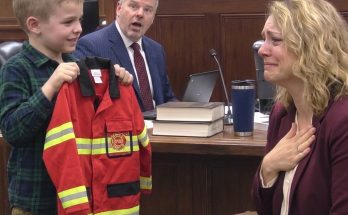
The courtroom had gone quiet enough for me to hear the clock above the clerk's desk.
Nolan stood beside my chair.
He was eight years old, and his shoes were still wet from the slush outside the courthouse.
Across the room, his father watched him with a smile that had never reached his eyes.
Grant Bellamy had brought an expensive lawyer, a photographer's picture, and a story about how I was failing our son.
I had brought a folder of receipts and a child who should never have needed to defend the place he called home.
Judge Elaine Mercer leaned forward.
“Nolan, sweetheart, you don't need to do anything unless you want to.”
He nodded without looking at her.
Then he raised the front of his navy shirt.
I caught my breath.
Just below his ribs were two fading marks.
They were not dramatic injuries.
But they were unmistakably bruises, and their placement made my hands turn cold.
His fingers trembled as he pointed.
“Daddy grabbed me when I wouldn't take off my shirt.”
Grant's smile vanished.
His lawyer, Preston Carroway, half rose from his chair.
“Your Honor, this is highly irregular.”
The judge lifted a hand.
“Sit down, Mr. Carroway.”
Nolan kept speaking.
“He said if I wore the dirty shirt, everybody would know Mom can't take care of me.”
I felt every person in the room turn toward us.
“He took my picture outside school.”
Nolan swallowed.
“I told him it wasn't dirty because Mom doesn't wash things.”
He looked down at the little embroidered moon.
“It's my birthday shirt.”
I wanted to pull him close.
I wanted to tell him he had already said enough.
But the judge spoke before I could move.
“Nolan, thank you for telling us.”
Her voice was gentle, but her face had changed.
“You can lower your shirt now.”
He did.
Then he reached for my hand.
Grant spoke from the opposite table.
“That isn't what happened.”
The judge turned toward him.
“I did not ask you a question, Mr. Bellamy.”
A court officer moved closer to Nolan's chair.
For a terrible second, I feared someone intended to take my boy away.
Instead, the judge called a recess.
She directed the court's child-services liaison to speak with us and told both sides that the child's disclosure would be handled through appropriate procedures.
She did not examine the marks herself.
She did not make an instant finding.
She simply ensured that the hearing would not continue as though nothing had happened.
Nolan looked at me.
“Am I in trouble?”
“No, sweetheart.”
I crouched carefully so we were eye to eye.
“You're not in trouble.”
“Daddy said people would think I was lying.”
The words hurt more than I expected.
I touched the sleeve of his shirt.
“You don't have to convince anybody right now.”
A woman introduced herself as Teresa Wells, the court's family-services coordinator.
She asked whether Nolan needed water, whether he felt safe, and whether he would be comfortable waiting in a separate room with my mother.
Ruth had come to the hearing despite the arthritis in her knees.
She stood immediately.
“I'll stay with him.”
Nolan slipped his hand into hers.
I watched them walk down the short hallway.
Only after they turned the corner did I realize I had been holding my breath.
Preston Carroway approached with Grant a few paces behind him.
“This is a misunderstanding,” Carroway said.
I could hear the strain beneath his polished tone.
“Perhaps we should discuss how to avoid unnecessary escalation.”
I looked at Grant.
He wore the silver watch he had purchased for nearly ten thousand dollars while telling me he could not afford Nolan's dental bill.
His jacket was pressed.
His hair was perfect.
He looked offended rather than concerned.
“Did you grab him?” I asked.
Grant's eyes narrowed.
“He was being difficult.”
Carroway touched his arm.
“Grant.”
“I was trying to straighten his clothes.”
“You left bruises.”
“You're always making something out of nothing, Leah.”
I had heard that sentence for twelve years.
It had described missed birthdays, forgotten school pickups, unpaid support, and eventually the end of our marriage.
Now he was saying it about our son's body.
Carroway asked us not to discuss disputed facts in the hallway.
For once, I agreed with him.
I stepped away.
The morning had begun with me wondering whether a stained shirt could make me lose custody.
Now I wondered how many times Nolan had been frightened during his visits and had not known how to tell me.
The answer was not something I could guess.
I needed to listen without asking him to repeat painful details merely to satisfy my fear.
I sat near the vending machines and opened my folder.
The first page was our temporary parenting order.
Grant had parenting time every other weekend and one Wednesday evening.
The second page was a spreadsheet of support payments.
Several months were blank.
The third contained messages where I had asked him to help pay for the inhaler Nolan sometimes needed during winter respiratory infections.
Grant had replied with a photograph of his new boat.
I stared at that message until the words blurred.
I remembered when Nolan was born.
Grant had carried him through the hospital corridor as if he had been handed the most precious thing in the world.
He had promised to teach him to fish.
He had promised that no son of his would ever feel abandoned.
I had believed him.
The failure of our marriage did not erase the fact that he was Nolan's father.
That was why I had kept trying to make their relationship work.
I had encouraged phone calls.
I had packed favorite snacks for visits.
I had told Nolan that adult disagreements were not his responsibility.
Sometimes I had gone too far in protecting the image of a father who was not protecting his child.
My phone vibrated.
It was a message from Grant.
You set him up to say that.
Another arrived.
You have no idea what you've started.
I did not reply.
I took screenshots, saved the messages, and placed the phone face down.
The coordinator returned half an hour later.
She explained that the disclosure would be reported for a proper assessment, and that Nolan should be evaluated by a medical professional.
She also said the judge would consider interim safety arrangements based on the available information.
Nothing about her voice suggested that she had already decided what happened.
That steadiness helped.
I had spent so long defending myself against Grant's accusations that I had forgotten what it felt like to have someone focus on the actual question.
Was Nolan safe?
The judge reconvened in the early afternoon.
She asked about the existing custody order and when Nolan's next visit was scheduled.
Carroway argued that an allegation made in the middle of a contested hearing should not automatically eliminate a parent's contact.
He was correct about the need for care.
I hated that he was correct about anything.
The judge said she was not making a final custody determination that day.
She issued a short-term order pausing unsupervised parenting time pending an expedited review.
Contact could occur by scheduled video call under the temporary conditions she described.
She also set a prompt follow-up hearing and directed us toward the local child-protection and medical processes.
Then she addressed me.
“Mrs. Bellamy, do you understand the limits of today's order?”
“Yes, Your Honor.”
“It is not a permanent conclusion about either parent.”
“I understand.”
I wanted to tell her about the landlord.
About the lost cleaning job.
About the investigator Grant had hired to photograph our child.
But she had not asked me to recite my life.
There would be time to present relevant evidence in an orderly way.
For that afternoon, Nolan's immediate safety came first.
When the hearing ended, I found Ruth sitting beside him in a quiet waiting room.
She had given him a little paper cup of pretzels.
He had arranged them into the shape of a planet.
“Did we win?” he asked.
I sat beside him.
“Court isn't really about winning, honey.”
He studied the pretzel planet.
“Are we going home?”
“Yes.”
He leaned into my shoulder.
“Can we stop at the bakery downstairs?”
I could barely afford parking that day.
But the bakery owner had always saved yesterday's bread for us at a discount.
“We can ask whether Mrs. Alvarez has cinnamon rolls left.”
Nolan smiled for the first time since morning.
Outside, the winter air stung my cheeks.
Grant stood near the courthouse steps speaking angrily into his phone.
When he saw us, he started forward.
Ruth moved instinctively closer to Nolan.
I raised one hand.
“Please communicate through the proper channels.”
He stopped.
His expression was furious.
“You're going to regret turning him against me.”
I did not answer.
I helped Nolan into the back seat of our aging car.
Then I walked around to the driver's side with my knees shaking.
I had thought the hard part would be surviving the hearing.
But as I started the engine, I understood that the hearing had only opened a door.
There were records to recover.
People to contact.
Questions Nolan deserved to have answered without being made responsible for the answers.
And one question I could no longer avoid.
If Grant had gone this far to make me look unfit, what else had he done when he thought nobody would check?
That evening, before I went to the clinic, I remembered another moment from the custody hearing.
Carroway had displayed the photograph on an easel as though he were unveiling a painting.
He had asked the judge to study the stains.
He had pointed to my son's messy hair, then to the scuffed toes of his shoes.
Not once had he mentioned what Nolan was doing in the picture.
My boy was carrying a library book under one arm and holding the door for another student.
The other child was shorter and had dropped a mitten.
Nolan bent to pick it up.
That was why his hair was falling across his forehead.
I knew the small kindness because Melissa had told me about it the same afternoon.
Yet in court, the kind gesture had become evidence of disorder.
The omission had not been an accident from my perspective.
It was what happened when people began with a conclusion and cropped away everything that did not fit.
I also remembered the smell of the courtroom.
Old paper.
Floor polish.
Coffee cooling in an attorney's cup.
It was a place where adults arranged facts into arguments.
For Nolan, it was a place where strangers discussed his clothes while he could hear every word.
I vowed that whatever happened next, I would ask for a process that protected him from unnecessary public scrutiny.
That did not mean hiding the truth.
It meant remembering that the truth belonged to a little boy, not to the adults who wanted to win an argument.
When I finally called the clinic, I made that request directly.
The nurse told me the team worked with children in difficult family situations and would explain the examination in age-appropriate language.
I held on to that small assurance as we drove through traffic.
At a red light, Nolan pressed his palm against the window.
Snow had collected on the curb.
He traced a circle in the fog on the glass.
“Moon,” he said.
I smiled despite everything.
“Always the moon.”
“It's easier to draw than Saturn.”
Then the light changed, and we continued toward the hospital.
Click here to continue reading: PART 2: The Doctor Asked Nolan One Question I Had Never Thought to Ask Him
When Nolan Lifted His Favorite Moon Shirt, the Judge Saw More Than a Photograph
Part 1 of 12