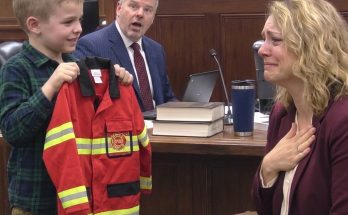
We did not go straight home from the courthouse.
Teresa Wells had given me the number of a children's hospital clinic that could evaluate Nolan without turning the examination into another courtroom confrontation.
I called from the parking lot.
The receptionist listened, checked the referral information, and offered an appointment later that afternoon.
She told me to bring the court papers and Nolan's insurance card.
I already had both in my folder.
Nolan heard the word hospital and stopped chewing his cinnamon roll.
“Am I sick?”
“No.”
“Then why?”
“Because you told the judge something important, and a doctor can make sure you're okay.”
He looked through the window at a row of bare trees.
“Will there be needles?”
“I don't know what they'll need, but we'll ask before anything happens.”
That answer seemed to satisfy him more than a promise I could not keep.
Ruth stayed with us.
She carried his jacket while I filled out the intake forms.
The clinic smelled of disinfectant and crayons.
Someone had painted a bright orange rocket beside the reception desk.
Nolan counted the stars around it while we waited.
A nurse named Andrea introduced herself and explained each step of the appointment.
She asked Nolan whether he wanted me in the room for the medical examination.
He nodded so quickly that his hair fell over his eyes.
I stayed beside the door as the physician, Dr. Priya Shah, asked about pain and carefully examined the marks.
She did not ask him to perform a demonstration of what his father had done.
She did not suggest an answer.
She asked what happened in Nolan's own words, then documented his response.
Afterward, she spoke to me in a separate conversation.
“The marks are consistent with pressure,” she said.
“They do not tell us every circumstance in which they occurred.”
I nodded.
“Is he going to be all right?”
“Physically, I don't see an urgent problem from this examination.”
She paused.
“But he appears anxious, and that deserves attention too.”
I had expected someone to hand me certainty.
Instead, she handed me a plan.
She would document her findings, follow reporting requirements, and recommend support from a child therapist trained in family stress and trauma.
She asked whether Nolan was sleeping.
“Not always.”
“Nightmares?”
“He's been waking up before five and asking whether he's late for school.”
“Has he complained about visits?”
I described what I had observed without embellishing it.
He sometimes grew quiet after weekends.
He had asked whether I would be angry if he loved his father.
He had begun checking my phone when it rang.
Dr. Shah wrote those details down.
Then she asked the question that stayed with me.
“What does Nolan do when he thinks an adult is disappointed in him?”
I opened my mouth.
Nothing came out.
I knew the answer, but I had never considered it as a pattern.
He apologized.
He apologized for spilling cereal.
He apologized when Ruth's knees hurt and she had to sit down.
He apologized when my car stalled, though he had not touched it.
“He says sorry,” I whispered.
“Even when nothing is his fault.”
Dr. Shah put down her pen.
“Then one useful thing you can do is show him that adults can manage their feelings without making him responsible.”
I wrote that sentence in the back of my notebook.
I did not trust my memory anymore.
That evening, we returned to the apartment above the bakery.
Our landlord, Mr. Densmore, had taped a notice about trash collection beside the entrance.
The hallway smelled of fresh bread and damp winter coats.
Nolan ran upstairs to show Ruth the rocket sticker he had received from the nurse.
I lingered beside our mailbox.
A rent reminder had been pushed through the slot.
I was not late yet.
But the sight of the envelope made my stomach tighten.
I had lost the cleaning contract that once paid nearly half our monthly bills.
Grant's court filings described my income as unstable.
They did not mention that his friend had influenced the person who canceled my work.
I still could not prove the connection.
I had an account of an overheard conversation from a former coworker, but not a document.
That distinction mattered.
I was tired of feeling certain and being unable to demonstrate why.
After dinner, Ruth washed dishes while Nolan chose a book from the shelf.
He picked the constellation book I had bought with money from Grandma's locket.
The cover had softened at the corners.
“Can we read the moon chapter?” he asked.
“Of course.”
He climbed into bed, then looked at me with sudden seriousness.
“Mom, if Daddy says I'm bad, does that make me bad?”
I sat on the edge of the mattress.
“No.”
“What if he says you make me say stuff?”
“That doesn't make it true.”
Nolan rubbed the embroidery on his shirt.
“I didn't want everyone to see.”
“I know.”
“I just wanted the lawyer to stop saying you don't wash my clothes.”
I felt my eyes sting.
“You never have to show anybody your body to prove you love me.”
He looked at me for a long moment.
“I know.”
Then he whispered something else.
“I thought Daddy would stop if the judge saw.”
I kissed his forehead.
I did not tell him that everything would be fixed now.
I told him the adults would take care of what happened next.
When he fell asleep, I sat at the kitchen table with the court folder.
I made three piles.
One held what I could prove with records.
One held things people had told me but had not confirmed.
The last held questions that needed an answer.
The court order went in the first pile.
Grant's unpaid support went there too.
The allegation about the landlord stayed in the second.
The cleaning contract was in the third because I needed to know who had actually complained.
I had been frightened into thinking that if I could not explain everything, I could explain nothing.
Organizing the papers made that feeling smaller.
At nine, my phone rang.
It was Melissa Crane, Nolan's third-grade teacher.
She had attended the hearing only briefly before returning to school.
“I wanted to check on him,” she said.
“He's asleep.”
“I'm glad.”
Then she hesitated.
“Leah, there is something you should know.”
I pulled my notebook closer.
“A few weeks ago, Grant came to school asking for Nolan's attendance and clothing records.”
“He's his father.”
“Yes, and he has access to appropriate records.”
Melissa sounded careful.
“But he also asked staff to note every day Nolan wore the same shirt.”
I stared at the bedroom door.
“Why?”
“He said he was gathering evidence.”
She told me she had refused to turn normal classroom observations into a private surveillance exercise.
The principal had documented the request.
I asked whether those notes could be provided through the proper court process.
“I think so,” she said.
“Please ask the school office.”
She did not promise the records would settle anything.
She did tell me something I badly needed to hear.
“Nolan is cared for here.”
“He has friends.”
“He completes his work.”
“And when he's tired, we help him instead of assuming the worst.”
I thanked her.
After we hung up, I added another question to my list.
What else had Grant asked people to record?
Then a more uncomfortable question followed.
How many people had accepted his requests because he sounded confident and could afford to pay them?
Ruth entered the kitchen in her slippers.
“You need sleep,” she said.
“I need a lawyer.”
“We'll figure out how.”
I glanced at the numbers on the back of the rent envelope.
“I don't know where the money would come from.”
Ruth pulled out the chair opposite mine.
“You don't have to buy the most expensive person in the room.”
She pointed to the clinic paperwork.
“Tomorrow, ask about legal aid.”
I had been so intimidated by Grant's attorney that I had forgotten there were other ways to seek help.
I wrote legal aid at the top of a clean page.
Before going to bed, I checked on Nolan.
The navy shirt was folded neatly beside his pillow.
He had chosen clean pajamas, but he wanted his birthday shirt where he could see it.
I touched the embroidered moon.
Four months earlier, it had cost less than twenty dollars.
I had stood in a pawn shop holding an empty place where my grandmother's locket used to be, wondering whether I was foolish to spend anything beyond groceries.
That shirt had meant something to my son that Grant's lawyer could not calculate.
But its meaning was not evidence of my fitness as a parent.
My daily care was.
So was his schooling, his safety, his medical treatment, and the people who made sure he was never alone when he needed help.
The next morning, a voicemail waited on my phone.
The caller identified herself as a child-protection investigator assigned to follow up on the report.
She wanted to arrange a conversation.
I listened twice.
Then I called back before fear could persuade me to wait.
I did not tell Ruth the whole story about Dr. Shah's question until Nolan was asleep.
We sat near the small heater in the living room.
I told her how quickly he apologized for things that belonged to adults.
Ruth looked down at her hands.
“I've noticed it,” she said.
“Why didn't you say something?”
“Because I was trying not to frighten you.”
I knew that answer too well.
We had become a family of people protecting one another with silence.
Ruth told me about a morning when she dropped a mug on the kitchen floor.
Nolan immediately offered to replace it with money from his birthday envelope.
He had not touched the mug.
Ruth told him accidents were nobody's fault.
But he still looked worried until she laughed and made a joke about her clumsy fingers.
I remembered Grant once complaining that Nolan was too sensitive.
He said the boy needed to toughen up or the world would eat him alive.
At the time, I had argued about his words.
Now I wondered whether the problem was not sensitivity at all.
Perhaps Nolan was carefully watching adult expressions because he had learned that an ordinary mistake might lead to anger.
That possibility made me sad, but it gave me something practical to work on.
We decided to change how we spoke around him.
If a meal burned, we would say dinner needed another plan.
If the car failed, we would deal with the car.
If one of us was worried, we would name the feeling without suggesting it belonged to Nolan to fix.
We agreed not to make grand promises about never being upset.
Every family experiences frustration.
What mattered was showing him that frustration could be handled safely.
Ruth took a notebook from the shelf.
“Let's keep a list of things he enjoys,” she said.
“Not court things.”
“Ordinary things.”
We wrote library mornings, pancakes, science club, and feeding the birds by the parking lot.
I added listening to rain against the bedroom window.
She added making paper airplanes with me.
We laughed because hers always flew farther.
The list hung beside our calendar.
It reminded me that our lives contained more than documents and accusations.
When Nolan saw it the next morning, he added another item in careful handwriting.
Watching the moon with Mom.
I promised we would do that whenever the clouds allowed.
The promise was simple enough to keep.
A few nights later, we wrapped ourselves in blankets and stood by the window.
The moon appeared between two apartment buildings.
Nolan leaned against my shoulder.
He didn't mention court.
Neither did I.
We stood there until his toes grew cold.
Click here to continue reading: PART 3: A School Secretary Handed Me Records That Turned Grant’s Carefully Prepared Story Inside Out
When Nolan Lifted His Favorite Moon Shirt, the Judge Saw More Than a Photograph
Part 2 of 12