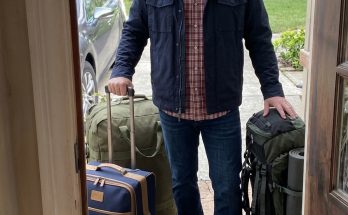
A year after Gary stood on my porch with his suitcases, I was late for my watercolor class.
Not because someone needed dinner.
Not because I had misplaced an important bill.
I was late because I had spent twenty minutes talking to the woman who lived downstairs about her tomatoes.
She had given me a bag of them.
I carried the bag into the community center, apologizing as I slipped into my chair.
My instructor smiled.
“Wonderful. We needed a still life.”
We arranged the tomatoes beside a blue pitcher and began to paint.
I was still not especially talented.
The first tomato looked like a red pebble.
The second looked like a balloon.
I painted them anyway.
After class, I met Linda for lunch.
She had started spending more time with her sister across town, and I was glad for her.
Our friendship had changed too.
When Gary first left, I called her almost every evening.
Now we could go several days without speaking and pick up exactly where we'd left off.
She no longer had to rescue me from every bad night.
She was my friend, not my emergency service.
“How's Hannah?” she asked.
“Good. She and Julian are moving into a bigger apartment.”
“Do you approve?”
“Of the apartment? Yes. Of them? It's their decision.”
Linda raised an eyebrow.
“Listen to you.”
I laughed.
It had taken effort to learn not to confuse concern with control.
I knew that because I had spent so many years letting someone else control my choices while calling it concern.
Hannah still saw Gary.
They had dinner every few weeks.
Sometimes she mentioned him.
Sometimes she didn't.
I never asked her to report on his private life.
One afternoon she told me he had apologized for putting her between us during the separation.
“He didn't ask me to forgive him right away,” she said. “He just said it was unfair.”
“I am glad he told you that.”
“He's trying,” she said.
“I hope he keeps trying.”
And I meant it.
Gary had stayed employed and settled into a small apartment.
He had kept his golf clubs.
I wasn't surprised.
He sometimes sent brief messages about shared administrative matters that had not yet faded away, or about events involving Hannah.
They were polite.
We no longer had long conversations about what might have been.
I didn't need those conversations.
The financial part of our separation had also become less dramatic.
The required transfers were finished.
The joint accounts had been closed in the manner agreed.
I kept the settlement file, tax documents, and receipts for the appropriate retention periods.
Celia reviewed my budget after six months.
The apartment was working well.
My emergency savings were intact.
My retirement contributions had resumed at the planned rate.
I could consider buying a smaller home later if I wanted.
For now, I didn't.
I liked walking to the library.
I liked not worrying about a large roof.
I liked opening my door to a hallway where someone always had a cheerful word.
One Saturday, I drove past our old neighborhood on my way to a garden store.
I hadn't planned to stop.
But curiosity pulled me toward the familiar street.
The house looked different.
The new owners had painted the front door dark green.
A little bicycle rested beside the porch.
The pear tree was still standing.
I parked across the street for a moment.
A woman came outside carrying a watering can.
A small child followed her into the garden.
She pointed toward the tree and the child ran beneath it.
I smiled.
I had worried that selling the house would erase our memories.
Instead, I saw that the place was still doing what houses were meant to do.
It was holding an ordinary life.
Just not mine anymore.
I drove on.
At the garden store I bought basil, a pot of thyme, and a small sunflower plant for my balcony.
I thought of the roses Gary once brought to the dental office.
I had kept trying to explain that I preferred sunflowers.
He always seemed to forget.
Now the person buying the flowers knew exactly what I liked.
At home, I repotted the sunflower carefully.
I spilled soil across the balcony tiles.
I swept it up.
Then I sat down with a glass of lemonade and watched the late-afternoon light move across the leaves.
There were still difficult days.
Sometimes I missed being part of a couple.
Sometimes I missed Gary's laughter or the way he whistled while cooking.
When those memories came, I didn't scold myself.
I could miss a person and still know that living together would not be good for me.
I could be grateful for our daughter and our history without promising my future to someone who had repeatedly ignored my needs.
I had learned that distinction slowly.
There was no single morning when I woke transformed.
There were dozens of ordinary mornings.
I paid a bill.
I asked a question.
I made a plan.
I called a friend.
I said no to something I did not want.
I said yes to something that frightened me a little.
Little by little, those decisions became a life.
As the year passed, I stopped measuring every good day against what Gary might think of it.
At first, when I found a new cafe or bought a piece of furniture, I imagined telling him.
Sometimes I imagined his approval.
More often I imagined his criticism.
Then those conversations gradually faded.
I could choose a bright tablecloth without defending it.
I could spend a rainy afternoon reading instead of finding a task that looked productive.
I could invite friends to dinner without checking whether he wanted a quiet evening.
Those changes weren't dramatic enough for anyone else to notice.
I noticed them.
At the beginning of spring, my neighbor Anita asked whether I wanted to join a small gardening project behind our building.
Several residents had permission to use raised beds near the parking area.
I agreed to help with herbs.
On the first morning, we carried bags of soil and argued gently about where the basil should go.
Anita believed it needed more sun.
A retired teacher named Mr. Walsh insisted it would be fine near the fence.
I suggested we check the instructions on the plants and observe the light.
Nobody laughed at me for wanting to be certain.
By summer, the basil was flourishing.
We left small bundles in the lobby for neighbors to take.
I used some in pasta sauce and brought the rest to Teresa at work.
The project gave me another reason to come home feeling pleased.
One afternoon, Hannah asked whether I missed being married.
We were walking near the library, carrying iced coffee.
I thought carefully before answering.
“I miss parts of it,” I said.
“Which parts?”
“Sharing a joke with someone who already knows the story. Having another person remember the day something happened. Sometimes just hearing footsteps in the hallway.”
She nodded.
“But not enough to go back?”
“No.”
I looked at the pavement for a moment.
“I don't think the good parts required me to accept the bad ones forever.”
She squeezed my arm.
We kept walking.
I didn't tell Hannah that her father had ruined my life.
He hadn't.
He had hurt me deeply, and we'd failed to build a marriage where both people felt heard.
Now we were responsible for what we did next.
Hannah didn't have to turn our marriage into a story with one perfect parent and one villain.
At home, I put the new photograph from the art exhibition beside the picture of Hannah on her bicycle.
The frames didn't match.
I liked the way they looked together.
One held a past worth remembering.
The other held a future I was still making.
When I looked at them, I no longer felt the need to choose between gratitude and disappointment.
Both belonged to the truth.
That evening, I opened my private notebook and reread the first page I wrote after Gary left.
It was full of questions.
Had I been boring?
Had I expected too much?
Would anyone want to build a life with me again?
I turned to a blank page.
I wrote about the garden, my friends, my work, and the places I wanted to visit.
Then I closed the notebook.
I had no urgent need to answer the old questions.
My life had become bigger than them.
In October, the community center held its autumn exhibition.
I helped hang paintings and arrange the refreshments.
My instructor persuaded me to submit one small watercolor.
It was a picture of a green ceramic bowl filled with pears.
The proportions were still imperfect.
But the colors were warm, and I had finally learned to leave enough white space for the light.
Hannah came with Julian.
Linda brought Teresa.
They stood in front of my painting and admired it far longer than it deserved.
“Mom,” Hannah said, “you should sign it.”
“I did.”
She leaned closer.
At the bottom, in small blue letters, was my name.
Deborah Lane.
Not someone's wife.
Not someone's abandoned wife.
Simply me.
After the exhibition, we returned to my apartment for soup and bread.
The table was crowded, and we had to bring over an extra chair from the bedroom.
Nobody complained.
When everyone left, I washed the dishes and looked at the clock.
It was nearly eleven.
A year earlier, I would have worried about whether the house was perfectly ready for Gary to return.
Now the only person I needed to satisfy was the woman who would wake up here tomorrow.
I dried the last plate and turned off the kitchen light.
Then my phone lit up.
It was a message from Gary.
He had seen a photograph Hannah shared of the exhibition.
“Your painting looks good,” he wrote. “I'm glad you're happy.”
I read it once.
“Thank you,” I replied.
Then I set the phone down.
I didn't wonder whether he wanted to come back.
I didn't rehearse the speech I would give him if he asked.
I had already given that answer on the day he stood at my door with his suitcases and his golf clubs.
The surprise wasn't that Linda and Meredith were standing behind me.
The surprise was that I had finally made a decision and trusted myself to keep it.
I opened the balcony door for a moment.
The sunflower moved gently in the night air.
I switched off the light and went to bed in a home I had chosen.
THE END
The End
Read more original stories on Feel Every Story.
Gary Returned With His Golf Clubs and Found a Reception He Had Never Imagined
Part 12 of 12