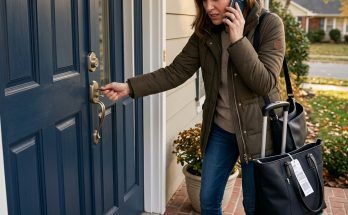
The doorbell rang on a Thursday morning, and I almost ignored it. At sixty-seven, I had become very good at keeping my life small. I drank coffee from the same chipped blue mug, kept books for three local businesses from my kitchen table, and preferred visitors who called first.
The bell rang again, not impatiently, just firmly enough to tell me whoever stood outside was not leaving.
A young woman stood in the hall with a faded backpack hanging from one shoulder. She looked about twenty-two, with dark hair tied loosely at the back of her neck and exhaustion under her eyes.
“Are you Eleanor Vance?”
Something in her face tightened my fingers around the doorknob.
“Who’s asking?”
“My name is Sarah Vance.”
Then she said the name I had spent twenty-five years refusing to speak.
“I’m Thomas’s daughter.”
Thomas.
The little boy who stood on a wooden crate in our restaurant kitchen so he could watch Arthur knead bread. The teenager who brought home injured animals. The young man who kissed my cheek one morning, promised he would see me that evening, and vanished before sunset with every dollar his father and I had saved.
Twenty-five years earlier, Arthur went into the restaurant office to retrieve cash for a supplier. Less than a minute later, I heard something heavy strike the floor.
I found him beside the open safe, his face gray and one hand clutching his chest.
Two hundred forty-seven thousand eight hundred dollars was gone.
Payroll. Taxes. Emergency fund. Building fund. Eighteen years of twelve-hour days and late-night bookkeeping.
Only three people knew the combination.
Arthur. Me. Thomas.
Arthur had severe coronary artery disease. The doctors later said the shock likely triggered a massive cardiac event in a heart already badly damaged. He never woke up.
By then, Thomas had vanished.
His clothes remained in his apartment, his car sat outside, and an uncashed paycheck stayed buried beneath his mail. His passport and wallet were gone.
So was Marcus Thorne, his best friend and business partner.
Their delivery company, Apex Freight, was drowning in debt. Police discovered that a large cash deposit hit the company account the same night our safe was emptied. Some covered overdue wages and suppliers. Some went to a commercial lender. The rest was withdrawn by Marcus.
A traffic camera later captured a rental car associated with Marcus heading east toward Idaho.
Thomas sat in the passenger seat.
No ransom demand. No plea for help. No letter.
Detective Elena Rossi never claimed she knew exactly what Thomas had intended. She only knew his fingerprints were on the safe, our money had moved into his failing company, and he disappeared.
At the time, that was enough for me.
My son took the money. My son ran. My son left while his father was dying.
Grief made certainty easier than doubt.
Vance’s Hearth did not survive. I sold the restaurant for less than it was worth, paid medical bills, funeral costs, unpaid invoices, and the last months of our lease. Then I disappeared into survival.
I cleaned hotel rooms before sunrise, worked at a department store in the afternoon, and kept books at night. For twenty-five years I carried one truth like a stone in my chest.
My son stole our life and ran away.
Now his daughter stood at my door.
And she had Arthur’s eyes.
That was what made me step aside.
Sarah sat across from me at the kitchen table while invoices and receipts remained spread around us. I poured coffee because my hands needed something to do.
“He passed away six weeks ago,” she said. “Pancreatic cancer. He was sick almost a year.”
The news reached me strangely. I had already mourned Thomas in every way except the one a mother should mourn a child.
“What did he tell you about me?”
“Almost nothing until the end. I grew up believing my grandparents died before I was born.”
“The truth is that he emptied our safe and disappeared.”
“He admitted taking the money.”
“Then there is nothing else to explain.”
“There is.”
Sarah opened her backpack and placed a small silver key between my calculator and red pen. The number 318 was stamped into it.
“He made me promise to bring you this.”
“A key to what?”
“A storage unit near Puget Sound. He said it contains a repayment fund, business records, letters, and a statement from Marcus.”
I looked up.
“Marcus is alive?”
“He died in 2022. He signed the statement in 2014.”
“For twenty-five years, your father never called me.”
“I know.”
“He never wrote.”
“He wrote hundreds of letters.”
“Yet none arrived.”
“No.”
She did not defend him.
“He said you had every right to hate him. He only wanted you to know the story you believed was incomplete.”
I picked up the key.
It felt too light for everything she claimed it carried.
We drove to the storage facility in my aging Ford. Unit 318 stood near the far end beneath a row of orange doors.
Sarah stayed beside me while I opened the padlock.
The door shrieked upward. Dust drifted through the sudden light.
Inside were four cardboard boxes, a filing cabinet, and a dark green safe.
For twenty-five years, I had believed the missing money was the last thing Thomas took from me.
Standing in that storage unit, I realized he might have spent the rest of his life trying to return something much harder.
The truth.
Before Sarah and I left for the storage facility, I asked to see identification.
The request embarrassed me.
Then I decided embarrassment was better than gullibility.
Sarah handed over her driver’s license.
Sarah Eleanor Vance.
Spokane address.
I checked the photograph twice.
Then I asked for proof connecting her to Thomas.
She had anticipated that too.
A copy of his death certificate.
A birth certificate listing Thomas Arthur Vance as her father.
A letter from the attorney administering his estate.
Everything matched.
“You came prepared.”
“He said you would ask questions.”
That irritated me.
“He remembered that about me.”
“He remembered everything about you.”
I almost told her not to say things like that.
Instead, I asked:
“Did he know where I lived?”
“Yes.”
“How long?”
“I don’t know exactly. The legal papers I found had your address from years ago. His attorney updated it near the end.”
“So he could find me.”
“Yes.”
The answer was clean.
No excuses.
I appreciated her more every time she refused to soften him.
On the drive to the storage facility, Sarah kept her backpack in her lap. She did not fill the silence.
I asked where she had grown up.
“Mostly Spokane.”
“Your mother?”
“Maria. She’s alive.”
“Are they divorced?”
“They divorced when I was seven.”
I looked at her.
“Because of Thomas?”
“Partly.”
That word warned me the story would resist simplicity.
“What did he do for work?”
“Equipment repair. Restaurant machines, commercial refrigeration, bakery ovens.”
I almost missed my turn.
“Restaurant equipment?”
“Yes.”
Of course.
Even after abandoning the restaurant, Thomas built a life repairing the kinds of machines Arthur had cursed at for eighteen years.
I gripped the steering wheel.
Sarah noticed.
“He talked about kitchens a lot.”
“Did he tell you why?”
“Not really. He said he grew up in one.”
That was technically true.
Lie beside truth.
A habit, apparently.
At a red light, I studied Sarah in profile.
Thomas’s nose.
Maybe.
Arthur’s eyes.
Definitely.
I hated how quickly my mind searched her for family.
Blood can demand recognition before trust has earned anything.
I reminded myself:
She is a stranger.
She is also grieving.
Both.
When we arrived, the facility manager recognized Sarah.
“Your dad rented that unit a long time.”
“How long?” I asked.
He checked.
“Nineteen years.”
I stared at Sarah.
She looked surprised too.
Thomas had maintained a room full of restitution, letters, and evidence for nearly two decades.
Nineteen years of rent.
Nineteen years of not sending the key.
That fact did not feel romantic.
It felt like architecture built around avoidance.
The manager required paperwork before letting us proceed.
Sarah had the authorization.
Again, Thomas had prepared everything at the end.
He had become meticulous once death removed the option to delay.
As we walked toward Unit 318, I said:
“He planned this better than he planned coming home.”
Sarah answered quietly:
“Yes.”
That sentence followed us to the orange door.