Winter returned gently that year.
The first snow settled on the repaired porch railing in a thin white line.
I stood at the window holding my morning coffee.
My little watercolor of the porch hung beside the doorway.
I had finally learned how to paint the shadows beneath the steps.
Alan would have laughed at how seriously I took it.
He always believed hobbies should be enjoyed before they were perfected.
I had begun to agree.
The library invited me back to run another workshop.
I said yes without checking whether the family needed me that evening.
I trusted David and Rachel to tell me if they had a genuine emergency.
I also trusted myself to decide whether I could help.
Those were different forms of trust.
Both had taken practice.
On the first Monday in December, I reviewed my bank statement.
The canceled monthly transfer was still absent.
The money had stayed in my account for nine months.
Some of it had paid Nathan for the porch railing.
Some had covered the insurance increase.
Some had purchased paints, brushes, and classes.
I put a little into savings.
There was nothing extraordinary about any of it.
The ordinary uses felt deeply satisfying.
David and Rachel were doing better with their own budget.
They had adjusted spending when overtime fell.
They had kept the children in their activities by planning ahead.
The new dining-room cabinet had never arrived.
Their old one still worked.
Rachel sometimes joked that she was glad they'd waited.
Brenda was still Brenda.
She sometimes offered unsolicited advice.
She still preferred her wine chilled.
But she no longer expected me to disappear into the kitchen while she relaxed.
At a recent dinner, she carried her own plate to the counter.
I noticed.
I didn't applaud.
Ordinary courtesy didn't need a ceremony.
The children remained at the center of the life we shared.
Leo was reading longer books now.
Sometimes he called to tell me about a chapter.
Mia was learning to write letters carefully enough that I could almost read them.
She sent me drawings of flowers with improbable numbers of petals.
We still had afternoons together.
Sometimes I watched them when their parents needed help.
Sometimes we simply went to the park.
The difference was that the adults made clear plans.
David asked before confirming anything.
Rachel thanked me afterward.
When I said no, they found another arrangement.
Nobody told the children I didn't love them because I had other plans.
That mattered more to me than any single dinner.
One afternoon, Mia asked why I didn't come every Sunday anymore.
We were sitting at my table making paper stars.
I considered my answer carefully.
“Because Grandma has things she likes to do too,” I said.
“Like painting?”
“Yes.”
“And gardening?”
“Yes.”
“And us?”
I took her hand.
“Always you.”
She smiled.
“Can I paint when I'm old?”
“You can paint now.”
She looked delighted by the possibility.
We spent the next hour making blue and yellow flowers.
When David arrived, Mia insisted he take one home.
He hung it on their refrigerator.
I saw it the following week.
It was still there beside the school calendar.
At Christmas, we decided on a small gathering at my house.
I offered because I wanted to.
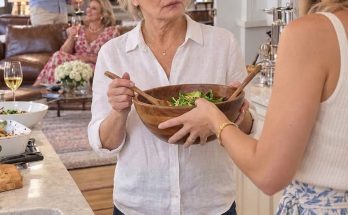
I told everyone I would make the main dish and a salad.
David and Rachel agreed to bring the rest.
Brenda offered to bring dessert.
We settled the menu by text in five minutes.
Nobody hinted that I should handle everything because I had a large kitchen.
On Christmas afternoon, the children tore wrapping paper with the enthusiasm children are supposed to have.
Leo received a book about space.
Mia opened a watercolor set made for little hands.
She gasped.
“We can paint together!”
“We can,” I promised.
David gave me a new sketchbook.
Rachel brought a small lamp for the table where I painted.
Brenda gave me a pot of paperwhite bulbs.
I thanked them all.
A few days before Christmas, I met Elaine and June for lunch.
We had become a small, reliable trio.
Elaine arrived carrying a paper bag of homemade biscuits.
June brought photographs from the conservatory trip.
We spread them across the café table while waiting for soup.
One picture showed me standing beneath an enormous fern with my mouth open in surprise.
June said it was her favorite.
I threatened to hide it.
She laughed and promised to give me a copy.
We talked about our plans for the new year.
Elaine wanted to join a walking group.
June had signed up for a figure-drawing workshop.
I was considering a short trip to the lakeside town on Alan's old list.
We made tentative plans without pretending every date was fixed.
It was good to look forward to something.
After lunch, I drove to the cemetery.
I brought a small bunch of winter greenery for Alan's grave.
The ground was cold but not frozen.
I brushed a few leaves from the stone.
Then I stood quietly.
I didn't speak to him as though he could answer.
But I remembered his patience when I worried too much about pleasing others.
He had always wanted me to have friendships and interests beyond our marriage.
I had been slow to follow that advice after his death.
Now I could almost imagine telling him about my paintings and laughing at how bad the early ones were.
I told him, softly, that David was doing well.
I told him the children were growing quickly.
I told him I missed him.
When I left, the afternoon sun was already low.
I went home and prepared the dining table for Christmas.
I counted the chairs.
I checked the serving dishes.
Then I put the checklist away.
The rest of the meal belonged to the people who had offered to bring it.
I trusted them to keep their promises.
We ate around my dining table.
Alan's photograph stood on the sideboard.
I missed him.
I would always miss him.
But the empty chair no longer seemed to ask me to fill every hour with someone else's needs.
I had found ways to make a life after losing him.
I was still a mother.
I was still a grandmother.
I was also Patricia.
After dinner, David rose and began clearing plates.
Rachel joined him.
Brenda carried the glasses to the counter.
I stood, ready to help.
David looked at me.
“Sit down, Mom. We invited ourselves to your house. We can clean up.”
I laughed.
“Are you certain?”
“Very.”
I sat beside Mia on the sofa.
She opened her new paints and asked which color made green.
I showed her blue and yellow.
In the kitchen, water ran and dishes clinked.
The sounds were familiar.
The feeling was not.
I wasn't being ignored.
I wasn't being assigned a job.
I was sitting with my granddaughter because I wanted to be there.
Rachel came into the living room to ask where I kept the clean towels.
I told her the second drawer on the left.
She found them and went back.
A few minutes later she returned with a cup of tea.
“I made one for you,” she said.
“Thank you.”
She glanced at the sketchbook on my lap.
“Will you show me what you draw in it?”
“I'd like that.”
She sat with us until Mia persuaded her to paint a purple flower.
Nobody spoke about the night I walked out.
We no longer needed to retell it to prove what had happened.
The changes were visible in the way the day unfolded.
I had not recovered every dollar I gave away.
I hadn't demanded it.
I had not received perfect apologies from everyone.
I hadn't expected them.
David and Rachel were still learning to ask rather than assume.
I was still learning not to say yes simply because someone looked disappointed.
Our family remained imperfect.
But I could visit without dreading the sink.
I could decline an invitation without losing my place at the table.
I could help when it felt generous instead of compulsory.
And when the evening ended, I could close my own front door and rest.
After everyone left, I walked into the kitchen.
The counters were clean.
The dishwasher was running.
A towel had been folded beside the sink.
I turned off the light.
Then I carried my tea into the living room and sat beneath the photograph of Alan.
Outside, the snow had started falling again.
I watched it settle on the porch railing.
I thought of the dirty plates I'd left behind nearly a year earlier.
They had seemed so small.
In truth, they had shown me something I needed to change.
I had spent years making room for everyone else.
Now there was room for me too.
THE END
The End
Read more original stories on Feel Every Story.
The Sunday I Put Down the Greasy Plates and Walked Out Without an Explanation
Part 16 of 16