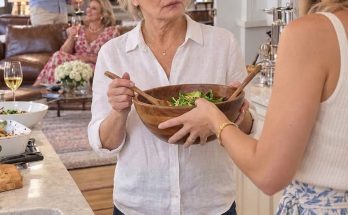
Thanksgiving morning began with a light frost.
I carried the casserole carefully from my car to David's front door.
The dish was warm beneath a folded towel.
Mia opened the door before I could ring.
“Grandma! We're making name cards!”
She took my hand and pulled me toward the table.
Leo had written everyone's name in large letters.
He had spelled Brenda correctly but given David an extra letter.
We decided the mistake was part of the design.
Rachel came out of the kitchen wearing an apron.
She took the casserole and thanked me.
“Put your coat away and have some cider,” she said.
I smiled.
“Is there anything I can do?”
“Yes, actually. Could you help Mia finish the cards?”
“I'd love to.”
The kitchen was busy but organized.
David had set timers for the turkey and potatoes.
Rachel checked the vegetables.
Brenda arrived with cranberry sauce and a tin of cookies.
She put her coat in the closet and joined us at the table.
For a while, we all helped the children decorate.
There were stickers, colored pencils, and little paper leaves.
No one handed me a sink full of pans.
When the food was ready, David carried the heavy turkey platter.
Rachel set out the vegetables.
I brought the casserole to the table because I was nearest to it.
Brenda filled the water glasses.
The work happened around us, not onto one person.
Before eating, David said he wanted to thank everyone for coming.
He looked around the table.
“It's been a complicated year,” he said.
I watched Rachel.
She seemed slightly nervous.
David continued.
“We've been figuring out how to do a few things differently.”
He squeezed Rachel's hand.
“I'm grateful we're all here.”
That was enough.
He didn't turn dinner into a ceremony of apology.
He didn't expose the family argument to the children.
We passed the potatoes and began to eat.
Leo announced that the turkey was better than the one at school.
David bowed dramatically.
Mia asked if people could have a second Thanksgiving for dessert alone.
Brenda said she supported the proposal.
We laughed.
Afterward, Rachel suggested everyone take a short walk before dessert.
David packed the leftovers.
I helped the children find their coats.
Brenda stayed inside to rest her back.
When we returned, the kitchen was already mostly tidy.
David had loaded the dishwasher before leaving.
I noticed without mentioning it.
We ate pie at the table.
Rachel had bought one from a neighborhood bakery.
She said she used to feel guilty if every part of the meal wasn't homemade.
I told her the pie was excellent.
She grinned.
“Then I'm buying it again next year.”
Later, after Brenda left and the children began a movie, Rachel came to sit beside me.
She had two cups of tea.
“Can we talk for a minute?” she asked.
“Of course.”
She held her cup in both hands.
“I've been thinking about last Thanksgiving.”
I remembered arriving early, cooking most of the side dishes, and washing pans until dark.
Rachel went on.
The week before Thanksgiving, I began preparing the casserole with a different feeling than the year before.
I checked the recipe and made a short shopping list.
Rachel had already confirmed how many people would be there.
David had asked about allergies and dietary preferences.
The arrangements were clear.
I bought exactly what I needed.
At home, I washed the spinach and set the ingredients out.
I remembered Alan standing nearby, stealing little pieces of cheese.
He claimed it was quality control.
I used to slap his hand gently with a towel.
He would pretend to be offended.
For a moment I felt the familiar weight of missing him.
Then I smiled at the memory and continued cooking.
I had chosen this dish because I liked making it.
That was enough.
The following afternoon, Elaine stopped by for tea.
She asked whether I was nervous about the holiday.
“A little,” I admitted.
“Why?”
“Because last year didn't go well.”
She reminded me that I could leave if I became uncomfortable.
“I know.”
“And you can also stay and enjoy yourself if it goes well.”
I looked at her.
“That's what I want.”
Elaine smiled.
“Then don't go prepared only for a fight.”
I thought about her advice that night.
I had spent so much energy learning to say no that I sometimes forgot how much I still wanted to say yes.
I wanted to share a holiday with my family.
I wanted to hear the children tell stories.
I wanted Rachel and David to enjoy the home they were building.
The boundary was not the destination.
It was what allowed us to gather without resentment.
On Thanksgiving morning, I put the finished casserole in its insulated carrier and drove over feeling cautiously hopeful.
“You left with the leftovers in a container because I didn't even offer you a seat afterward.”
I looked at her.
“I remember being tired.”
“I do too,” she said.
“I remember how relieved I was that everything got done.”
She paused.
“I never wondered who got worn out doing it.”
I didn't speak.
She looked toward the kitchen.
“I'm sorry for that, Patricia.”
The apology was specific.
It did not ask me to say everything had been fine.
I thanked her.
Then she said, “I've also been thinking about the monthly money.”
I waited.
“David and I finally made a budget that works without it.”
“I'm glad.”
“We can't save as much as we'd like yet.”
“Most families can't.”
“But we're not counting on you to fill the gap.”
She reached into her handbag.
For a moment I wondered whether she was about to hand me an envelope.
Instead she brought out a small card.
Inside was a gift certificate for a local art-supply shop.
“It isn't payment for anything,” she said quickly.
“We just thought you'd enjoy it.”
I looked at the card.
David had written a note on the inside.
For your next painting, Mom. Love, all four of us.
My eyes filled.
I thanked Rachel.
We sat quietly for a while.
Then I asked how her work project was going.
She told me about a difficult meeting and a client who kept changing requirements.
I listened.
We talked as two adults rather than a manager assigning tasks and an unpaid helper receiving them.
At eight, I put on my coat.
David walked me outside.
The night was cold and clear.
He asked whether I wanted help carrying the empty casserole dish.
“No, thanks. I've got it.”
He smiled.
Then he hugged me.
“Thanks for coming, Mom.”
“Thank you for having me.”
As I drove home, I realized how much could change without anyone making a grand speech.
It required a year of ordinary decisions.
It required people to remember them when they were tired.
That was the difficult part.
That was also the hopeful part.
Click here to continue reading: PART 16: The Christmas I Sat with My Granddaughter While the Dishes Were Done Without Me
The Sunday I Put Down the Greasy Plates and Walked Out Without an Explanation
Part 15 of 16