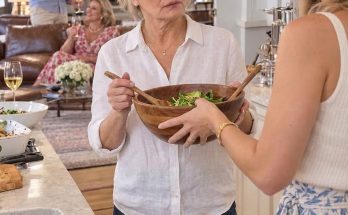
Our first Christmas with Margaret was awkward.
The second was easier.
By the third, the grandchildren behaved as if she had always been part of the family.
Children are practical that way.
If someone shows up, remembers birthdays, brings decent cookies, and listens to stories, they become part of the landscape.
Adults require more paperwork.
That third Christmas, Emily suggested a family photograph.
Everyone gathered in my living room.
Mark stood behind his wife.
Jenna sat on the arm of the sofa.
The grandchildren arranged themselves badly.
Margaret hovered near the hallway.
“Come on,” Emily said.
Margaret shook her head.
“This is your family.”
Jenna looked at her.
“You’re literally our grandmother.”
Margaret froze.
Jenna had never said that aloud before.
Not “Margaret.”
Not “Dad’s mother.”
Our grandmother.
Something shifted.
Margaret sat beside me.
The photographer counted down.
At the last second Noah shouted, “Great-Grandma, smile!”
Margaret did.
The photograph later became one of my favorites.
Not because everyone looked good.
Mark blinked.
I was turned slightly sideways.
One grandchild had a mouth full of cookie.
It was imperfect.
That was why it was right.
Several weeks later, Margaret gave me an envelope.
Inside was a copy of an old photograph from our wedding.
Michael and me walking down the church steps.
Margaret stood behind us.
“I found the original in storage.”
I stared at it.
“You kept this?”
“Yes.”
“I thought everything was lost in the fire.”
“Most of it was.”
She sat beside me.
“There is something else I want to give you.”
I tensed automatically.
She noticed.
“Not a secret.”
“Good.”
She handed me a small savings passbook.
The account held twenty-three thousand dollars.
I looked up.
“What is this?”
“Money I saved from the help Michael gave me.”
“What do you mean?”
“Some months he sent extra for utilities or emergencies. I did not always use it.”
“You saved it?”
“Yes.”
“For what?”
“At first, emergencies.”
“And now?”
“I want you to take it.”
“No.”
“Claire.”
“No.”
“It was your marital money.”
“Some of it.”
“All of it came from Michael.”
“That does not make it mine now.”
She pushed the passbook toward me.
“I don’t want to keep something that hurts you.”
I pushed it back.
“Then use it in a way that doesn’t.”
She looked confused.
We discussed it for weeks.
At first Margaret wanted to split the account among the grandchildren.
I objected.
“That turns it into another secret inheritance.”
“It would not be secret.”
“It still makes the money about guilt.”
She thought about that.
Then she suggested returning it to me.
I refused again.
Finally Jenna asked a question that changed the conversation.
“What helped you leave Frank?”
Margaret looked at her.
“A shelter.”
“What did they pay for?”
“Two weeks in a motel. Bus fare. Food. A lawyer helped later.”
“How much would that have cost?”
“Not much.”
“And did it matter?”
Margaret’s eyes filled.
“It mattered more than anything.”
Jenna nodded toward the passbook.
“Then do that.”
Margaret used part of the money to create a small emergency fund through the local domestic violence shelter.
Not a grand foundation.
Not a scholarship with her name engraved.
A quiet fund for transportation, temporary lodging, document replacement, and emergency medication.
The shelter director, Angela Morris, insisted on written rules.
Margaret liked that.
“No private favors,” Angela said. “The fund will be administered by staff. You won’t choose recipients.”
“Good.”
“No one owes you contact.”
“Good.”
“No one owes you gratitude.”
Margaret smiled.
“Especially good.”
The first grant paid for a motel room and bus tickets for a woman and her child.
The second paid for replacement identification documents.
The third covered a week of medication after someone left home without time to pack.
When Margaret told me, she cried.
“So something good came from it.”
I chose my words carefully.
“Something good came after it.”
She looked at me.
“That’s different.”
“Yes.”
I had become cautious about turning pain into a lesson.
Suffering does not become worthwhile because something meaningful happens later.
But people can still decide what to build from what remains.
That same winter, Margaret began speaking occasionally at the shelter’s older-survivor support group.
Not as an expert.
Not as someone with perfect answers.
She told them the truth.
That leaving saved her life.
That hiding saved her at first.
That later, hiding became its own kind of cage.
One afternoon she asked me to attend.
I sat in the back.
Margaret told the group, “For years I thought safety meant no one knowing where I was.”
A woman across the circle nodded.
“Then I thought shame meant I should stay gone.”
Margaret looked down at her hands.
“I lost years because I could not tell the difference between danger and fear after the danger ended.”
No one applauded.
I was glad.
The room was not a stage.
A woman named Denise asked, “Would you do it differently?”
Margaret answered slowly.
“I would leave Frank exactly the same way.”
Then she looked at me.
“But once I was safe, I would tell the truth sooner.”
I felt that sentence physically.
It was not an apology to me.
It was a conclusion she had earned.
After the meeting, Denise approached us.
“You’re Claire?”
I nodded.
“Margaret talks about you.”
I almost laughed.
“That sentence used to terrify me.”
Denise did not understand.
Margaret did.
On the drive home, she said, “Did I say too much?”
“No.”
“Were you uncomfortable?”
“Yes.”
“Do you want me to stop?”
“No.”
She smiled.
“Those answers do not match.”
“They do now.”
The next Christmas, the family photograph from the previous year sat on Margaret’s bookshelf.
She had written the date on the back.
Underneath, in small handwriting, she added:
The first Christmas I stopped standing near the doorway.
When I saw it, I had to sit down.
That sentence explained Margaret better than any legal file.
For nearly three decades, she lived near the doorway of our family.
Close enough to see.
Too ashamed to enter.
Now she had finally sat down.
But family inclusion did not erase boundaries.
That mattered too.
There were moments when Margaret expected closeness faster than some people could give it.
One afternoon, she called Jenna three times.
Jenna did not answer.
Margaret called me.
“Is she upset?”
“I don’t know.”
“Could you ask?”
“No.”
“Claire.”
“If Jenna wants to tell you, she will.”
Margaret went quiet.
“I’m still learning.”
“So are we.”
Later Jenna explained she had been in meetings all day.
Nothing was wrong.
But I was glad I had not intervened.
Michael had spent years managing the relationship between Margaret and the rest of us without our knowledge.
I refused to become the new manager.
Direct relationships needed direct communication.
That was another family rule.
If Margaret had a question for Jenna, ask Jenna.
If Mark was angry, he told Margaret.
If Emily needed space, she said so.
No messengers unless necessary.
No hidden channels.
No triangulation.
At first it felt unnatural.
Then it felt peaceful.
One evening, Mark called Margaret because he was angry about something small.
She had told one of her friends that he might help fix a shelf.
Mark had never agreed.
“I’m not Dad,” he said.
Margaret apologized immediately.
“I know.”
“No, I mean I’m not automatically available because I’m your son’s son.”
“I understand.”
“Do you?”
“Yes.”
Mark later told me, “She handled it better than Dad would have.”
I laughed.
“Your father would have fixed the shelf while complaining.”
“Exactly.”
We were learning that love did not require silent service.
That was a lesson bigger than the original secret.
Michael’s mistake was not simply secrecy.
It was the belief that he had to carry everything himself.
Margaret’s housing.
Margaret’s safety.
My reaction.
The children’s possible anger.
He managed all of it privately.
The result was a structure built on one person’s decisions.
We were doing something different.
Messier.
Slower.
More honest.
By spring, the emergency fund Margaret created had helped nine people.
Angela sent her a simple report.
No names.
No identifying details.
Only categories and totals.
Margaret read it twice.
Then handed it to me.
“Michael would have liked this.”
“Probably.”
“He would have wanted to increase it.”
“Definitely.”
She smiled.
“He always thought money was a tool.”
“He did.”
“And sometimes a shield.”
I looked at her.
“Yes.”
We sat on her balcony overlooking the community garden.
Below us, two residents argued over tomato stakes.
Margaret laughed.
“I spent twenty-seven years having my rent paid in secret.”
I waited.
“Now I spend twenty minutes arguing publicly about tomatoes.”
“Progress.”
She leaned back.
“I’ll take it.”
So would I.
Click here to continue reading: PART 14: What I Finally Forgave
The Folder in the Bottom Drawer
Part 13 of 16