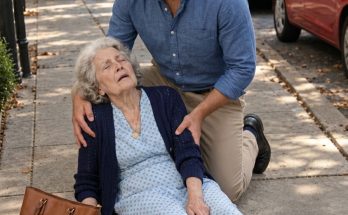
At sixty-four, I believed I had learned how to recognize a lie.
I had taught eighth-grade English for thirty-seven years.
Children lied about homework.
Parents lied about why they missed conferences.
I had sometimes lied to myself about how lonely retirement felt.
But the most frightening lie came from the man who brought me tea every evening.
My name is Margaret Bennett.
Six months before everything happened, I married Daniel Bennett.
He was thirty-one.
I knew what people said about us.
They said he was young enough to be my son.
They said a wealthy businessman could have married anyone he wanted.
They asked why he had chosen a retired schoolteacher with a modest pension and a garden full of stubborn roses.
I told them he made me laugh.
That was true.
He also remembered how I took my coffee.
He listened when I talked about my former students.
He had once spent an entire Sunday repairing the loose steps behind my small house, although he could have hired someone to do it.
I had been widowed for nine years.
I had grown accustomed to eating in front of the television.
Daniel made dinner feel like an occasion.
His house was grander than any place I had ever lived.
It had tall windows, a marble staircase, and a kitchen where I could never remember which drawer held the dish towels.
He called it our home.
I tried to believe him.
Every evening, he made my favorite warm drink.
It was a mild spiced milk with a little honey.
At first, I found the habit comforting.
Then I noticed he watched until I finished every drop.
Some nights, I had already eaten too much.
He would still bring the cup.
“Just a little more, sweetheart.”
“I'm full, Daniel.”
“It helps you sleep.”
I wondered why he sounded so certain.
One evening, I returned to the kitchen for my reading glasses.
Daniel stood with his back to me.
He tipped a small dark bottle over my cup.
Several drops fell into the warm milk.
When he heard me, he tucked the bottle into his pocket.
“What was that?”
“Special flavoring.”
“Why hide it?”
“Because you're going to worry over nothing.”
He kissed my forehead.
I did not drink the cup.
He took it away without arguing.
For weeks, I had been unusually tired.
I sometimes lost my place in a book.
Once, I drove to the library and couldn't remember why I was there.
I had blamed retirement and poor sleep.
Then I heard Daniel talking on the phone after midnight.
“I'm following the instructions,” he whispered.
A pause.
“She's asking questions.”
Another pause.
“We're running out of time. We could lose her.”
I lay still until he returned to bed.
The next evening, I poured a little of the drink into a clean container before he came to collect the cup.
The following morning, I called a private laboratory.
They explained that they could not identify every possible substance from a vague request.
They took down the circumstances and referred me to a physician who could order targeted screening and check whether a clinical evaluation was necessary.
I brought the sample, the bottle photograph I had managed to take, and a list of my symptoms.
Two days later, Dr. Reeves asked me to come in.
He closed his office door.
“Does your husband know you're here?”
“No.”
He turned his screen toward me.
There was my name.
My birth date.
A medical record I had never seen.
The heading read RESEARCH PARTICIPANT.
I felt a tightness beneath my ribs.
“I never agreed to research.”
“I understand,” he said.
He had obtained the record through a hospital system where he had previously worked, after a discrepancy in the laboratory paperwork required verification.
He pointed to a photograph attached to the entry.
It showed a woman standing outside a brick school building.
She had short dark hair and a blue coat.
I knew that coat.
I had owned it twenty-five years ago.
The woman was me.
And the person standing beside me was a teenage boy I had once helped after a terrible winter accident.
His name had been Daniel.
I looked at the doctor.
The room seemed to tilt.
“That's my husband,” I said.
Dr. Reeves folded his hands.
“Then we need to go through this very carefully.”
The photograph kept drawing my eye.
Dr. Reeves noticed.
“You recognize the young man?”
“I think so.”
I told him about the school where I taught.
Our building had been built before anyone thought classrooms needed more than a blackboard, a radiator, and windows that stuck in winter.
The hallways smelled of floor polish.
Every December, the heating system broke on the coldest day.
I remembered Daniel as a student who always arrived early, though he never belonged to my class.
He used the library because it was warm.
At lunchtime he ate slowly, saving half his sandwich for later.
One Friday, I found him waiting outside the principal's office with wet gloves.
He said his mother was working double shifts and the building manager wouldn't let them collect their belongings after the fire.
I called a community support organization.
I didn't solve their problems.
I helped him find a coat and finish a school project.
Then, like so many children, he grew older and disappeared from my daily life.
Dr. Reeves tapped the printed record.
“Did he know you remembered him?”
“I didn't know he was that boy.”
I felt ashamed to admit it.
I had been proud of remembering my students' names.
But the teenager had become a tall man with a new surname, a beard, and an easy confidence.
When Daniel introduced himself at the library fundraiser, he spoke about historical novels and volunteer work.
He never mentioned the old school.
I tried to recall whether he had asked unusual questions about my past.
He had.
What year had I started teaching?
How long had I lived in town?
Did I remember the winter of the apartment fire?
At the time I thought him attentive.
Now I wasn't sure.
The doctor offered me a glass of water.
I drank it, then felt foolish for wondering where it had come from.
He seemed to understand.
“You're not required to make sense of this today.”
That was the first kind thing I had heard since discovering the bottle.
He told me that his principal role was to address my health, not investigate a marriage.
He could document symptoms, explain what testing showed, and refer concerns through appropriate channels.
He could not make a medical conclusion from an image and a suspicious computer entry.
I asked what I should do with the sample container.
He instructed me to follow the laboratory's storage guidance and preserve its original documentation.
We discussed my regular prescriptions, supplements, and whether I had used anything over the counter.
I answered as carefully as I could.
For the first time, I realized how many little decisions about my health Daniel had begun making for me.
He booked appointments.
He filled the car with gas before I went anywhere.
He often ordered for both of us in restaurants.
None of those acts was automatically wrong.
I had appreciated many of them.
But together with the drink, they raised a question I could not ignore.
When had I stopped being asked?
Before leaving, I requested a copy of my visit summary.
I placed it in a folder beside the laboratory paperwork.
The receptionist smiled as she handed me the envelope.
Outside, sunlight flashed off parked cars.
I stood beside mine for a long moment.
Then I put my keys on the passenger seat and opened my notebook.
I wrote down one sentence.
I am allowed to ask questions about my own care.
I remembered our wedding morning especially clearly.
Daniel had insisted on a small ceremony.
He said big weddings turned private promises into performances.
I agreed.
Eleanor helped fasten the little clasp on my necklace.
Ruth traveled across the state and arrived carrying a bunch of flowers from her garden.
Daniel stood at the front of the room with his hands folded.
He looked nervous.
I thought that nervousness meant he understood the seriousness of marriage.
During the vows, he promised to respect my independence.
I remembered those exact words because they made me smile.
I had spent my life paying my own bills and making difficult decisions.
I wanted companionship, not someone to manage me.
After the ceremony, we ate lemon cake and danced to an old song.
The photographs made us look happy.
We were happy that afternoon.
The realization hurt.
I could not protect myself by pretending that every pleasant hour had been a trick.
But the promises had created obligations.
Daniel hadn't kept all of them.
I thought about that while Dr. Reeves stepped into the hallway to speak with his staff.
Through the window, I watched a young woman carry a sleeping child toward the elevators.
She adjusted the child's coat without waking him.
Care could be gentle and ordinary.
Care could also be controlling when someone decided that knowing better entitled them to ignore another person's choice.
The difference mattered more than the language used to describe it.
When Dr. Reeves returned, I asked him to speak to me as he would any patient.
“Please don't soften things because of my age.”
He nodded.
“I won't.”
I felt myself sit a little straighter.
Click here to continue reading: PART 2: The Old School Photograph Reopened a Winter I Had Tried to Put Behind Me
The Evening My Husband Hid a Bottle and My Doctor Opened an Unfamiliar Medical File
Part 1 of 16