I sat outside the building for almost forty minutes.
Every time I tried to turn the key, I pictured our kitchen table.
Melissa kept the monthly bills in a blue folder there.
The mortgage payment was due in eleven days.
Our eldest daughter, Nora, needed braces.
June had outgrown her winter coat.
I had told them both that we could afford those things after the promotion Gavin had hinted might come in January.
Now I had no paycheck and no written explanation for losing it.
Priya called as I reached the first traffic light.
“Are you driving?”
“Yes.”
“Pull over when you can.”
I parked behind a pharmacy.
She sounded exhausted.
“Gavin was angry before you arrived. The clients were upset about the delay, but they didn't walk out because of you.”
“What happened?”
“He changed your price assumptions during the meeting. The numbers didn't match the proposal he'd already sent them.”
I closed my eyes.
“You're sure?”
“I watched it happen.”
“Will you put that in writing?”
She hesitated.
“I need this job, Chris.”
“I know.”
That was the worst part.
I understood her fear completely.
By noon, Gavin had emailed instructions for collecting my things after business hours.
A supervisor would accompany me.
My account access had been disabled.
There was no mention of final wages, unused vacation, or insurance.
Melissa met me at home with two sandwiches.
I couldn't eat mine.
She sat across from me and opened the blue folder.
“We have some savings.”
“Not enough.”
“We'll make a plan.”
“I don't even know if unemployment will approve me.”
“Then we ask.”
She wrote four headings on a sheet of paper.
Income.
Bills.
Insurance.
Next steps.
I watched her work.
The ordinary scrape of her pen kept me from falling apart.
When Nora and June came home, we told them I was no longer working at Eastbridge.
Nora looked worried.
“Did you do something bad?”
“No.”
“Then why did they fire you?”
“Sometimes adults make decisions I don't agree with.”
June asked whether I could still come to her music recital.
“Yes.”
She smiled.
“That part sounds good.”
Later, my phone rang from an unfamiliar number.
A woman introduced herself as a patient liaison at West County Hospital.
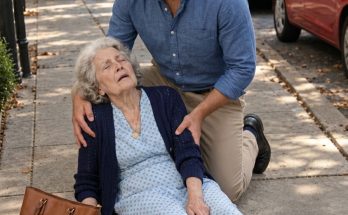
She asked whether I had assisted an older woman on Route 16.
I said yes.
“The patient is recovering. She asked whether we could pass along her thanks.”
My shoulders relaxed.
“Is she going to be okay?”
“She is receiving care. I can't share her medical information without permission.”
“Of course.”
“She would like to speak with you if you're comfortable.”
I said she could give the woman my number.
For the first time that day, I took a full breath.
Ten minutes later, another number appeared on my screen.
A tired voice said, “Christopher? This is Eleanor Vale. I believe you dropped your work badge beside my car.”
I looked at my jacket.
The badge clip was empty.
That evening, I tried to put the girls to bed as though it were a normal school night.
June needed a drink of water.
Nora wanted to talk about a group project.
Neither asked about my job until I reached the bedroom door.
“Dad,” Nora said, “do we need to sell the house?”
I stopped.
“Why would you think that?”
“Someone in my class moved because his dad lost his job.”
I pulled a chair beside her bed.
“We have money saved, and Mom is working. We're figuring out what comes next.”
“But it could happen?”
“Lots of things could happen. That's why we're planning.”
I didn't promise that nothing could ever go wrong.
I promised that she and June wouldn't have to solve it.
She accepted that with a small nod.
Later, I found Melissa in the laundry room sorting uniforms.
“I told Nora we're planning,” I said.
“Good.”
“I wish I could tell her we're completely safe.”
Melissa folded a shirt.
“Children can tell when we're pretending.”
She handed me a towel.
“Help me with these.”
We worked quietly.
The dryer made a soft clicking sound as it cooled.
Our marriage had never been built on speeches.
It had been built on evenings like this.
I remembered how little I had been home during the last campaign.
Gavin called at dinner.
He sent messages on Sunday mornings.
I had answered almost every time because I thought availability proved commitment.
Melissa had complained, but eventually she stopped asking me to put the phone away.
Now the phone wasn't ringing.
The quiet felt wonderful and frightening at once.
I apologized for the evenings I had missed.
She looked at me.
“I'm angry about those,” she said. “But I'm more worried about how you speak to yourself right now.”
I tried to laugh.
She shook her head.
“You keep saying you ruined everything.”
“I lost our income.”
“You lost one source of income. Those aren't the same thing.”
She was right, although I didn't feel ready to believe her.
The next morning, I made breakfast before she woke.
June came downstairs wearing mismatched socks.
She asked if I had another day off.
“I'm looking for a new job.”
“Can you still pack my lunch?”
“I think I can manage.”
She requested a sandwich cut into triangles.
I made it carefully.
It was a small task.
Finishing it helped me begin the larger ones.
The school called on Tuesday about June's music recital.
Parents were asked to send a white shirt and black trousers.
I normally would have forwarded the email to Melissa and forgotten it.
This time I checked the closet.
June's black trousers were two sizes too short.
We went to a thrift shop after school.
She found a nearly new pair and insisted on trying them on immediately.
“They fit!”
She twirled in front of the mirror.
I carried the old trousers to the donation bin.
The outing cost less than the takeout lunches I had bought during a typical week at Eastbridge.
That thought embarrassed me.
I had spent money carelessly while telling Melissa we were too busy to plan.
But I didn't want to turn our new budget into constant guilt.
When June asked whether we could get a small hot chocolate, I said yes.
We sat by the café window.
She told me everything about the recital, including which student kept singing too loudly.
I pretended to be scandalized.
She giggled.
At home, Nora asked whether I had sent another résumé.
“Three today.”
“Are you going to get three jobs?”
“I hope not.”
She laughed.
Then she asked whether I missed my old friends.
I thought about Priya, the designer, and the receptionist who had looked away.
“Some of them,” I said.
“Can you still talk to them?”
“Yes.”
“Then you haven't lost everything.”
I carried that sentence upstairs with me.
That night, I started a list of people I wanted to stay in contact with.
Not to ask for work.
To preserve friendships that deserved to survive the job.
Click here to continue reading: PART 3: The Woman From Route Sixteen Who Refused to Let Me Call Her a Hero
The Eight-Thirty Presentation I Missed Because a Stranger Collapsed Beside the Highway
Part 2 of 16