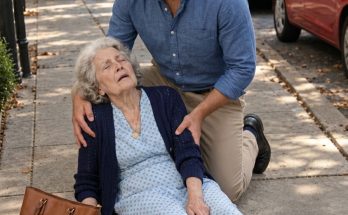
Eleanor Vale sounded older than I remembered.
Her voice was steady now, although she stopped to breathe between sentences.
“I hope I haven't interrupted your evening,” she said.
“Not at all.”
“Your badge was stuck beneath my grocery bag. A paramedic found it.”
“I'm glad you're all right.”
“I had a cardiac event. They've explained it to me in enough detail to make me promise to follow instructions.”
I laughed despite myself.
She wanted to thank me in person.
I told her it wasn't necessary.
“Nonsense. You missed work because of me.”
I didn't know how she had heard that.
“The paramedics said you kept checking your watch. When I asked why, one of them said you had mentioned a presentation.”
I looked toward the living room.
Melissa was helping June sound out a word.
“There was a presentation,” I admitted.
“Was it important?”
“Yes.”
“And did you make it?”
“No.”
There was a pause.
“I'm sorry.”
“You didn't ask to collapse beside the road.”
“Neither did you ask to have your morning turned upside down.”
She invited me to visit after she was discharged.
I said I would consider it.
The next afternoon, I drove back to Eastbridge for my belongings.
The receptionist let me into the lobby but not the work floor.
A security employee brought out two boxes.
Inside were family photographs, a chipped mug, and the small cactus Nora had given me on my birthday.
My notebooks were missing.
“Those are company property,” the employee said.
“Some are personal.”
He shook his head.
“Talk to HR.”
Eastbridge didn't have a separate HR department.
Gavin handled personnel matters himself.
Outside, Priya waited beside my car.
She handed me a folded sheet.
“It's the agenda that went to the client before the meeting.”
The document listed Gavin as executive sponsor.
My role was lead presenter, but Priya and two other managers were authorized to continue if I was unavailable.
“Please don't tell him I gave you this.”
“Priya, I don't want you in trouble.”
“I know.”
She looked toward the office doors.
“He told the whole team you abandoned the presentation.”
I held the paper carefully.
“I messaged you before it started.”
“I know. I got the message.”
“Did he?”
“I read it aloud to him.”
For a moment I could only stare.
Back at home, I copied every work-related message I was still allowed to access from my personal phone.
I wrote down the times of the emergency call and the ambulance arrival.
Melissa watched me stack the papers.
“Are you going to fight the firing?”
“I don't know yet.”
“Good. You don't have to decide tonight.”
A few days later, Eleanor left me a voicemail.
She had been discharged.
She also had my badge.
And she wanted to return it herself.
I called back and offered to collect it.
Her answer surprised me.
“Come for tea, Christopher. I would rather speak to a person than a wall.”
The missing notebooks made me think about how much I had allowed work to occupy my identity.
My favorite notebook had a blue cover and a torn corner.
I used it to write campaign ideas on the train and while waiting outside my daughters' activities.
Some pages contained personal reminders.
Other pages contained client information.
I could not responsibly demand the whole thing back without separating those matters.
Rafael later suggested that I ask whether Eastbridge could return or copy only the personal material after review.
I sent a polite request.
Gavin didn't answer.
The notebook became less important as the weeks passed.
What stayed with me was the realization that I had never kept a clear boundary between my work and my own time.
Even my private thoughts seemed trapped in the office.
Priya and I had once eaten lunch at our desks for three weeks straight.
One afternoon, she found me making changes to a presentation while feverish.
“You should be at home,” she'd said.
“Gavin wants this by five.”
“Gavin wants everything by five.”
We had laughed about it.
Now the memory felt less funny.
After Eleanor's first call, I searched for her name online.
I found newspaper articles about meal deliveries and a photograph of volunteers sorting canned goods.
I was tempted to read everything.
Then I stopped.
She had shared her number to thank me, not to invite me into her private life.
I closed the browser.
When we finally met, she told me what she wanted me to know.
That felt like a better beginning.
At her kitchen table, she asked whether I had always worked in advertising.
I told her about the printing shop where I'd worked during college.
My first supervisor there was a woman named Denise who believed in correcting mistakes immediately.
She was strict.
She also stayed late to help us when a large order went wrong.
Eleanor smiled.
“Sounds like someone who knew the difference between holding people accountable and humiliating them.”
I hadn't put it that way before.
Denise had expected a lot.
I had been proud to work for her.
Gavin expected a lot too.
But I had begun to dread his footsteps.
The difference wasn't standards.
It was trust.
When Eleanor walked me to the door, she told me to call if I wanted advice.
I said I would.
I didn't know whether I would actually do it.
But having someone offer help without demanding a favor in return changed the way the day felt.
Eleanor's front room contained a framed photograph of a younger man standing beside a fishing boat.
I noticed it while she went to get the badge envelope.
She saw me looking.
“My husband, Samuel,” she said.
“He died nine years ago.”
“I'm sorry.”
“He made a terrible cup of coffee. I still miss it.”
I smiled.
She told me he had been a school custodian.
Every December, he repaired broken toys donated to a holiday collection.
People used to leave boxes on their porch.
Sometimes he could fix the toys.
Sometimes he couldn't.
“He never promised people miracles,” she said. “He promised to try.”
I looked down at my hands.
The morning on Route 16, I had done nothing that felt miraculous.
I hadn't diagnosed Eleanor.
I hadn't supplied medicine.
I had been frightened and uncertain.
I had made a call and stayed.
Eleanor seemed to understand why that unsettled me.
“You don't have to become a different person because you helped me,” she said.
I nodded.
Before leaving, I asked whether she needed anything moved or repaired.
She declined.
“I'm not a project,” she said kindly.
“I know.”
“Good. Then come back for tea when you'd like company.”
I drove home appreciating that she had protected both of us from turning gratitude into an obligation.
When I told Melissa, she said Eleanor sounded like someone worth knowing.
“She is.”
“Then invite her for dinner one day.”
I said I would wait until she was feeling stronger.
Melissa nodded.
There was no urgency.
Friendship didn't need a dramatic deadline.
Click here to continue reading: PART 4: Tea at Eleanor Vale’s Kitchen Table and a Story That Complicated My Anger
The Eight-Thirty Presentation I Missed Because a Stranger Collapsed Beside the Highway
Part 3 of 16