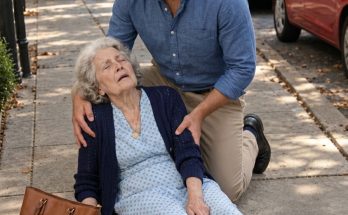
Almost a year after Eleanor collapsed, I drove along Route 16 on my way to a training session.
The shoulder where I had stopped looked ordinary.
Weeds had grown through the gravel.
Traffic moved past at the usual speed.
There was no marker.
Nothing told passing drivers that two people had once been frightened there.
I pulled into a safe rest area farther along the road.
Not because I needed to reenact the morning.
Because I had been thinking about what Nora asked.
Would I stop again?
I knew the answer.
Yes.
I would park as safely as possible.
Call emergency services.
Follow their instructions.
Get other help when available.
And notify work as soon as I reasonably could.
I would also expect my employer to have a plan for a missed meeting.
Compassion and responsibility were not enemies.
A workplace could ask hard questions without declaring that a stranger wasn't worth helping.
My phone buzzed.
It was a message from Melissa.
Don't forget milk on the way home.
I laughed.
Of all the messages I had received on that road, this was my favorite.
The training went well.
I came home on time.
June met me at the door with a drawing of our family.
Eleanor appeared in the corner, wearing green.
“Why is she so tall?” I asked.
“Because she knows lots of things.”
We put the drawing on the refrigerator.
That weekend, Eleanor joined us for dinner.
She still needed occasional rides.
She had learned to use the delivery app her granddaughter installed.
She didn't like it.
She said the vegetables arrived looking disappointed in themselves.
Nora laughed until she had tears in her eyes.
After dessert, Eleanor asked about my job.
I told her we had reached our enrollment target for the season.
She raised her glass of water.
“To everyone who helped.”
We all raised our glasses.
I thought of Priya, who had told the truth despite being afraid.
I thought of Melissa, who had opened the blue folder when I couldn't think clearly.
I thought of Sonya, who had judged my application by my work.
I thought of Rafael, who had explained the difference between being wronged and having a provable legal claim.
And I thought of the paramedics on the shoulder of Route 16.
They had taken over when I had reached the limit of what I could do.
That was a kind of responsibility too.
The next morning, I walked June to the bus stop.
She reached for my hand.
“Dad, if someone needs help, do we always have to do everything?”
“No,” I said. “We do what we safely can. And we ask people who know more to help.”
She nodded seriously.
“Like the ambulance people.”
“Exactly.”
The bus arrived.
She climbed aboard and waved from the window.
I stood there until it turned the corner.
Then I went home, picked up my work bag, and left for a job I no longer dreaded.
I was still the man who had missed an eight-thirty presentation.
I was also a husband, a father, a colleague, and a friend.
None of those roles could be reduced to one awful morning.
Eleanor had survived.
Our family had survived a difficult year.
And I could finally remember the roadside without hearing Gavin's voice first.
Nora's assignment became a small family conversation.
She interviewed Melissa first.
“What did you think when Dad came home?”
Melissa considered her answer.
“I was frightened about the job, but I was also glad he was safe.”
“Were you angry?”
“At what happened, yes.”
“Were you angry at Dad?”
“Not for helping someone.”
Nora wrote carefully.
Then she called Eleanor with our permission.
Eleanor told her that memory of the emergency came in pieces.
The stopped car.
The rough pavement.
A voice saying help was coming.
“I don't remember a grand speech,” she said. “He just stayed.”
Nora asked whether she would have helped a stranger too.
“I have tried to help plenty of strangers. That day I needed one to help me.”
After the call, Nora looked at her notes.
“Everyone tells the story a little differently.”
“Because we were standing in different places,” I said.
She asked about Gavin.
I told her he had made a decision I thought was wrong.
I didn't ask her to describe him as evil.
I didn't want her school assignment to become a public argument about my old employer.
She chose to write about how ordinary people respond when someone needs help.
Her teacher praised the clear sequence of events.
Nora brought the paper home folded in her backpack.
There was a small red star beside the title.
I read it that evening.
The last sentence made my eyes sting.
My dad couldn't fix everything, but he did what he could until people who knew more arrived.
I handed it back.
“That's a good ending.”
She grinned.
“It's what happened.”
A few days later, the coalition needed volunteers for a weekend book drive.
I signed up for one shift, then left at the time I had promised my family.
A year earlier, I would have stayed until every box was sorted.
This time, another volunteer took over.
The work continued without me.
I drove to Nora's soccer game.
She waved from the field.
I waved back.
I thought about what Eleanor had said at her kitchen table.
No one person had to keep everything running.
We could care deeply and still allow other people to carry their share.
The lesson had become practical.
It lived in my calendar, not just in my thoughts.
Click here to continue reading: PART 16: The Last Box I Unpacked and the Life I No Longer Needed to Prove
The Eight-Thirty Presentation I Missed Because a Stranger Collapsed Beside the Highway
Part 15 of 16