A few months later, I found the last box from Eastbridge in the basement.
It had been pushed behind camping supplies and winter boots.
Inside was my old cactus, now hopelessly dry.
A framed photograph showed the staff at a holiday party.
Priya stood beside me, smiling.
Gavin was at the back.
I had almost forgotten that there were good days in that office too.
The company had not always been a place I feared.
That made its ending harder to put away.
Melissa found me sitting on the basement stairs.
“What's in the box?”
“Pieces of my old job.”
“Anything you want to keep?”
I sorted through the contents.
The photograph went into an album.
The mug went into the kitchen.
The faded company lanyard went into the trash.
I left the cactus pot on the workbench until spring.
Sometimes things couldn't be repaired.
Sometimes their containers could still be useful.
That night, we talked about how much our family had changed.
We had canceled a trip and delayed expenses.
We had learned to have uncomfortable conversations about money.
I had learned that asking for advice didn't mean I had failed.
Melissa had learned to tell me when my silence frightened her.
The girls had learned that adults can lose jobs without losing their worth.
None of those lessons had been free.
But we had stopped pretending everything was fine when it wasn't.
On the anniversary of the accident, Eleanor asked whether we would join her for lunch.
We met at the diner near the library.
She brought a photograph of herself from thirty years earlier.
She was standing beside a van marked COMMUNITY MEALS.
“You looked busy,” Nora said.
“I was,” Eleanor replied. “And I thought I was the only person who could keep everything running.”
“Were you?”
“No. Thank goodness.”
Eleanor glanced at me.
“That's a hard lesson for people who like to be needed.”
I smiled.
After lunch, I paid the bill before she could reach for it.
She protested on principle.
I promised to let her pay next time.
Outside, the air smelled of rain.
I held the door while she put on her coat.
She asked whether I ever regretted stopping.
I took a moment before answering.
“I regret what happened at work.”
“Of course.”
“I regret the fear it caused my family.”
She nodded.
“But I don't regret helping you.”
“Good,” she said. “Neither do I.”
I drove home with Melissa and our daughters.
We stopped at the grocery store for milk.
June argued that we also needed cookies.
Nora said cookies weren't on the list.
Melissa bought them anyway.
At home, I hung my coat by the door and started dinner.
The phone stayed quiet.
No angry messages.
No demand to explain why I was five minutes late.
Just our ordinary house, a half-finished puzzle on the table, and the sound of June singing upstairs.
I had once believed that proving myself at work would make my family safe.
Now I understood that security required more than a title and a paycheck.
It required honest plans, people who would tell the truth, and room to admit when help was needed.
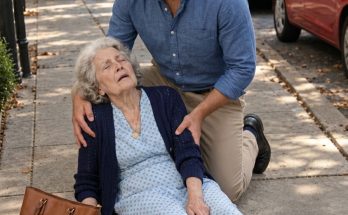
The woman on Route 16 had needed an ambulance.
I had needed a second chance at building my working life.
We had each received help from other people.
I turned down the stove and called the girls to dinner.
They came running.
For once, nobody had to wait for me.
The next time I cleaned the basement, I found a photograph from the day Nora was born.
I looked young and terrified.
Melissa sat in the hospital bed, smiling through exhaustion.
I remembered promising that I would always provide for our family.
I had interpreted that promise narrowly for years.
Earn more.
Stay later.
Answer every call.
Never let a boss think I wasn't committed.
Those were measurable things.
They felt like security.
But when I lost the job, the people who kept our household together weren't measuring my response times.
Melissa opened the folder and worked through the bills with me.
My daughters made room for ordinary joy even when money was tight.
Friends gave honest references and practical advice.
Eleanor reminded me to eat lunch.
None of it made the mortgage disappear.
It made facing the mortgage possible.
I put the hospital photograph beside the family album.
Then I called Melissa downstairs.
“Look how young we were.”
She smiled.
“And you thought you knew everything.”
“I still sometimes do.”
“Less often.”
She kissed my cheek and went back upstairs.
I finished unpacking the box.
There was no great ceremony.
I wiped the shelf clean and put away the things we wanted to keep.
The trash went outside on Tuesday morning.
That evening, our neighbor knocked to ask whether I could help jump-start her car.
I checked that I had time and brought out the cables.
Another neighbor knew more about the battery than I did, so we asked him to take a look.
The engine started after a few minutes.
Our neighbor thanked us both.
I walked back inside without thinking of the incident as a test of my character.
It was simply something I could help with.
At dinner, June asked what I had done after work.
“Helped Mrs. Barnes start her car.”
“Were you late?”
“Five minutes.”
“Did you get fired?”
I laughed.
“No. I sent Mom a message and she kept dinner warm.”
June nodded as though this was the obvious way the world should operate.
Maybe it was.
I didn't need the whole world to be that reasonable.
I needed to build a life around people who made a serious effort to be.
When I tucked the girls into bed, Nora asked whether Eleanor would come for Thanksgiving.
“We can invite her.”
“Will she say yes?”
“I don't know.”
“Ask her tomorrow.”
“I will.”
I switched off the hallway light.
The house settled into its familiar nighttime sounds.
For the first time in a long while, I was looking forward to an ordinary morning.
At Thanksgiving, Eleanor arrived carrying a small container of cranberry sauce.
Melissa had offered to pick her up.
Eleanor insisted that her granddaughter would drive her and stay for dessert.
Our table was crowded.
June had made paper place cards with everyone's names.
She misspelled Eleanor's twice.
Eleanor kept the first version as a souvenir.
During dinner, Nora asked each guest to name something that had helped them that year.
Melissa mentioned neighbors who had watched the girls during interviews and appointments.
Eleanor thanked her granddaughter for patiently taking her to medical visits.
I thanked the people sitting around the table.
June said she was grateful for mashed potatoes.
Everyone laughed.
Later, while we cleared dishes, Eleanor found me near the sink.
“You seem more settled,” she said.
“I am.”
“Do you still think about the road?”
“Sometimes.”
“So do I.”
We didn't say anything for a while.
There was no need to explain what that morning had cost or what followed it.
We both knew.
Eleanor dried a plate and handed it to me.
From the dining room came the sound of the girls arguing over a board game.
I put the plate away.
Then we went back to join them.
THE END
The End
Read more original stories on Feel Every Story.
The Eight-Thirty Presentation I Missed Because a Stranger Collapsed Beside the Highway
Part 16 of 16