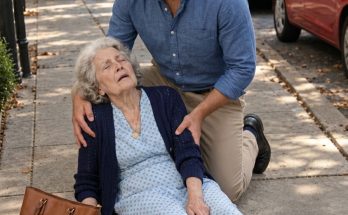
Helen requested one final conversation.
Her lawyer contacted Susan.
I declined at first.
Then I thought about the woman who had written me a thank-you card so many years ago.
I wanted to tell her something directly.
We arranged a brief meeting in a conference room.
Susan sat beside me.
Helen arrived with her own attorney.
She looked older than I remembered.
Her hair had turned white.
Her posture was careful.
For a moment, I saw the exhausted nurse from the school hallway.
Then I saw the researcher who had put my name into a system without my informed agreement.
“Margaret,” she said.
“Hello, Helen.”
She apologized.
Her voice trembled as she described how frightened she had been about her son's past illness and how confident she became in the small study.
I waited until she finished.
Then I asked one question.
“Did you ever consider asking me?”
She lowered her eyes.
“We were afraid you'd refuse.”
“Yes,” I said.
“I probably would have.”
She looked up.
“That was my right.”
Helen nodded slowly.
I told her about my fear each time I made tea.
I told her about the mornings I checked my memory against a list.
I told her how difficult it was to understand that she had used my old kindness as part of a reason to involve me.
She listened.
She did not interrupt.
I appreciated that much.
It wasn't enough to repair the past.
Helen said she hoped I could forgive her eventually.
“Maybe,” I answered.
“But I won't promise that.”
I explained that I would cooperate with any appropriate inquiry and would not conceal the facts to spare her embarrassment.
She said she understood.
Whether she truly did was not mine to determine.
The meeting ended without an embrace.
Outside, Susan asked how I felt.
“Tired.”
“Anything else?”
I thought for a while.
“Clearer.”
The next week, I received an update that the relevant professional review remained pending.
It might take many more months.
I no longer organized my days around its outcome.
I kept copies of documents and responded when asked.
Then I returned to my library shifts and my garden.
Ruth arrived for our coastal trip with three sweaters and two novels.
We drove past old farmhouses and fields beginning to turn green.
At the inn, I opened the window and smelled the sea.
That evening, we ate soup in a restaurant with uneven wooden tables.
Ruth raised her glass of water.
“To what?” I asked.
“To choosing for yourself.”
I touched my glass to hers.
That seemed worth celebrating.
I expected the meeting with Helen to leave me angry for days.
Instead, I felt strangely quiet.
I spent the next morning reading in a café.
A young couple at the next table argued over which apartment to rent.
They were polite but tired.
One wanted a balcony.
The other wanted a shorter commute.
I watched them compare notes on a sheet of paper.
They were doing what I wished Daniel and I had done more often.
They were talking about choices before making them.
I returned to my book.
At lunch, I called Eleanor and told her what Helen had said.
Eleanor asked whether I believed the apology.
“I think she regrets what happened.”
“Is that the same thing?”
“No.”
I thought about it.
Regret could mean she disliked the consequences.
Accountability required accepting what she had done and helping repair what could still be repaired.
The professional review would test some of that through records and rules.
I didn't need to judge every emotion she expressed.
Denise encouraged me to decide how much contact I wanted with the people involved.
I chose none beyond what was necessary for official processes.
I told Susan to route all future correspondence through her office.
Then I deleted Helen's number from my phone.
I didn't need it stored beside my friends and family.
During our trip, Ruth and I visited a small museum about the coastal town's fishing history.
We watched a film about women who kept local businesses running during storms.
Ruth said I would have made a formidable harbor master.
“Too many forms,” I told her.
We laughed.
That evening, I wrote a postcard to Eleanor.
The picture showed a lighthouse.
I told her the weather was windy and the soup excellent.
I didn't mention the research project.
The card was about a trip, not a crisis.
I posted it the following morning.
Then Ruth and I walked along the harbor with our coats buttoned high.
Before the meeting with Helen, I had written down three things I wanted to say.
I wanted her to know that her actions had affected my health.
I wanted her to understand that my old kindness was not permission.
I wanted her to stop describing what happened as an unfortunate misunderstanding.
When we sat across from each other, I kept the paper in my handbag.
I didn't need to read it.
The words came naturally.
After the meeting, I checked the paper again.
I had said everything that mattered.
There were more questions I could have asked.
Why had she chosen this particular preparation?
Who else had questioned the plan?
What did she tell Daniel to make him think concealment was acceptable?
Those issues belonged in the formal inquiry and any relevant proceedings.
I did not need to turn a personal meeting into an interrogation.
On my way home, I bought flowers for the apartment.
They were inexpensive yellow daisies.
I arranged them beside the window.
Their brightness was almost cheerful enough to feel rude.
I liked that.
Not every part of life needed to match my sadness.
A month later, I found a photograph of the school library among the old records. The tables were crowded with paper flowers made for a spring fundraiser. I could see myself at the far end of the room, holding a tray of biscuits. I could also see several students helping stack chairs. I knew how quickly life had moved since then. Some of those children now had families of their own. Some had moved away. One had become my husband and made choices I never could have predicted. I set the photograph on the desk and wrote a note on the back identifying the event and the approximate date. I wanted the record to be accurate. I had learned what harm a misleading date could cause. Then I put the picture with the rest of my school collection. It was one small piece of a much larger history. I didn't want Daniel's actions to become the only lens through which I remembered my teaching years. They contained thousands of ordinary acts of patience, laughter, correction, and care. Those years still belonged to me.
Click here to continue reading: PART 16: A Year After I Left Daniel I Found Peace in the Life I Was Finally Allowed to Choose
The Evening My Husband Hid a Bottle and My Doctor Opened an Unfamiliar Medical File
Part 15 of 16