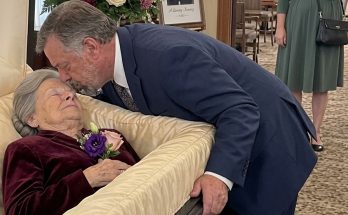
Joe and my mother, Margaret, disliked each other almost immediately after they met.
For nearly three decades, every holiday dinner followed the same pattern.
Polite smiles.
Short answers.
Long silences.
Then, sooner or later, one of them found a reason to leave the room.
Mom never called him her son.
Not once.
Joe once told me he would rather work Christmas morning than spend another full holiday at her house.
For years, I assumed they were simply incompatible.
Mom had built a small financial consulting business after my father died and became fiercely independent.
Joe came from a modest background and was proud of everything he had earned on his own.
I thought their conflict came down to pride, money, or personality.
But every once in a while, something happened that made me wonder.
One night after a particularly tense argument, I heard Mom say:
“You know exactly what you did.”
Joe went silent.
Not angry.
Not defensive.
Silent.
Later, I confronted them both.
“What did she mean?”
Mom changed the subject.
Joe told me it was nothing.
I asked more than once over the years.
Always the same answers.
“We’re just different.”
“We’ve never understood each other.”
“It doesn’t concern you.”
Eventually, I stopped asking.
Then Mom died at seventy-eight.
After the funeral, our family gathered at her house.
At one point, I realized Joe was missing.
I assumed he had stepped outside.
Then I found him near the room where Mom’s open coffin had been placed.
The door was partly open.
I was about to step inside when I heard him speak.
“I kept our secret, Margaret.”
I stopped.
Joe had one hand resting on the edge of the coffin.
“No one ever found out.”
My heart started pounding.
Then he lowered his voice.
“And it’ll stay buried beneath the red maple in your yard forever.”
I stepped away before he could see me.
The red maple.
It stood behind the house where I had grown up.
Mom planted it twenty-seven years earlier.
The exact year she met Joe.
Suddenly, old memories came back.
She refused to let gardeners work near the roots.
When the tree cracked part of the walkway, she repaired the concrete instead of removing the maple.
Once, my daughter started digging near the trunk with a plastic shovel.
Mom reacted so sharply that the child burst into tears.
At the time, I thought she was sentimental about the tree.
That night, after the last relatives left, I drove back to Mom’s house.
The porch light barely reached the yard.
The maple looked enormous.
I stood there for several minutes.
Then I went into the garage and got a shovel.
I kept telling myself grief was making me irrational.
Maybe Joe had been speaking metaphorically.
Maybe buried meant forgotten.
I started digging anyway.
Roots.
Damp soil.
Rocks.
After twenty minutes, embarrassment was beginning to replace fear.
Then the shovel hit something.
Clang.
Metal.
I dropped to my knees.
About two feet below the surface, wrapped in several layers of old plastic, was a rusted metal container.
I carried it onto the porch.
My hands shook.
For a long time, I could not make myself open it.
Then I lifted the lid.
Inside were old documents.
Financial records.
An envelope with Joe’s name.
A photograph.
And an old police report.
I picked up the photograph first.
Mom was standing in front of her old office, much younger.
Beside her was a woman I vaguely remembered from childhood.
Evelyn Ross.
She had once been one of Mom’s closest friends.
Then she disappeared from our lives almost overnight.
A date was written on the back.
Twenty-seven years earlier.
Then I opened the envelope with Joe’s name on it.
Inside were copies of checks, an old written statement, and a page with his signature.
The police report concerned money that had temporarily disappeared from an elderly client’s account at Mom’s firm.
The amount was close to sixty thousand dollars.
I was not an expert.
But I could see that the money had moved through several accounts before being restored.
Joe’s name appeared in the notes as someone who had been questioned.
My stomach tightened.
Then I found a letter written by Mom.
Joe, if you ever do this again, I will give everything to the police.
Another line stopped me cold.
I protected you once for her. There will not be a second time.
For her.
Me?
I did not know.
I did not try to invent an explanation.
I called the police.
I told them exactly what I had found.
Not that Joe was guilty.
Not that Mom had covered up a crime.
Only that there were documents buried in the yard, an old police report, and my husband’s name all over the file.
Two officers arrived about an hour later.
They photographed the box, the hole, and the papers.
One of them asked:
“Does your husband know you found this?”
“No.”
“Do not confront him alone tonight.”
That sentence chilled me.
They took the documents for verification.
I got home after midnight.
Joe was asleep.
I sat in the living room until sunrise.
The next morning, he asked:
“Where were you?”
I looked at him.
“At Mom’s.”
His face barely changed.
Barely.
“Why?”
“I needed to be there.”
He nodded.
Then he made coffee.
For three days, I said nothing.
The police were comparing the records with archived material.
I started trying to understand a period of Mom’s life I had always simplified.
She became a widow at thirty-nine.
My father died of a heart attack when I was twelve.
He left her a house, some savings, and a small business that was still fragile.
Mom turned that consulting firm into a successful practice.
She worked constantly.
She trusted very few people.
Evelyn Ross had been one of the exceptions.
I remembered Evelyn coming to dinner.
I remembered her laugh.
Then suddenly, nothing.
Five years after my father died, I met Joe.
At the time, he worked for an IT contractor that managed systems for financial firms.
I never knew he had known Mom before I introduced them.
I always thought their first real meeting happened at a dinner I arranged.
Now I was not so sure.
I searched old photo albums.
In one photograph from a professional reception Mom hosted, Joe appeared in the background.
The date was several months before our official introduction.
I had to sit down.
They had known each other before me.
That changed the question.
It was no longer only: What had Joe done?
It was also: Why had both of them agreed to lie to me for twenty-seven years?
More memories surfaced.
The first time Joe offered to help Mom with her computer, she refused so sharply that I felt embarrassed.
“I already have someone,” she said.
Joe simply replied, “Of course.”
At the time, I thought she found him arrogant.
Now I wondered whether she simply never wanted him near her systems again.
Another year, Joe gave Mom a small Japanese maple for her birthday.
She stared at it before saying:
“I do not need another tree.”
He took the gift back without arguing.
That scene had seemed odd.
Now it felt almost unbearable.
I also remembered that Mom rarely criticized Joe’s job, income, or the way he treated our daughter.
Her warnings were stranger.
“Always keep your own copies.”
“Never sign something without reading it.”
“Be careful what you let other people control.”
I thought she was simply cautious because of her profession.
Maybe she had been trying to warn me without breaking a promise she had made.
That possibility made me angry with her too.
Why protect a secret for twenty-seven years if that secret poisoned every room it entered?
I also started thinking about all the times Mom had warned me in ways that seemed unrelated to Joe.
When I bought my first house with him, she insisted I keep copies of every closing document.
When we opened a joint investment account, she asked whether I still had money in my own name.
At the time, I found it intrusive.
Joe did too.
“She thinks everybody is waiting to rob you,” he once said.
Now I wondered whether those warnings had been about him all along.
That possibility made me angry with both of them.
Mom may have believed silence protected me.
Joe may have believed silence preserved the marriage.
Neither of them had asked what I wanted.
They simply decided I was better off not knowing.
I opened one of Mom’s old desk drawers and found a stack of personal calendars.
She kept everything.
Receipts.
Appointment books.
Tax notes.
Birthday cards.
In a planner from the year I met Joe, three entries were marked only with the initials J.M.
The dates were months before the dinner when I supposedly introduced them.
I photographed the pages and sent them to Collins.
She called less than an hour later.
“Leave the originals where they are.”
“Do the initials matter?”
“They may. We are checking.”
Her calm voice kept pulling me away from the worst possibilities.
The internet could have given me a hundred dramatic theories in five minutes.
The police kept bringing me back to evidence.
Fact: Joe knew Mom before I introduced him.
Fact: his name appeared in an old financial investigation.
Fact: Mom buried records.
Fact: Joe knew where those records were.
Everything else was still unknown.
Waiting was the hardest part.
The second night, I nearly woke Joe and confronted him.
I stood in our bedroom doorway and watched him sleep.
We had been married twenty-seven years.
He had held my hand when our daughter was born.
He had sat beside me after surgery.
He had driven six hours in the middle of the night when our daughter’s car broke down at college.
He was not a stranger.
But he also had an entire history I did not know.
Those two truths existed at the same time.
That frightened me more than if he had suddenly become a complete monster.
I returned to the living room without waking him.
The next afternoon, I called our daughter.
I did not tell her about the buried box.
I asked only:
“Do you remember anything strange between Grandma and your dad when you were little?”
She thought for a while.
Then she said:
“Grandma once told Dad he needed to tell you the truth about something.”
My stomach dropped.
“When?”
“I was maybe ten. I heard them in the garage.”
“What did Dad say?”
“Not now.”
I sat down.
“Why didn’t you ever tell me?”
She laughed softly.
“Mom, I was ten. I thought they were talking about your birthday present.”
Of course.
After we hung up, I added that memory to my timeline.
At that point, I was no longer only asking what Joe had done.
I was asking how many chances he had been given to tell me.
And how many times he had chosen not to.
On the fourth day, an investigator named Collins called.
“Ma’am, we verified several items. The documents appear authentic.”
I closed my eyes.
“What does that mean?”
“It means we need to speak with your husband. But it does not necessarily mean what you think.”
I appreciated the caution.
“Did he steal the money?”
“We cannot conclude that from the box alone.”
“Then why is his name everywhere?”
Long silence.
Then she said:
“Because there is another person at the center of the matter. Someone who probably explains why your mother kept these records.”
“Who?”
“Evelyn Ross.”
I froze.
“Mom’s friend?”
“Yes.”
Then Collins added:
“There is a connection between Evelyn and your husband you do not appear to know.”
I tightened my grip on the phone.
“What connection?”
“Evelyn Ross was Joe’s mother.”
Everything around me seemed to go quiet.
Joe had always told me his mother died when he was a young adult.
He had never told me she worked with Mom.
He had never told me she was at the center of the buried file.
Suddenly, the secret beneath the maple no longer looked like a random criminal mystery.
It looked like the real origin of twenty-seven years of family hatred.