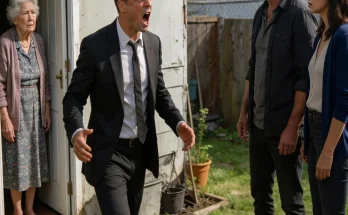
“If you ever say no to me again, I swear to God you’re going to regret giving birth to me.”
When my son said that in the kitchen of my house in Naperville, I wanted to believe it was another tantrum.
Another ugly sentence.
Another thing I could explain away because accepting the obvious felt worse.
Dylan was twenty-three.
Tall.
Broad-shouldered.
Strong enough that when he filled a doorway, I noticed.
As a child, he had been affectionate and energetic.
The kind of boy who brought me dandelions and cried when he found a dead bird in the yard.
As a teenager, resentment settled into him.
First because his father, Robert, moved to Chicago after our divorce.
Then because college did not work out the way he expected.
Then because he dropped out halfway through.
Then because jobs never seemed to last.
Then because his girlfriend left.
Eventually, he did not need a reason.
Feeling slighted was enough.
I defended him too much.
I defended his shouting when he began talking to me as if I were a servant.
I defended his demands when asking for money turned into announcing how much he needed.
I defended slammed doors, nights smelling of beer, broken glasses, lies, and all the small sentences that make a mother doubt herself.
I’ll pay you back tomorrow.
Don’t overreact.
You always make me the bad guy.
Mothers can mistake endurance for love.
That night, I came home exhausted after my shift at a school library.
My feet hurt.
My back hurt.
My pride hurt from stretching every paycheck to maintain a house where I increasingly felt like a guest.
Dylan walked into the kitchen.
“I need eighty.”
“For what?”
“Going out.”
“No.”
He stared at me.
“No?”
I dried my hands on a dish towel.
“No.”
He smirked.
“And who do you think you are now?”
“I think I’m the person paying the mortgage, utilities, groceries, your phone, and most of everything else in this house.”
His face hardened.
“It’s over, Dylan. I’m not giving you money for drinking or nights out anymore.”
“Don’t talk to me like that.”
“I’m talking to you the way I should have talked to you a long time ago.”
His laugh contained no humor.
“Oh, really?”
Then:
“Learn your place once and for all.”
His hand struck my face before I understood he had moved.
The force snapped my head sideways.
I did not fall.
There was no dramatic crash.
No blood.
That almost made it worse.
The house simply continued.
Refrigerator humming.
Clock ticking.
My hand pressed against the counter.
Dylan looked at me.
For one second, I expected horror.
An apology.
Anything.
He shrugged.
Then walked upstairs.
His bedroom door slammed.
I stood alone with my cheek burning.
And finally accepted the sentence I had spent months avoiding.
I was not safe in my own home.
At 1:20 a.m., I called Robert.
The man I had spent years trying not to need.
He answered thick with sleep.
“Helen?”
I could not speak at first.
Then:
“Dylan hit me.”
Silence.
Heavy.
Then Robert’s voice changed.
“I’m on my way.”
I did not sleep.
At four, I started cooking.
Pancakes.
Bacon.
Eggs.
Hash browns.
Coffee.
I brought out the embroidered tablecloth I used only for holidays.
The good china.
Not because I wanted drama.
Because my hands needed something familiar to do while my mind held onto one decision.
This ends today.
Robert arrived before six.
Whiter hair than the last time I had really looked at him.
Dark overcoat.
Brown manila folder under one arm.
He saw my face.
Saw my hands.
Did not ask whether I had provoked Dylan.
Did not ask whether I was sure.
“Is he upstairs?”
“Asleep.”
His eyes moved over the table.
“You always cooked like this before you changed something big.”
For the first time in years, I felt seen.
“It ends today.”
Robert placed the folder on a chair.
“Then I need to know one thing. Do you want him out of this house?”
I closed my eyes.
I saw scraped knees.
Little sneakers by the front door.
A boy asleep against my shoulder.
Then the man in the kitchen.
“Yes.”
Robert nodded.
He opened the folder.
Inside were not magical papers that could make an adult disappear instantly.
Robert had called a lawyer he knew through work.
There was information about an emergency order of protection.
Police reporting.
Documentation.
Formal notice.
Tenant and occupancy questions.
A list of local resources.
A written statement form.
“This doesn’t mean we throw him onto the sidewalk without process,” Robert said. “It means you stop handling this alone.”
That distinction mattered.
The plan was not:
Humiliate Dylan at breakfast.
It was:
Document the assault.
Get professional advice.
Create immediate safety.
Use lawful procedures for the house.
No improvising around a violent adult because he was my son.
Then the stairs creaked.
Dylan came down wearing gray sweatpants and a T-shirt.
He smelled like sleep and stale beer.
He smiled at the breakfast table.
Then at me.
“So you finally learned.”
The sentence hit harder than the slap.
Then he saw Robert.
The smile vanished.
“What is he doing here?”
Robert stayed seated.
“Morning.”
Dylan looked at me.
“You called Dad?”
“Yes.”
“For what?”
I touched my cheek.
He glanced at the bruise forming along my jaw.
Then rolled his eyes.
“Oh my God. Seriously?”
That reaction became the last piece of denial I lost.
Robert did not stand.
He did not threaten.
He did not play the bigger man.
“Helen is going to make a police report this morning.”
Dylan laughed once.
“About that?”
“Yes,” I said.
He turned toward me.
“You’re really doing this?”
“Yes.”
“You want me arrested over one slap?”
“I want the truth documented.”
“Mom, come on.”
His tone changed.
Not remorse.
Alarm.
“You know I didn’t mean—”
“You told me I’d regret giving birth to you.”
“I was mad.”
“You hit me.”
“You were in my face.”
I had not been.
But the old Helen would have debated details until the central fact disappeared.
This time:
“You hit me.”
He looked at Robert.
“Say something.”
Robert answered:
“I am not here to decide what happened. You and your mother will speak to the police separately.”
Dylan’s jaw tightened.
“You’ve always wanted this.”
Robert did not respond.
Dylan pointed at the folder.
“What’s that?”
“Information.”
“About kicking me out?”
I answered.
“Yes.”
His face changed again.
This time fear.
“Where am I supposed to go?”
That question broke my heart.
It also did not change my answer.
“I don’t know.”
“You’re my mother.”
“Yes.”
“And you’re throwing me away.”
“No. I’m refusing to live with someone who threatened and hit me.”
He knocked his chair backward.
Robert stood immediately.
Not advancing.
Creating space.
Dylan saw.
For a moment, I thought he would swing.
Then he grabbed his phone.
“You’re both insane.”
He moved toward the stairs.
I said:
“Do not take anything that isn’t yours. We are calling the police now. You can pack essentials after they tell us how to handle this.”
He stared at me.
“Listen to yourself.”
I was.
For the first time in a long time.
I heard someone who was scared.
But no longer negotiating the fact of danger.
I called the non-emergency line because Dylan was no longer actively attacking anyone.
I explained there had been an assault the previous night and the adult son who lived in my home was present.
Dispatch sent officers.
Dylan paced.
Robert remained.
Nobody touched him.
Nobody blocked him.
When police arrived, I gave my account separately.
They photographed my cheek.
Asked about the threat.
Asked whether there had been prior violence.
I said:
“Not hitting me. Broken things. Blocking doors once. Shouting. Threats.”
One officer asked whether I wanted medical evaluation.
I declined ambulance transport but agreed to see urgent care later.
The officers spoke with Dylan.
He admitted slapping me.
He insisted I had “pushed him emotionally.”
That phrase did not change the fact.
Based on the evidence and circumstances, they arrested him for domestic battery.
I watched my son put his hands behind his back.
I wanted to scream:
Wait.
I almost did.
Then he looked at me.
Not scared.
Furious.
“This is your fault.”
The officer guided him toward the door.
And I understood something I would need to remember for years.
Calling police did not create the slap.
Documenting violence did not create the consequence.
A boundary is not the cause of what happens when someone crosses it.
After they left, the breakfast went cold.
Robert poured out the coffee.
My hands began shaking so badly I could barely hold a cup.
Then I cried.
Not because I regretted calling.
Because there is no version of a mother’s life where watching her child leave in handcuffs feels like victory.
After the officers left, Robert stood in my kitchen looking at the untouched breakfast.
The bacon had gone soft.
The eggs were cold.
The pancakes had absorbed syrup around the edges.
I remember thinking how absurd it was that I had cooked so much food for a morning in which none of us could eat.
Robert started clearing plates.
“Leave it,” I said.
“You’ll hate looking at it later.”
He was right.
So we cleaned.
That became the first ordinary task after the emergency.
Scrape plates.
Rinse cups.
Fold the good tablecloth.
I stopped when I reached the corner where Dylan’s chair had knocked it crooked.
My hands shook again.
Robert did not take it from me.
He just stood nearby.
I folded the cloth myself.
That mattered.
For months, I had felt like my son’s anger determined what I could handle.
That morning, even folding a tablecloth became a way of reminding myself that fear did not make me helpless.
Later, when I finally slept for two hours, I woke with one thought:
What if I overreacted?
The question was so immediate it frightened me more than the bruise.
My mind had already begun searching for the version where I could restore normal.
One slap.
He was tired.
He had been drinking.
Maybe I embarrassed him.
Maybe police were too much.
Then I looked at the photograph the officer had taken on my phone with my permission.
The bruise.
My own face.
And I remembered the threat.
If you ever say no to me again.
That was not a misunderstood accident.
The picture did not make the decision for me.
It stopped me from editing the past because the future felt painful.
Later that afternoon, I wrote the date on an index card and placed it in the folder with the police report. Not because I wanted to preserve pain forever. Because I knew my own mind would eventually try to soften what happened. Facts gave me something steadier than guilt. Date. Time. Words. Injury. Response. I had spent too long letting emotion rewrite evidence.
Click here to continue reading: PART 2: The emergency order protected my house immediately, but the harder part was accepting that law, love, and housing were three different questions
The breakfast table was not a trap, and Robert’s folder was not revenge — it was the first plan I had made in years that did not depend on Dylan calming down
Part 1 of 9