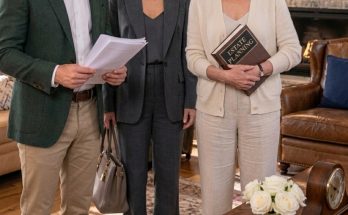
Dominic stared at the original power of attorney in his hands.
Amber leaned over his shoulder.
“What does it say?”
He did not answer.
I could see him reading the same paragraph again.
The document named him as a limited agent for matters connected to Harold’s illness.
Insurance claims.
Medical billing.
Certain hospital and rehabilitation paperwork.
Nothing about my home.
Nothing about selling real estate.
Nothing about transferring proceeds.
Nothing about placing me in a care facility.
Dominic’s face had gone white.
Amber grabbed the page.
“This isn’t the one we used.”
“No,” I said. “It isn’t.”
She looked at him.
“Dominic?”
He finally raised his eyes.
“What are you trying to do, Mom?”
That question almost made me laugh.
He was standing in my living room after using a different document to sell my house, and somehow I was the one “doing” something.
I sat back in Harold’s chair.
“My attorney is challenging the transaction.”
Amber’s voice rose.
“You can’t just undo a sale.”
“Correct.”
That surprised her.
I continued.
“That’s why there are lawyers, a title company, the buyer, the closing agent, the bank, and a court involved.”
The reality was more complicated than the fantasy Dominic had sold himself.
My attorney, Margaret Peterson, had warned me on the first day.
A fraudulent power of attorney does not create a magical undo button.
If a buyer purchased in good faith, if a title insurer had relied on a recorded document, if money had already moved, there could be multiple claims.
We would have to prove what happened.
Protect the property if possible.
Recover money.
Possibly involve law enforcement.
Maybe settle.
No instant revenge.
But one fact was clear:
I had not authorized Dominic to sell.
That mattered.
Dominic held up the original.
“Where did you get this?”
I stared.
“My own attorney obtained the recorded copy from the lawyer who prepared it when your father was sick.”
He swallowed.
Margaret had also obtained the instrument used at closing.
It looked similar.
My signature appeared.
But the page granting real-estate powers was not in the original.
The notarization raised questions.
The font shifted.
Page numbering was inconsistent.
And the notary whose stamp appeared on the altered document told Margaret she had no memory of notarizing any expanded power for me.
That did not prove everything yet.
But it was enough for an emergency filing.
Amber paced.
“This is insane. We paid for everything.”
I looked at her.
“With what money?”
She stopped.
The closing proceeds had been wired into an account Dominic controlled as my purported agent.
From there, almost all of it had been spent or transferred.
Luxury hotels.
Designer stores.
Restaurants.
First-class airfare.
A watch.
Prepaid bookings.
Some money moved into Amber’s new-business account.
Margaret had traced what she could through records obtained after emergency court orders and bank cooperation.
Not every charge was recoverable.
Not every merchant would refund.
But the spending pattern was documented.
Dominic said:
“You knew we were going to Europe.”
“No.”
“You knew we’d been planning a trip.”
“A two-week anniversary trip, not three months funded by my house.”
He looked at Amber.
She looked away.
That tiny movement told me something.
Maybe Dominic had told her more authority existed than he really had.
Maybe she knew exactly.
I did not assume.
The truth would matter legally.
I was done guessing.
A knock came at the front door.
Both of them jumped.
I stayed seated.
“That will be Margaret.”
My attorney entered with another woman, Leah Brooks, a lawyer from the title insurer.
Dominic stared.
“You invited the title company here?”
Margaret said:
“Ms. Brooks asked to inspect the original and discuss preservation of the property while the ownership dispute is pending.”
He looked like he had swallowed glass.
This was no longer family theater.
No one cared who was the better son.
No one cared about Europe.
The professionals wanted documents.
Dates.
Authority.
Money.
Leah introduced herself.
She explained the buyers had not yet moved in because their planned occupancy had been delayed after our emergency filing.
That detail had mattered enormously.
The “sale” had closed days before I fully understood, but possession had not changed permanently, and the title insurer had agreed to a temporary arrangement while court reviewed the alleged authority.
My return home had happened under a court-approved interim occupancy order negotiated among counsel, not because I simply changed locks and declared victory.
I appreciated reality.
It protected me better than fantasy.
Leah looked at Dominic.
“Mr. Hayes, who prepared the power of attorney used at closing?”
Dominic hesitated.
“I don’t remember.”
Amber stared at him.
Margaret wrote something.
Leah asked:
“Who notarized it?”
“I don’t remember.”
“Who gave it to the closing agent?”
“I did.”
“Did you represent that your mother was aware of the sale?”
Silence.
Amber stepped backward.
Dominic said:
“My mother had been struggling.”
I laughed once.
“With what?”
He looked at me.
“You were alone.”
I was sixty-two.
I was living independently, managing my own home, appointments, finances, and daily life.
“I was living independently.”
“You were overwhelmed after Dad.”
“Harold died three years ago.”
“You were still overwhelmed.”
Margaret interrupted.
“Mr. Hayes, this is not the setting for you to give testimony without counsel. You should contact your lawyer.”
That was more ethical.
We were not going to trick him into confessing on my couch.
Dominic’s anger returned.
“You’re treating me like a criminal.”
Margaret said:
“There are allegations of fraud and financial exploitation. You need counsel.”
Amber whispered:
“Dominic, did you change the document?”
He snapped:
“Not now.”
Her face changed.
That was the first crack between them.
I did not enjoy it.
I watched.
Leah examined original power of attorney.
Photographed with permission.
Compared.
Then she told us the title insurer would continue cooperating with court and might seek recovery from anyone responsible if the title had been obtained through fraud.
The buyers were protected by title insurance subject to policy terms.
Their interests mattered too.
This relieved me.
I had imagined strangers losing money because of my son.
I did not want another family harmed.
After the lawyers left, Dominic and Amber remained.
I said:
“You should go.”
Dominic looked at me.
“Are you really going to press charges?”
“That is not entirely my decision.”
Criminal charges are brought by government if evidence supports.
I could report.
Cooperate.
Provide records.
I had.
He looked shocked.
Amber said:
“We can pay you back.”
I looked at her.
“With what?”
Silence.
Nearly one hundred eighty thousand had been spent in eight weeks.
Not every dollar from sale proceeds—some came from their own funds and credit—but enough of my money had financed the trip that the distinction would matter.
Margaret was tracing.
I said:
“Talk to your lawyers.”
Dominic’s face twisted.
“You’re my mother.”
“Yes.”
That did not mean I could erase what he did.
It also did not mean I wanted him destroyed.
Both could be true.
They left.
I locked the door.
Then, for the first time since returning home, I let myself cry.
Not triumphant tears.
Grief.
My son had not merely wanted money.
He had decided my life could be rearranged because he thought he had the right.
That hurt more than the spending.
The case would take months.
Maybe years.
The house might remain mine.
Maybe the title insurer would resolve ownership differently and compensate.
Money might be unrecoverable.
Dominic might face civil judgment, criminal investigation, or both.
I did not know.
But I knew one thing with absolute clarity:
I was no longer going to let anyone use the word “care” to disguise control.
Click here to continue reading: PART 2: Sarah came home furious that we had hidden the truth from each other, and her first demand was not revenge — it was that we stop treating me like an old woman whose children were entitled to manage her life
Dominic thought the forged authority had turned my home into his money, but the first person who truly frightened him was not me — it was the title attorney who asked where the original power of attorney came from
Part 1 of 16