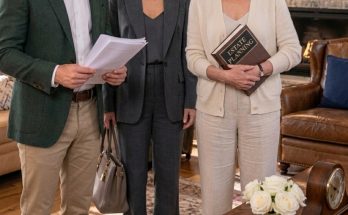
We met in court-ordered mediation for civil case.
Separate rooms at first.
Then, at my request, one joint session near end.
Margaret beside me.
Dominic with counsel.
Amber separate and did not attend joint because her case posture differed.
My son looked older.
Europe tan gone.
Luxury watch gone—sold under settlement.
He would likely plead criminally soon.
I asked one question:
“When did you decide the house was yours to use?”
His lawyer looked concerned.
Dominic answered.
“After Dad died.”
I felt cold.
Not when debt exploded.
Not before Europe.
Three years earlier.
Why?
Harold and I had once told both children:
“When we’re gone, you’ll split what’s left.”
Normal estate conversation.
Dominic heard:
Half the house is eventually mine.
Then, after Harold died, he began helping with insurance paperwork.
He saw accounts.
He knew house paid off.
I remained there alone.
He started thinking:
Mom has a $250,000 asset she is not “using.”
I stared.
“I lived there.”
“I know.”
“You called that not using?”
He covered face.
“I know how it sounds.”
It sounds exactly like entitlement.
He said Amber’s business failed.
They accumulated debt.
Sarah lived across country and “didn’t need anything.”
He thought if he could liquidate house, put me somewhere cared for, use part now, he could “rebalance” family wealth.
That word.
Rebalance.
As if he were executor before my death.
I said:
“You treated me like an estate.”
He started crying.
“Yes.”
There.
That was the truth.
Not hatred.
Not one greedy wife.
He had stopped seeing my life as active.
At sixty-two.
Why nursing facility?
He said:
“You were lonely.”
“Did I say that?”
“No.”
“Did a doctor say I needed care?”
“No.”
“Did Sunset Manor assess me before you signed contract?”
He looked ashamed.
The facility had performed a basic intake based on Dominic’s representations that I needed supportive placement. Sunset Manor operated several levels of senior care. Dominic had arranged for me to enter a private-pay assisted unit based on his representations, even though no doctor had determined that I needed institutional care.
Dominic had exaggerated.
He told staff I had memory problems.
I did not.
That hurt.
“You told them I had cognitive decline?”
He nodded.
“Why?”
“So they wouldn’t question.”
I gripped table.
This was worse than money in some ways.
He had weaponized age.
Sixty-two.
Competent.
Independent.
And he had described me as impaired so his plan looked caring.
Margaret put hand near mine, not on.
Choice.
I asked:
“Did you ever believe it?”
Dominic whispered:
“I think I started to.”
That is how rationalization works.
He noticed me asking him to help with online insurance portal.
I once forgot where I put glasses.
I disliked driving at night after cataract? We didn't establish. No.
He collected ordinary aging moments into story:
Mom can’t manage.
Because story benefited him.
This terrified me.
Not because I doubted myself.
Because it showed how easily concern can become evidence when someone wants control.
Mediation paused.
I needed air.
Outside, Sarah waited? She was not party; maybe in town. She had chosen not to see Dominic. Fine.
Margaret said:
“You can stop.”
“No.”
I wanted finish.
Back in room, Dominic said:
“I’m sorry.”
I said:
“You need to be precise.”
He looked.
“You did not make a bad financial choice. You falsified authority and represented me as incapable because you wanted my asset.”
He cried harder.
“Yes.”
That was accountability.
Would it last?
Unknown.
I did not forgive there.
Mediation resulted in tentative civil settlement subject to criminal case and insurer claims.
I went home exhausted.
That night, I walked room to room.
Thirty-five years.
Harold’s chair.
Photos.
I realized I had begun treating house as evidence too.
Proof I still could manage.
I had to be careful.
Keeping home should be my choice, not counterargument to Dominic.
If one day I wanted assisted living, I should be free to choose without feeling he “won.”
That insight became important later.
For now, I stayed because I wanted.
I hired cleaner twice month.
Why not?
Independence does not mean doing every task.
I had grocery delivery sometimes.
Used rideshare after eye dilation.
No shame.
Help does not equal incapacity.
The difference:
I choose.
I pay.
I can change.
That became my definition.
Sarah returned California after mediation.
Before leaving, she said:
“If you ever want to move, tell me before you think I’ll freak out.”
I laughed.
“I will.”
“You know I’m not going to say stay in house forever because of Dominic.”
“I know.”
That was healthy.
She saw person, not symbol.
Dominic had more learning ahead.
So did I.
The mediation also exposed something about Harold that I had not wanted to examine.
Had he ever encouraged Dominic to think the house was partly his?
Not legally.
But Harold used phrases like:
“One day this will all be yours and Sarah’s.”
Normal parent talk.
He sometimes let Dominic help with repairs and joked:
“Take care of your inheritance.”
I had laughed.
Those jokes were not authorization.
But they may have contributed to a family story in which Dominic saw himself as future co-owner instead of eventual beneficiary of whatever remained.
This did not excuse.
It taught me to be more precise.
I told Sarah:
“Never talk about my assets as yours while I’m alive.”
She said:
“I don’t.”
“I know. I’m saying it clearly anyway.”
Later, when I spoke at elder-planning events, I mentioned this.
Parents can create entitlement unintentionally by constantly telling adult children:
This house will be yours.
We’re saving it for you.
Don’t worry, you’ll inherit.
Then children begin making life plans around property they do not own.
Better:
“My estate plan currently says X, but my assets support my life first and plans can change.”
Less sentimental.
More honest.
I updated my own language immediately.
Dominic heard too.
He said:
“Dad did say things like that.”
I looked at him.
“And?”
“And I turned a future possibility into current permission.”
Exactly.
He could hold context without shifting blame to dead father.
That mattered.
The forged document was still his choice.
But understanding the family narrative helped prevent repetition.
Sarah stopped joking about “my future china.”
I stopped saying “your inheritance.”
We used:
“My things.”
“Your dad’s watch.”
“The estate plan.”
Small words.
Clear boundaries.
Language cannot prevent fraud.
It can make entitlement harder to disguise as family expectation.
Another reason I eventually stopped fearing every future document was that Margaret made me practice reading them myself.
At first, I would hand her papers and ask:
“Is this safe?”
She would answer:
“What do you think it says?”
Annoying.
Useful.
We reviewed lease terms.
Bank forms.
Insurance changes.
Healthcare documents.
I learned where to look for authority, duration, revocation, fees, and signatures.
Not enough to become lawyer.
Enough to stop feeling helpless around legal language.
This mattered because the forged power had made paper itself frightening.
Margaret did not want that fear to become dependence on her.
A good professional should increase a client’s understanding, not become another person who says:
“Just trust me.”
I appreciated that more over time.
When she retired years later, I was sad but not panicked.
I had a new attorney.
I kept copies.
I knew questions to ask.
That was another form of restored agency.
The person who had once stepped into a taxi with one suitcase eventually became someone who could sit at a desk, read a document, ask for clarification, and say:
“No, I’m not signing this today.”
That skill outlasted the lawsuit.
It also made every later planning decision calmer.
I could accept help without surrendering understanding.
That was exactly what had been missing when Harold was ill and I first gave Dominic limited authority.
Click here to continue reading: PART 5: The criminal case gave Dominic consequences I could not control, and I had to decide whether being his mother meant asking for mercy or simply telling the truth about what his choices had done
Dominic thought the forged authority had turned my home into his money, but the first person who truly frightened him was not me — it was the title attorney who asked where the original power of attorney came from
Part 4 of 16