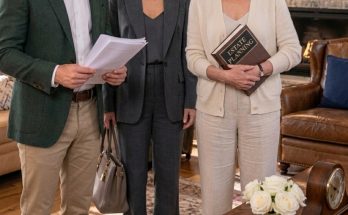
Sarah arrived from California the next evening.
Not because I asked.
Because Margaret told me the case would involve family records and I finally called my daughter.
I expected anger at Dominic.
I got that.
I also got anger at me.
“You let them put you in Sunset Manor and didn’t call me?”
I sat at the kitchen table.
“I called you after I got the attorney.”
“Days later.”
“Yes.”
“Mom.”
She paced.
“You thought I had my own life?”
“That is what Dominic said.”
“And you believed him?”
“No. I was ashamed.”
That stopped her.
I had not admitted it even to myself.
Ashamed that my son had treated me like an object.
Ashamed I had signed paperwork years earlier without retaining copies carefully.
Ashamed I had climbed into the taxi with one suitcase.
Ashamed I did not scream.
Sarah sat.
“You did nothing shameful.”
I almost told her not to be dramatic.
Then stopped.
Maybe shame thrives when interrupted.
“I should have called.”
“Yes.”
She held my hand.
Then:
“Please do not make me your new manager.”
I laughed.
“Excuse me?”
“I know how this family works. Dominic overreaches, then everyone decides I’m the good child and gives me access to everything. No.”
Smart.
I had been thinking of adding Sarah to all accounts.
Of course.
Fear.
She said:
“Use professionals. Give me specific roles if you want.”
Margaret had said same.
My new estate plan and powers would be carefully separated.
Healthcare proxy could be Sarah primary, perhaps.
Financial agent could be a professional fiduciary or co-agent with safeguards.
No single child with everything.
Not because Sarah untrustworthy.
Because structure protects relationships.
I nodded.
“You’re right.”
She looked relieved.
Then she asked:
“What exactly did you sign when Dad was sick?”
We found original attorney’s file.
Harold had been in hospital.
I was exhausted.
The lawyer had prepared limited durable power for specific insurance and medical-billing matters.
Dominic had pushed:
“It will make things easier.”
At the time, true.
He handled claims.
Argued with insurers.
Helped.
This mattered.
He had not been scheming from day one.
He had genuinely supported us during Harold’s illness.
After Harold died, the original authorization expired six months later by its own terms. The altered version removed that expiration and added broad powers.
Margaret found that difference.
The original authorization expired six months after Harold’s death.
The document used at closing had no expiration and included broad real-estate authority.
Someone had modified.
That sharpened.
Sarah stared.
“Why would he think he could get away with this?”
I did not know.
Maybe Dominic believed I would accept after fact.
Maybe he convinced himself paperwork gave authority.
Maybe Amber encouraged.
Maybe debt.
We needed facts.
Margaret subpoenaed? Through civil discovery after filing. Law enforcement investigation separately.
We learned Dominic and Amber had serious debts before Europe.
Credit cards.
Business losses.
Amber’s boutique online venture had failed.
Dominic had quit his job shortly before the Europe trip, telling himself he would use the trip as a reset before deciding whether to return to school or find a different career.
They saw my house as unlocked capital.
The house sold for $250,000. After ordinary closing costs and fees, the net proceeds were a little under $240,000.
They paid six months at Sunset Manor perhaps $36k.
Spent/tranferred nearly $180k.
Some remained, frozen.
This meant trip was not only luxury; facility payment was from my own proceeds too.
They had used my money to pay for my displacement.
That realization made Sarah sick.
“Mom.”
“I know.”
She wanted to call Dominic.
I stopped.
“Lawyers.”
She laughed bitterly.
“You’re calmer than me.”
“No. I’m tired.”
We met with elder-abuse investigator from county agency and detective assigned financial crimes after report.
I gave statement.
No dramatizing.
Original document.
Altered copy.
Bank records.
Facility contract.
Real-estate closing package.
The detective said investigation would take time.
No promises.
Good.
I did not need fantasy arrest on porch.
I needed process.
Sarah stayed a week.
She helped inventory belongings returned.
Some items missing.
Harold’s watch.
A box of family jewelry.
Silver.
Were they sold?
Stored?
Amber claimed buyers had packed.
Closing inventory messy.
We documented.
No accusation until facts.
The buyers had moved some furniture into storage after title dispute.
Through attorneys, we recovered most personal items.
Harold’s watch was not there.
Later, bank records showed Dominic sold it to a reseller before Europe.
That broke me.
Not because value.
Harold’s watch.
Sarah cried.
The reseller no longer had Harold’s watch by the time investigators traced it. It had been resold, and recovering that exact watch was no longer realistic.
I stopped asking every day.
One object should not consume case.
Still, grief.
Sarah wanted Dominic disinherited immediately.
I considered.
Margaret cautioned:
“Estate decisions should reflect your wishes, not be made in acute anger if you can wait.”
Good.
I updated urgent safety items first:
Revoked any old powers.
Recorded revocation.
Bank alerts.
Credit freeze.
New will draft later after time.
Trusted contacts.
Mail security.
I did not make revenge will overnight.
That became important.
Dominic called Sarah repeatedly.
She blocked.
I did not.
I kept one communication channel through lawyer.
He sent message via counsel:
I believed Mom had agreed before Dad died that house would eventually help both children.
False memory maybe.
Harold and I had discussed leaving estate equally.
That is not permission to sell while I’m alive.
Inheritance is expectation, not ownership.
I told Margaret:
“Make that clear.”
She did.
His attorney understood.
Dominic had treated future inheritance as present asset.
This was at core.
He saw me as sixty-two widow with “too much house.”
Sunset Manor as practical.
Europe as once-in-life.
He arranged values without asking.
That was not care.
That was entitlement wearing logistics.
Sarah and I talked late one night.
“Do you want the house when you die?”
She asked.
“I don’t know.”
“Then don’t promise.”
Good.
I said:
“My assets are for my life first.”
“Yes.”
“If there’s anything left, estate handles.”
“Yes.”
She smiled.
“We agree.”
That sentence gave me peace.
Not all children see parents’ property as waiting room for inheritance.
Dominic had.
Sarah did not.
But I would not turn her into saint.
She had her own flaws.
She could become controlling under stress.
She admitted.
We built role clarity.
She returned California.
I stayed home.
Alone.
Not helpless.
Supported.
There is a difference.
Click here to continue reading: PART 3: The civil case revealed that Amber knew less about the altered document than I feared but far more about the money, forcing me to separate betrayal by my son from the choices his wife made after the sale
Dominic thought the forged authority had turned my home into his money, but the first person who truly frightened him was not me — it was the title attorney who asked where the original power of attorney came from
Part 2 of 16