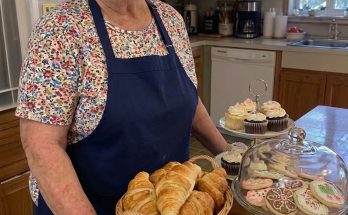
The family meeting happened by accident.
Grandma’s seventy-fourth birthday.
Twenty people.
Nothing formal.
No intervention.
We ate barbecue in Aunt Susan’s backyard.
Someone brought up the wedding cake.
Of course.
A cousin said:
“Best gift box ever.”
People laughed.
Grandma did not.
That stopped it.
She said:
“I’m tired of being the funny old lady who finally made people pay.”
Silence.
Good.
Then she said something none of us expected.
“You all do it.”
Every face changed.
Not Ashley only.
All of us.
Grandma began listing examples.
Not to shame.
To explain.
Susan asked her to hem six bridesmaid dresses years ago and bought only thread.
Our uncle left two grandchildren with her for an entire weekend after saying “a couple of hours.”
Daniel regularly took containers of leftovers home without checking whether Grandma wanted them.
I asked her to make my college graduation cake and never once offered ingredient money.
I stared.
She was right.
I had been twenty-two.
Broke.
Still.
I had assumed.
Cousin Mark used her car for a week after his transmission failed and returned it nearly empty.
Everybody laughed when she said that.
Mark raised both hands.
“Guilty.”
Then Grandma looked around.
“I liked doing most of those things.”
Important.
“This is not a bill.”
We relaxed slightly.
Then:
“But I want you to understand Ashley did something bigger in a family where smaller assumptions were already normal.”
That was generous and uncomfortable.
Ashley had lied.
We had not.
But the family culture around Grandma’s giving made Ashley’s calculation plausible.
She thought:
Grandma gives.
Family gets discount.
She stretched it into dishonesty.
Different level.
Same soil.
I thought about my gift box.
I had treated myself as protector of someone our whole family casually used.
Hypocrisy stung.
I said:
“You made my graduation cake?”
Grandma looked at me.
“Who do you think made it?”
“I know you made it. I mean paid.”
“Yes.”
“How much?”
She laughed.
“I don’t remember.”
I did.
Or rather, I remembered not thinking about it at all.
That was the point.
I apologized.
Grandma waved me off.
Then stopped herself.
“No. Thank you.”
Growth.
She accepted apology without erasing the issue.
Aunt Susan said:
“What do you want us to do differently?”
Grandma thought.
“Ask like no is possible.”
That sentence went around the table.
Ask like no is possible.
Not perform politeness while expecting yes.
Daniel nodded immediately.
Ashley looked down.
I wrote it in my phone.
Grandma continued.
“And if I say yes as a gift, stop trying to pay me after I say it’s a gift.”
Ashley looked up.
That one for her.
Everyone laughed gently.
Then Grandma added:
“And stop telling me I’m too old to do things before I decide.”
That one hit me.
I had done it.
Driving.
Carrying.
Baking.
We wanted to protect.
Sometimes we reduced her autonomy.
Again, helpful intentions can become control.
The birthday conversation lasted ten minutes.
Then someone brought cake.
Store-bought.
Because Grandma refused to bake her own birthday cake.
Good.
We sang.
No more family analysis.
But habits shifted afterward.
At Thanksgiving, Grandma said:
“I’m bringing rolls.”
Susan asked:
“Do you want ingredients covered?”
“No.”
“Okay. Thank you.”
Done.
At Christmas, Mark asked if she could watch his daughter for two hours.
Then added:
“If no, totally fine.”
Grandma said:
“No.”
Everyone stared.
Then she smiled.
“I have plans.”
No one asked what plans.
That was progress.
She went to a movie with a church friend.
Wonderful.
I began noticing how powerful a real no is.
Families often say:
Of course you can say no.
Then punish no with disappointment.
Grandma practiced.
We practiced accepting.
The first few times awkward.
Then easier.
Ashley benefited from the same culture shift.
She was no longer the single villain.
That helped her change without escaping accountability.
If the whole family admitted smaller entitlement habits, she did not need to defend herself by saying everyone does it.
We could say:
Some of us did.
You lied.
Both true.
That fairness reduced defensiveness.
At another dinner, Ashley offered to pay for everything before Grandma even agreed.
Grandma laughed.
“Now you’re annoying in the other direction.”
Ashley smiled.
“I’m calibrating.”
Good word.
Calibration.
Not shame.
The family story changed.
Instead of:
Remember when Ashley was so cheap she stole a cake?
We moved toward:
Remember when Grandma taught all of us to ask properly?
That version was less dramatic.
More accurate.
And better for Grandma, who had never wanted her work to become ammunition forever.
After the birthday conversation where Grandma told us “ask like no is possible,” I noticed my own language.
I used phrases designed to make refusal awkward.
“Could you possibly…”
“If it’s not too much trouble…”
“We’d really appreciate…”
Polite, but loaded.
Sometimes politeness hides expectation.
I started asking more plainly.
“Can you make dessert?”
Grandma:
“No.”
“Okay.”
At first, the lack of softening felt rude.
Actually, it gave her clearer space.
Then when she said yes, gratitude felt more honest.
This changed outside family too.
Coworkers.
Friends.
Requests.
A real ask contains a real no.
That idea improved my life in places that had nothing to do with cake.
I realized how often I agreed to things because saying no would disappoint someone.
Grandma had built an entire personality around avoiding that disappointment.
No wonder Ashley found the boundary so easy to push.
Again, not excuse.
Opportunity.
We all practiced tolerating disappointment.
Someone says no.
You feel annoyed.
You survive.
No negotiation unless invited.
Simple skill.
Hard to learn late.
Grandma learned at seventy-four.
That embarrassed the rest of us into trying.
The family birthday conversation changed our jokes too. We noticed how often humor had protected uncomfortable habits. “Grandma will do it.” “Daniel will pay.” “Ashley has coupons for everything.” Jokes can reveal patterns before people admit them. Afterward, we became more careful not because humor was banned, but because we stopped using laughter to make one person absorb an unfair role. The funniest family stories got funnier once nobody was still paying for the punch line.
Once everyone began asking properly, Grandma actually said yes to plenty. The difference was that yes came from her instead of from expectation.
The family discovered that a genuine yes feels warmer when everyone knows no would have been accepted too.
The family became warmer once favors were chosen instead of quietly assigned.
Click here to continue reading: PART 11: Ashley returned to Grandma’s kitchen and learned why three days of work could never be called just ingredients
Three days of careful baking ended with Ashley laughing at the woman she had promised to pay
Part 10 of 16