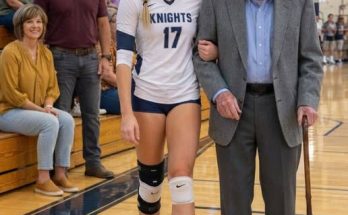
Dad answered on the fourth ring.
I could hear the television behind him.
He always turned the volume too high, then insisted there was nothing wrong with his hearing.
“Jodi?”
“Hi, Dad.”
“Is everything all right?”
“Everybody's safe.”
That was the first thing I said because Dad had started every phone conversation that way since Mom died.
I told him about Thursday.
I told him about the ceremony.
Then I told him what Travis had said.
Dad didn't interrupt.
He let me reach the end without making Travis into a villain.
“What does Kaylee want?” he asked.
“She wants you.”
There was a small rustle at his end.
I pictured him sitting forward in his brown recliner.
“What time should I be there, sweetheart?”
“Six would be good. They'll start announcing at six thirty.”
“I'll be early.”
“Dad, the gym floor is slippery.”
“I've walked on ice longer than that girl's been alive.”
“That isn't reassuring.”
He chuckled.
“Ask the coach whether I can use the side entrance. And tell her I won't hurry.”
It was the practical answer of a man who had learned to measure risk without letting fear make all his decisions.
I promised to call the school.
Then we discussed where he could park.
How long the walk would be.
Whether there would be a chair near the athletes' entrance.
Only after those details did he ask how Kaylee was feeling.
“Embarrassed,” I said.
“She's got nothing to be embarrassed about.”
“I know.”
“But she doesn't know it yet.”
Dad paused.
“When your mother died, people kept telling me how I was supposed to grieve.”
“I remember.”
“Some wanted me to sell the farm. Some wanted me to travel. A few told me I should be grateful I had so many good years.”
His voice softened.
“People get very comfortable telling somebody else where their heart belongs.”
I looked toward the dark kitchen window.
“I think Travis was scared of claiming a place that wasn't his.”
“Then he should have told her he was scared.”
That made my eyes sting.
Dad always found the short sentence I had been searching for.
The next day, I called the school office.
The athletic director, Ms. Foster, confirmed that a cane was fine.
A student volunteer could escort Dad from the door to the waiting area.
They could give him a chair if he needed one.
Kaylee would choose her own pace across the court.
I appreciated that last part.
Not the school's pace.
Not the crowd's.
Kaylee's.
I texted Dad the parking instructions.
Then I found Kaylee making a sandwich before practice.
“Grandpa said yes.”
She put down the bread.
“Really?”
“He asked what time to come.”
She smiled.
It was the first unguarded smile I'd seen since dinner.
At practice, I watched her through the bleacher railing.
She was our strongest defensive player.
She anticipated the ball before it crossed the net.
Her coach had explained that skill once by saying Kaylee paid attention to the spaces between people.
I wondered whether she'd developed it partly at home.
Children notice absences.
They learn when grown-ups are about to withdraw.
They recognize the moment a room changes.
When she was nine, Kaylee used to wait by the front window on the first Saturday of every month.
Brandon had promised those Saturdays would be his.
Twice he came.
The third month he said work kept him away.
Then his messages grew sporadic.
I had stopped promising her he would arrive.
I would say, “We'll make our own plan and see what happens.”
She grew older.
She stopped asking.
Travis was different.
He showed up.
But he rarely used the word daughter.
At parent-teacher meetings, he introduced himself as Kaylee's stepdad.
At the clinic, he would identify himself carefully because the receptionist needed to know who could consent to treatment.
Those distinctions were sensible in some situations.
I hadn't understood how much they could hurt in others.
On Wednesday evening, Travis came home early.
He was carrying a box of volleyball snacks donated by the seed company.
“Thought the team could use these,” he said.
“Thanks.”
He set the box on the counter.
“Kaylee at practice?”
“Yes.”
He waited.
I wondered whether he expected me to tell him how to repair it.
But I had done that too often.
The work was his.
“She's asked Dad to walk with her,” I said.
Travis stared at the box.
“Your father?”
“Yes.”
“He just had surgery.”
“Last year. I checked with the school and Dad.”
“He could fall.”
“Kaylee knows he'll need time.”
Travis ran a hand along the cardboard edge.
“Okay.”
There was the same small word Kaylee had given him.
I could not tell whether hearing it from me affected him.
That evening, I noticed him standing in the hallway outside Kaylee's room.
Her door was open.
She was studying chemistry.
He raised his hand as if he might knock.
Then Mason called from the living room about a missing remote.
Travis went to help him.
Kaylee never looked up.
I could have called Travis back.
I didn't.
The next night would ask enough of all of us.
On Wednesday morning, Kaylee's coach called about the ceremony schedule.
Mrs. Henning had coached high school volleyball for eighteen years.
She cared deeply about senior night, but she also knew ceremonies could bring complicated family feelings into the gym.
“Do you need us to announce anything differently?” she asked.
“Just the escort Kaylee has chosen.”
“That's what we'll do.”
She explained that the students had filled out their forms weeks earlier.
Kaylee had originally written Travis's name.
My throat tightened.
“Did she change it?”
“She brought me the corrected form this morning.”
The coach paused.
“She looked disappointed. I didn't ask why.”
“Thank you.”
“I told her senior night is about her years of work, not about satisfying anybody else's expectations.”
I thanked her again.
After the call, I sat at my desk and thought about that form.
Kaylee had already pictured herself crossing the court with Travis.
She had written his name in ink.
Then she'd had to cross it out.
No wonder she'd been so quiet.
At lunch, I stopped by the florist to pick up an extra small arrangement for Dad.
He would be embarrassed by flowers.
I bought them anyway.
The florist knew Kaylee from local tournaments.
She asked whether the family was excited.
“Yes,” I said.
Then, because I was tired of pretending, I added, “It's been an emotional week.”
She didn't pry.
She wrapped the stems in brown paper.
“Those nights can bring up more than people expect,” she said.
I carried the flowers to the car.
For the first time, I understood that I did not need to explain our family's trouble to everyone who asked about senior night.
Kaylee deserved privacy.
She could choose what to tell her teammates.
When she came home from practice, I told her I'd spoken with the coach.
“She changed the paperwork,” Kaylee said.
“I know.”
“She was nice.”
“I'm glad.”
Kaylee took off her shoes.
“I almost left the escort line blank.”
“Why?”
“I didn't want Grandpa to feel like a replacement.”
I pulled out a chair.
“Have you told Grandpa that?”
“No.”
“Then maybe you should.”
She called him that evening.
I heard her say, “I want you because you're you.”
Dad's answer was too quiet for me to hear.
But Kaylee smiled.
That was enough.
Click here to continue reading: PART 3: Grandpa Duane’s Slow Walk Across the Gym and Travis’s Unexpected Descent from the Bleachers
The Dinner Where Kaylee Asked Travis to Walk and Heard the Words Real Fathers Instead
Part 2 of 16